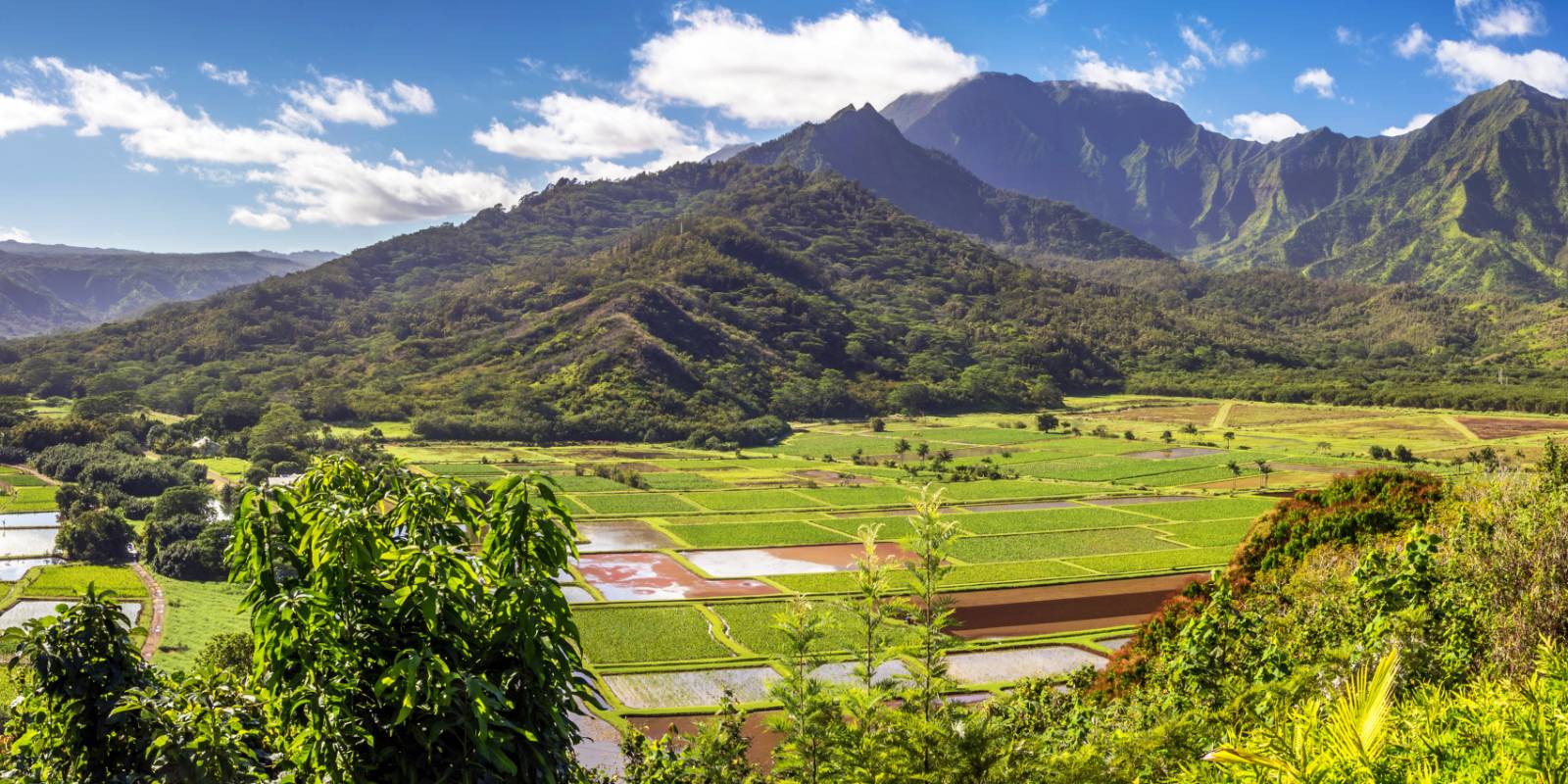


Hanalei Valley taro fields with mountains and waterfalls on Kauai

Hanalei National Wildlife Refuge Viewpoint

John C. Derrick

Founder & certified Hawai'i travel expert with 20+ years of experience in Hawai'i tourism.

Most of Hawaii’s best views face the ocean. Hanalei Valley is the exception.

This inland panorama on Kauai’s north shore is one of the finest in the state. The valley floor is a patchwork of taro fields and wetlands. Behind it, jagged green mountains rise into clouds, laced with waterfalls and prone to sudden rainbows. It looks like someone invented the concept of “lush” specifically to describe this place.

The Hanalei National Wildlife Refuge sits in the middle of it all. Established in 1972, it is Kauai’s oldest wildlife refuge. The 917-acre wetland habitat protects several endangered species, including the Hawaiian stilt (ae’o), Hawaiian coot (‘alae ke’oke’o), Hawaiian moorhen (‘alae ‘ula), and Hawaiian duck (koloa maoli). The refuge itself is closed to the public. Always has been.

But the view into it is open to everyone. And that view tells a story that goes back centuries. Hanalei Valley contains roughly 60% of Hawaii’s taro production. Taro — kalo in Hawaiian — is not just a crop here. It is the elder sibling of the Hawaiian people in the Kumulipo, the Hawaiian creation chant. The plant that feeds the nation. The fields you see from above are a living agricultural tradition that predates Western contact by hundreds of years, and they are still cultivated by local families today.

Birding is the other draw. Even from the overlook, you can spot endangered waterbirds wading through the flooded lo’i (taro paddies). Bring binoculars. The stilts are easy to pick out — long pink legs, black and white bodies. The coots and moorhens are harder to distinguish at distance, but they are down there. The U.S. Fish and Wildlife Service manages the refuge specifically for these species, and population counts have improved since the refuge was established.
The Old Roadside Lookout

For decades, the only way to see Hanalei Valley was a small pullout along Kuhio Highway near the one-lane Hanalei Bridge. You’d slow down, squeeze into whatever space was left, snap a few photos, and move on. It worked, but barely. No real parking. No information. No room to breathe. Just a narrow shoulder with a million-dollar view.

The old lookout is still there. You can still stop. If you’re driving north toward Hanalei from Princeville, you’ll see it on the left just before the descent into the valley. Best light is in the morning when the sun illuminates the valley floor and the waterfalls on the back cliffs catch the light. Late afternoon works too, but the mountains often cloud over by then.

A practical tip: go early. By mid-morning the pullout is packed and you may not find a spot. If you miss it, don’t try to back up on the highway. Just continue into Hanalei and come back on the return trip.

As Kauai’s visitor numbers climbed into the millions, that roadside stop became increasingly inadequate. Traffic backed up. People parked in bad spots. The experience was rushed and cramped for a view that deserves more than a two-minute window.

A New Viewing Area Near Princeville

The County of Kauai has been building a proper viewing facility near the Princeville Shopping Center. This is not a minor upgrade. According to the County of Kauai’s project page, the new site covers more than 5 acres and includes two separate viewing areas, 25 dedicated parking spaces, short-term bus parking, seating, restrooms, and educational signage about the valley’s ecology and cultural significance.

The primary goal is education. Hanalei Valley’s taro fields connect directly to Hawaiian culture and food traditions. The wetlands are critical habitat. Interpretive signs will give visitors real context for what they’re looking at — the names of the mountains, the species in the wetlands, the history of taro cultivation in the valley — instead of just a pretty backdrop for selfies.

A secondary goal is traffic management. Famous vistas draw crowds, and crowds need infrastructure. A designated site with proper parking and facilities keeps people off the highway shoulder and gives them a reason to stay longer and learn something.

An official opening date has not been announced as of March 2026, though Kauai County planning documents indicate the project has been in active development. The Princeville Community Association and local news outlets like The Garden Island newspaper are the best sources for status updates before your trip.

In the meantime, the old roadside lookout remains your best bet. It is still one of the top five views in all of Hawaii. Tight parking and all.

Practical Tips for Visiting

The lookout is free and open 24 hours. No entrance fee, no reservation. Just pull over and look.

Bring binoculars. The taro fields and waterbirds are far below the overlook, and naked-eye viewing misses the best details. A decent pair of 8x42s will let you pick out stilts wading through the lo’i and distinguish the different species. Photography-wise, a 200mm lens or longer helps.

Morning light — roughly 7 to 9 AM — is the magic window. The sun rises behind you and lights up the valley floor, the waterfalls catch the light on the back cliffs, and the mountains haven’t clouded over yet. By noon, cloud cover rolls in more often than not. Late afternoon can produce dramatic light if the clouds break, but it’s less reliable.

Rain is constant in Hanalei Valley. That’s what makes everything so green. Don’t skip the lookout because the forecast says showers. Some of the best views happen when mist rolls through the valley and the waterfalls swell. Bring a light rain jacket and embrace it.

If you’re heading into Hanalei town afterward, note that the one-lane Hanalei Bridge just below the lookout operates on an alternating traffic pattern. Expect a short wait. It’s been that way for decades and it’s part of the charm. Kuhio Highway beyond the bridge is slow and winding — the drive itself is gorgeous.

More Kauai Guides

Planning your Kauai north shore trip? These guides cover nearby beaches, tours, and getting around.

Get Hawaii Tips in Your Inbox

Join 150,000+ subscribers. Free Hawaii travel tips, deals, and local insights. Unsubscribe anytime.

Things to Do Kauai

Affiliate Disclosure: We may earn commissions from some travel partners (like Amazon or Expedia) which helps us maintain this site. These links are at no extra cost to you and don't impact our honest & unbiased recommendations.

Article Published: