

Quick answer: What is the best time to visit Hawaii?
For most travelers, choose late April through May or mid-September through October. Our single-month pick is May. For lower demand and better value, start with the weeks after Labor Day through October.
Choose January through March if whale watching is the priority. Expect the highest statewide lodging demand around Christmas and New Year.
Jump to your month:
Before this site existed I worked as a NOAA weather-station analyst, so I don't pick travel windows on vibes. For our own trips we aim for the shoulders: late April into May, or September into early October. You get summer's ocean without summer's crowds, and rates that haven't peaked. If whales are the goal, that's a winter calendar and there's no substitute.
— John C. Derrick, Founder · About John »

Kalalau Valley - Kauai
How to Beat the Hawaii Crowds
When are periods of high and low demand?
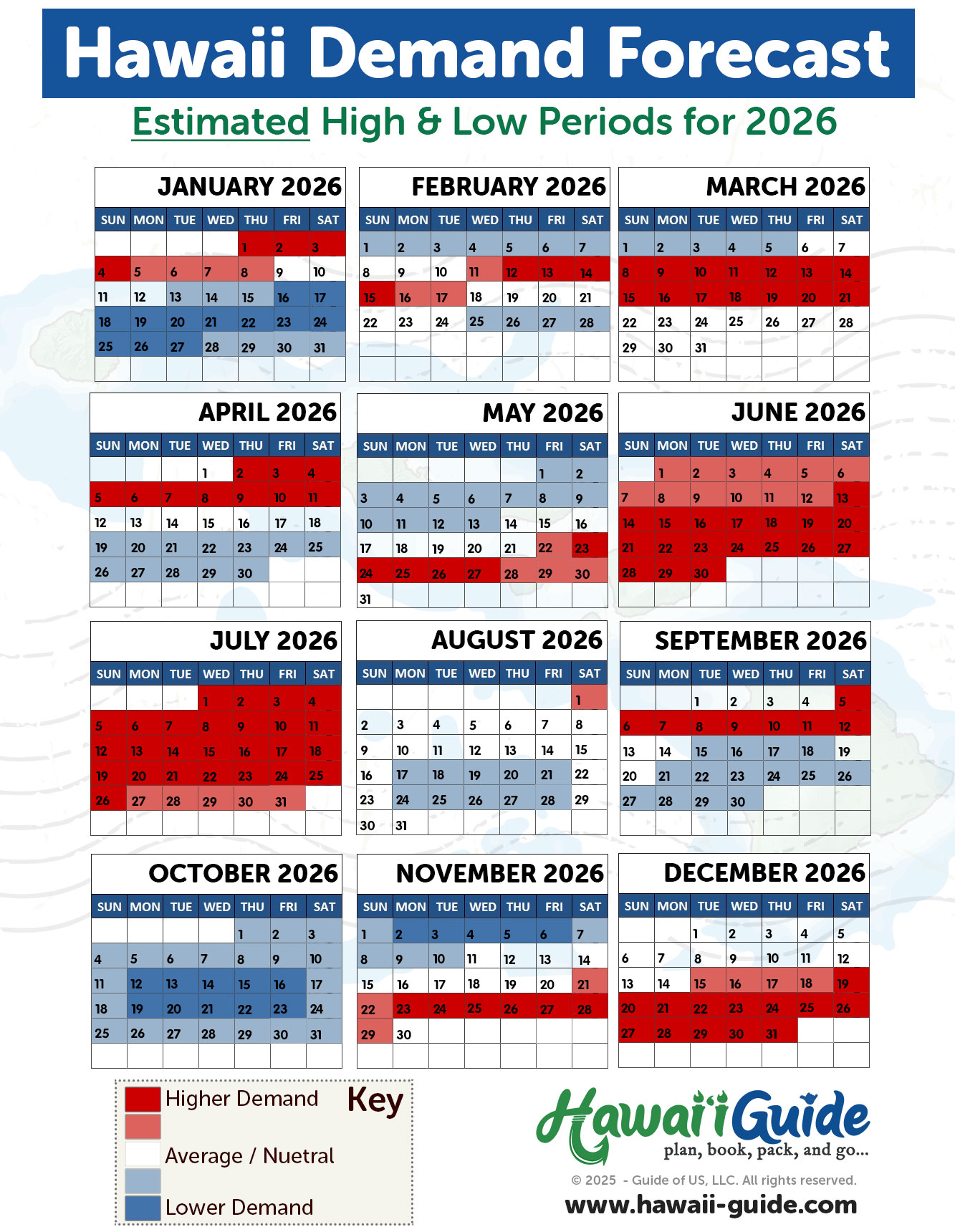
To help you visualize Hawaii's higher- and lower-demand periods, we've created the following 2026 Hawaii Demand Forecast. You can also return to the 12-month comparison above.
These charts are an approximate overview of when we expect Hawaii to see increased visitation on-island, based on travel trends in Hawaii over the last several years and considering recent events within Hawaii.
Visit it. Stamp it. Wear it.
Collect landmark stamps free with the Hawai'i Guide Passport, then shop the landmark tee collection.

 Shop the landmark tees
Open your free Hawaiʻi Guide Passport
Shop the landmark tees
Open your free Hawai'i Guide Passport
Hawaii Climate Summary
High/low temperatures and monthly precipitation
| Jan | Feb | Mar | Apr | May | Jun | Jul | Aug | Sept | Oct | Nov | Dec | |||||||||
|---|---|---|---|---|---|---|---|---|---|---|---|---|---|---|---|---|---|---|---|---|
| Oahu | 81/67°F 1.8" |
81/67°F 1.9" |
81/68°F 2.4" |
83/70°F 0.8" |
85/72°F 0.8" |
87/74°F 0.5" |
88/75°F 0.5" |
89/76°F 0.8" |
88/75°F 0.9" |
87/74°F 1.5" |
84/72°F 2.3" |
82/69°F 2.2" |
||||||||
*Climate Notes: 1991–2020 monthly normals from NOAA NCEI's Honolulu station USW00022521 data. Values are rounded to whole degrees and the nearest tenth of an inch. These station averages are not a daily forecast or a whole-island estimate. Conditions can change quickly with terrain, elevation, exposure, and the trade winds.
| Jan | Feb | Mar | Apr | May | Jun | Jul | Aug | Sept | Oct | Nov | Dec | |||||||||
|---|---|---|---|---|---|---|---|---|---|---|---|---|---|---|---|---|---|---|---|---|
| Maui | 82/64°F 2.4" |
82/64°F 2.0" |
83/65°F 2.6" |
85/67°F 1.3" |
87/68°F 0.7" |
88/70°F 0.2" |
89/72°F 0.5" |
90/72°F 0.5" |
90/71°F 0.5" |
89/70°F 0.8" |
86/68°F 1.8" |
83/66°F 2.8" |
||||||||
*Climate Notes: 1991–2020 monthly normals from NOAA NCEI's Kahului station USW00022516 data. Values are rounded to whole degrees and the nearest tenth of an inch. These station averages are not a daily forecast or a whole-island estimate. Conditions can change quickly with terrain, elevation, exposure, and the trade winds.
| Jan | Feb | Mar | Apr | May | Jun | Jul | Aug | Sept | Oct | Nov | Dec | |||||||||
|---|---|---|---|---|---|---|---|---|---|---|---|---|---|---|---|---|---|---|---|---|
| Big Island (Kona) | 81/69°F 1.4" |
82/68°F 1.2" |
82/70°F 1.0" |
83/71°F 0.6" |
84/73°F 0.6" |
85/74°F 0.8" |
86/75°F 0.5" |
87/76°F 0.5" |
87/75°F 0.5" |
86/75°F 0.9" |
84/72°F 0.8" |
82/70°F 1.1" |
||||||||
| Big Island (Hilo) | 79/64°F 7.9" |
78/64°F 10.2" |
79/65°F 12.7" |
79/66°F 9.4" |
81/67°F 7.0" |
82/69°F 7.3" |
83/70°F 9.2" |
83/70°F 11.3" |
83/70°F 8.7" |
82/69°F 10.2" |
80/68°F 14.39" |
79/66°F 12.1" |
||||||||
*Climate Notes: 1991–2020 monthly normals from NOAA NCEI's Kona station USW00021510 and Hilo station USW00021504 data. Temperatures are rounded to whole degrees; precipitation is displayed to the precision shown. These station averages are not a daily forecast or a whole-island estimate. Conditions can change quickly with terrain, elevation, exposure, and the trade winds.
| Jan | Feb | Mar | Apr | May | Jun | Jul | Aug | Sept | Oct | Nov | Dec | |||||||||
|---|---|---|---|---|---|---|---|---|---|---|---|---|---|---|---|---|---|---|---|---|
| Kauai | 79/66°F 2.8" |
78/66°F 3.6" |
79/67°F 5.6" |
80/70°F 2.0" |
82/71°F 2.2" |
83/73°F 1.8" |
85/75°F 1.8" |
85/75°F 2.3" |
85/75°F 2.2" |
84/74°F 3.3" |
81/71°F 4.0" |
79/69°F 4.6" |
||||||||
*Climate Notes: 1991–2020 monthly normals from NOAA NCEI's Lihue station USW00022536 data. Values are rounded to whole degrees and the nearest tenth of an inch. These station averages are not a daily forecast or a whole-island estimate. Conditions can change quickly with terrain, elevation, exposure, and the trade winds.
| Jan | Feb | Mar | Apr | May | Jun | Jul | Aug | Sept | Oct | Nov | Dec | |||||||||
|---|---|---|---|---|---|---|---|---|---|---|---|---|---|---|---|---|---|---|---|---|
| Statewide | 80/66°F 3.3" |
80/66°F 3.8" |
81/67°F 4.9" |
82/69°F 2.8" |
84/70°F 2.3" |
85/72°F 2.1" |
86/73°F 2.5" |
87/74°F 3.1" |
87/73°F 2.6" |
86/72°F 3.3" |
83/70°F 4.7" |
81/68°F 4.6" |
||||||||
*Climate Notes: Simple averages of the 1991–2020 NOAA U.S. Climate Normals shown in the island tabs: Honolulu, Kahului, Kona, Hilo, and Lihue. This is a planning summary, not a daily forecast or a climate value for every coast. See island detail: Kauai | Oahu | Maui | Big Island.
Hawaii by Season
A detailed overview of each season in Hawaii

Spring in Hawaii
March - April - May
Spring transitions from Hawaii's wetter season toward the drier May-through-October pattern. March can still bring winter rain and north-shore surf, while late April and May are generally warmer and drier. Trade winds remain a central part of Hawaii's climate; they do not simply disappear for summer.
Demand depends heavily on spring-break and Easter timing. Once those periods pass, late April and May often provide better availability before the summer family-travel peak. Hilo is an important exception during the Merrie Monarch Festival.
This is our favorite season for travelers who value a balance of comfortable coastal weather, manageable demand, and broad activity options. Daily ocean and trail conditions still matter more than the month printed on a calendar.
Ocean temperatures remain comfortable for many swimmers, but surf exposure changes by coastline. Winter north swells become less frequent as spring progresses, while summer south swells can begin. Choose beaches by the day's conditions and lifeguard advice.
The Merrie Monarch Festival is held in Hilo in the week after Easter and can sharply reduce local availability. Confirm exact dates with the official festival calendar before booking.

Summer in Hawaii
June - July - August
Summer is not uniformly a low season. Family travel increases after schools break, and July—especially around Independence Day—can be busy and expensive. Late August often becomes easier as mainland school calendars resume.
June through August are among the warmest and driest months on many leeward coasts. Trade winds frequently provide relief, but humid or light-wind periods can feel hot. Airfare and room pricing still vary by route, island, and week.
Central Pacific hurricane season runs from June 1 through November 30. Most trips are not disrupted, but travelers should monitor NOAA forecasts and understand cancellation terms.
July is a major family-travel month, so reserve capacity-limited lodging and activities early. You can often reduce cost and congestion by shifting to early June or late August, but there is no single statewide price pattern.
Typical coastal highs are in the 80s, with the hottest locations sometimes approaching or exceeding 90°F. Windward showers remain possible. North-facing shores are often calmer than in winter, while south-facing shores can receive substantial summer swell.
Summer Swimming & Hiking Conditions
Water temperatures are warm, but safe swimming depends on surf, currents, wind, and beach exposure. Use the Hawaii Beach Safety conditions map and choose a lifeguarded beach; a quiet-looking reef can still have dangerous current.
For hiking, start early, carry more water than you expect to need, and avoid exposed lava or coastal trails during peak heat. Trail closures, flash-flood risk, and permit rules apply in summer as they do in every season.
Tropical Storms in Hawaii
Central Pacific hurricane season runs June 1 through November 30, with the climatological peak from July through September. As reviewed August 13, 2026, NOAA's current outlook favors an above-normal Central Pacific season, and its latest ENSO update gives a greater than 90% chance of a very strong El Niño during fall and winter 2026–27. A seasonal outlook describes activity across the basin; it cannot predict whether a storm will affect Hawaii. Monitor the Central Pacific Hurricane Center before and during travel, and see our El Niño guide for broader seasonal context.

Fall / Autumn in Hawaii
September - October - November
September and October remain warm and are often less crowded after Labor Day. November transitions into the wetter season, with greater potential for rain on windward and mountain slopes.
This is one of the best value periods outside Thanksgiving week. Hotel prices are not guaranteed to fall on every island, so compare exact dates—especially around large events in Kona, Honolulu, or resort areas.
September through November also remains within hurricane season. Later in fall, Kona lows can interrupt the usual trade-wind pattern and bring widespread heavy rain or thunderstorms. Follow National Weather Service watches and warnings rather than relying on a seasonal average.
Kona Storms in Hawaii
A Kona low can replace the usual northeasterly trades with southerly or southwesterly flow. These systems may bring heavy rain, thunderstorms, strong wind, high-elevation snow, and hazardous surf to areas that are normally sheltered. Impacts vary by storm and island, so treat any official flood, wind, or surf alert as trip-changing information.
Similarity to 'Spring' Shoulder Period
In general, the fall months and the spring months are very similar. Like in the spring, the Big Island of Hawaii can become quite busy during October, as a major event is held on the island.
Typically, in October, the Ironman Triathlon event is held on the Kona side of the Big Island of Hawaii. Check online calendars for the exact dates each year.
Also note that in the late fall, visitor demand to Hawaii increases around Thanksgiving, which typically causes rates for flights, tours, and accommodations to rise.

Winter in Hawaii
December - January - February
Winter contains both one of Hawaii's busiest periods and several quieter windows. Christmas through New Year's brings extremely high demand; early December and portions of January after the holiday can be more manageable.
This is Hawaii's wetter season, especially on windward and mountain slopes. Large north- and west-shore swells can create spectacular professional surf and dangerous swimming conditions. Leeward resort coasts often remain drier, but no location is guaranteed rain-free.
Humpbacks are generally present from November through April, with peak abundance from January through March. Winter is the best season for that wildlife priority, provided you accept more variable weather and ocean conditions.
Bottom line on pricing: Christmas and New Year's are the winter outliers to avoid if value or low crowds is your priority. Do not assume every day from December through February carries the same premium.
Coastal days remain warm, but water is cooler than in late summer and winter surf can be rough. Watch big-wave events only from designated safe areas and follow closures. For whale watching, January through March is the peak planning window. If neither whales nor professional surf is important to you, late spring or early fall usually provides a simpler balance of weather, demand, and price.
Hawaiian Island Updates
Things to know for each island
When planning your trip, there are a few things to keep in mind for each Hawaiian island, in addition to our Hawaii Essential Things to Know. Below we've made note of the most significant events and/or dates that may affect each island during your visit.
Quiz: When Should You Visit Hawaii?
Every month in Hawaii is different — prices, weather, crowds, ocean conditions, and wildlife all shift with the seasons. This 8-question quiz matches your priorities to the best time of year for your trip. Takes about 2 minutes.
If you're considering visiting Hawaii in the coming months, then we've got you covered...
- Check out our 'Best time to...' FAQ
- TL;DR - skip directly to our Best Month to Visit Hawaii Quiz →
- Explore Hawaii Hotel Rates by Season
- 2026 Hawaii Update: How the last few years changed a lot...
Below we'll go over the latest on each island's conditions, general weather expectations, our expected visitor demand, visitor trends, and much more.
Hawaiian Islands Visitor Demand
Estimated Hawaii visitors by month (DBEDT, 2023–2025)
The chart above plots three complete years of visitor arrivals from Hawaiʻi's Department of Business, Economic Development & Tourism (DBEDT). Hover or tap a bar for the underlying number. For the freshest planning context, DBEDT's separate monthly release now extends through June 2026.
August 2026 Hawaii Planning Update
- Visitor demand: Hawaii recorded 858,577 visitors in June 2026, 0.2% more than June 2025, while the average daily visitor census was 11.2% lower because the average stay was shorter. That combination reinforces why statewide arrival totals do not predict how busy a particular island or week will feel. See the June 2026 DBEDT release.
- Lodging: Our rate chart below now uses DBEDT's June 2026 hotel and vacation-rental data. Statewide averages were about $384 per hotel room at 78.7% occupancy and $534 per vacation-rental unit at 49.8% occupancy; these are market averages, not quotes for a particular stay.
- 2026 hurricane outlook: NOAA's August 13 ENSO discussion gives a greater than 90% chance of a very strong El Niño during fall and winter 2026–27, and its 2026 Eastern and Central Pacific outlook favors an above-normal Central Pacific season. This is not a Hawaii landfall forecast. Hurricane season runs June 1 through November 30, so monitor official forecasts and keep flexible booking terms where practical.
- Lodging tax: Under Act 96, Hawaii's state Transient Accommodations Tax increased from 10.25% to 11% on January 1, 2026. County TAT and General Excise Tax may also be passed through on a lodging bill. The law's application to cruise fares is currently paused by a federal injunction while the state appeals, so do not budget for it as a currently active cruise charge. See Hawaii Department of Taxation announcements 2025-03 and 2026-01.
- Maui vacation rentals: Maui County's Ordinance 5909 phases out qualifying transient vacation rentals in apartment districts beginning January 1, 2029 in West Maui and January 1, 2031 elsewhere in the county. It does not eliminate those units during a 2026 trip. Confirm that any rental you book is lawfully permitted. See the adopted Ordinance 5909.
- Lahaina: Recovery remains active in the historic district, but saying Lahaina is entirely or mostly closed is no longer accurate. Limited daytime public access and harbor operations have returned. Follow current access instructions, avoid restricted areas, and use the County of Maui update when planning a West Maui visit.
Bottom line: May remains our best all-around recommendation, with mid-September through October the strongest value window for many travelers. For an August 2026 trip, compare late-month dates if your schedule is flexible, book capacity-limited items early, and monitor NOAA and county alerts close to departure.
Hawaiian Lodging Rates
Nightly average Hawaii accommodation prices
Hawaii Hotel Rates
Average Accommodation Prices
Hawaii lodging prices respond strongly to holidays, school breaks, island-specific events, and room supply. The interactive chart above uses the latest available DBEDT/Hawaii Tourism Authority hotel and vacation-rental data through June 2026 and is more useful than a fixed annual graphic. Compare the island and month you actually plan to visit rather than relying on a statewide average alone.
The chart describes reporting hotels across the state—not the price of a particular room—and vacation rentals follow a separate market. Use our Hawaii Trip Cost Calculator to build a trip-specific estimate.
Be sure to also check out the relevant non-resident Hawaii fees you may encounter.
'Best Time to/for...' Hawaii FAQ
Seasonal events, when to book, finding the best rates, and more
Best Time for Good Weather?
Hawaii is a year-round destination, but late April, May, September, and October offer a particularly useful balance of weather and demand. The drier season generally runs May through October; the wetter season generally runs October through April. Windward and mountain areas receive more rain than many leeward resort coasts, and north-shore surf is typically larger in winter. Learn more about Hawaii weather.
Best Time to avoid crowds?
To avoid the largest crowds, look at May or mid-September through early November, excluding Thanksgiving. Late April can also work after spring-break and Easter travel subsides. Demand varies by island and event, so check the current hotel chart and event calendar for your exact dates.
Best Time to Book Hawaii Hotels?
Start comparing Hawaii accommodations several months ahead. Book earlier for Christmas and New Year's, spring break, summer holidays, or a specific high-demand resort. Flexible travelers can compare refundable reservations as rates change; those needing a particular room type or island itinerary should prioritize availability over waiting for a last-minute discount.
Best Time to purchase Hawaii Airline Tickets?
Hawaii airfares vary by origin, route, day of week, airline capacity, and holidays. Begin tracking fares a few months ahead and book when the schedule and total price work for you. Holiday travelers should act earlier because desirable nonstop flights and schedules can disappear even when another fare remains available.
Best Time to Find Deals & Discounts?
If you’re searching for the best rates when visiting Hawaii, we’d advise you to start your search for flights that arrive/depart in the middle of the week. Flying during the middle of the week will save you a lot of money, especially when flying from geographically further away. Generally, the most affordable rates for both flights and hotels in Hawaii will be primarily during the fall and somewhat so during the spring.
For accommodations, the months of September through November (sometimes into early December) offer the best hotel deals, again excluding Thanksgiving. In the spring, the best accommodation rates can be found from late March until early June (excluding the Easter holiday and Japan’s ‘Golden Week,’ in April).
For tours and activities, prioritize limited-capacity reservations over waiting for a speculative last-minute deal. If you want to bundle flights, hotels, and activities, Hawaii vacation packages can simplify comparison, but always check the total price, cancellation terms, and exactly what is included.
Best Time for Snorkeling, Swimming, and Diving?
Hawaii offers snorkeling, diving, and swimming year-round, but there is no universally safe month. Summer often brings smaller surf to north-facing shores, while south swells can affect leeward beaches; winter reverses much of that pattern. Check the daily forecast, use lifeguarded beaches, and stay out when warning signs or lifeguards advise it.
In our opinion, Maui snorkeling is the best you'll find in the entire state, followed by snorkeling on the Big Island. Both islands offer great snorkeling locations largely protected from surf and tradewinds on the leeward side of each island.
Best Time to See Snow?
Snow can fall on the highest Big Island summits during winter storms, but it is intermittent and should not be treated as a ski-resort experience. Access may close for ice, high winds, or other hazards. Check official road and weather notices before considering a visit to Maunakea, acclimate carefully to altitude, and never bypass a closure.
Best Time to take a cruise to/around Hawaii?
Cruise pricing and schedules depend on the ship, itinerary, embarkation port, and repositioning calendar. Compare the total fare and port time rather than relying on a single statewide "best" month. Winter itineraries may coincide with humpback season, but rougher ocean conditions and wet weather are also possible.
Best Time to go Whale Watching?
Humpback whales are generally present from November through April, with the peak whale-watching period from January through March according to NOAA's Hawaiian Islands Humpback Whale National Marine Sanctuary. Sightings are never guaranteed, and federal approach rules apply to boats, swimmers, and drones.
Best Time to get married/have a destination wedding?
May is our preferred month for a destination wedding in Hawaii because it usually combines drier-season weather with lower demand than summer. No date is weather-proof. Choose a venue with a rain and wind backup, and remember that hurricane season runs June through November.
Best Time for Hiking?
For many travelers, April, May, September, and October provide a useful balance of lower heat and drier-season conditions for hiking. That does not override a flash-flood warning, closure, permit requirement, or extreme heat. Check the official status of your chosen route, carry adequate water and sun protection, and expect Kauai trails in particular to become muddy or hazardous after rain.
Best Time to visit Kilauea Volcano or go stargazing on Mauna Kea?
Kīlauea's Puʻu ʻŌʻō eruption lasted from 1983 to 2018; later eruptions have occurred in separate episodes. There is no reliable month for seeing active lava. Check the U.S. Geological Survey and National Park Service shortly before visiting, stay on open routes, and see our current lava-viewing guide.
For stargazing, a clear night near the new moon generally provides darker skies than a full moon. You do not need summit access: lower-elevation visitor areas can provide excellent viewing with less altitude risk. Maunakea conditions can be cold and windy in any season, and closures take priority over an itinerary.
Best Time to go Fishing?
Fishing is available year-round, but target species, sea conditions, and regulations vary by island and season. Ask a licensed local charter what is realistically running during your dates, and confirm the cancellation policy for unsafe weather. Shore anglers should review current Division of Aquatic Resources rules and local access restrictions.
Best Time to Surf, Bodyboard, or Paddleboard (SUP)?
Winter brings the largest and most dangerous surf to many north- and west-facing shores; those conditions are for experienced surfers, not a general recommendation for visitors. Summer often brings smaller north-shore surf and more south swells. Beginners should use a reputable lesson at a protected location selected for that day's conditions.
For other water sports like paddleboarding, we like the spring and fall the best, but this again can be a year-round activity if you select the right location(s) based on the time of year you visit.
Best Time for local festivals and events?
The best month for festivals depends on the event. The Merrie Monarch Festival is held in Hilo in the week after Easter. Oʻahu's Aloha Festivals commonly schedule major events in September. Other recurring festivals move from year to year, so confirm dates on the organizer's official calendar before booking a trip around one.
King Kamehameha Day is June 11, and Lei Day is May 1, with programming that varies by island and year. Check our Hawaii events page and then verify the final schedule with the host.
Final Recommendation
If your dates are flexible, start with May or mid-September through October. Choose January through March for peak humpback season, and accept the wetter weather and winter surf that come with it. If school calendars force a July trip, book the limited-capacity pieces early rather than treating the month as a bad choice.
Once the month is settled, check official park, road, weather, and ocean updates for the island you selected. Seasonal averages are useful for choosing a window; the forecast and closure notices are what should shape each day.