
Whale Watching in Hawaiʻi Illustrated Field Guide
Illustrated guide to nine humpback behaviors to spot from shore or boat during Hawaiʻi's winter whale season.
We may link to trusted Hawaiʻi resources at no extra cost to you.
Use this page as a seasonal planning guide, not a live-sighting feed or count. NOAA's boating guidance uses a November–May season window, while the sanctuary's overview says whales are generally seen November–April. Both identify January–March as the usual peak.
NOAA says humpbacks are generally seen in Hawaiʻi from November into spring, with the usual peak from January through March. Its sanctuary pages describe the spring endpoint differently: the boating guidance uses November–May, while the overview says whales are generally seen November–April. We treat May as a shoulder month when a sighting is possible but should not drive the trip.
We use this page to decide whether whales make the itinerary or remain a possible bonus. For island and viewing advice, continue to our Hawaiʻi whale watching guide after checking your month below.
January through March: We would make whale watching part of the itinerary if it matters to you. This is the most dependable part of the season, though wildlife sightings are never guaranteed.
December and April: Both months fall within the general season but outside the usual peak. Keep whale watching in the plan if it matters to you, then choose a day with suitable ocean conditions.
November and May: These months sit at the edges of NOAA's broader boating-season guidance. We treat a sighting as a bonus rather than the reason to choose a tour or island.
June through October: NOAA says humpbacks may still be encountered in limited numbers during other months. For most itineraries, we would keep whale watching off the must-do list and choose another ocean activity.
We picked these stops for open-ocean sightlines and public access. Conditions and access can change before your visit.
Whales are often seen from shore along the Kohala Coast during the active season. This is a region rather than one designated lookout, so choose a lawful public shoreline with an open horizon and give yourself time to scan.
View Kohala Details »This north-shore overlook is inside a national wildlife refuge. The refuge is currently closed for post-hurricane repairs and maintenance. Do not make a special-trip detour until you check the current refuge status.
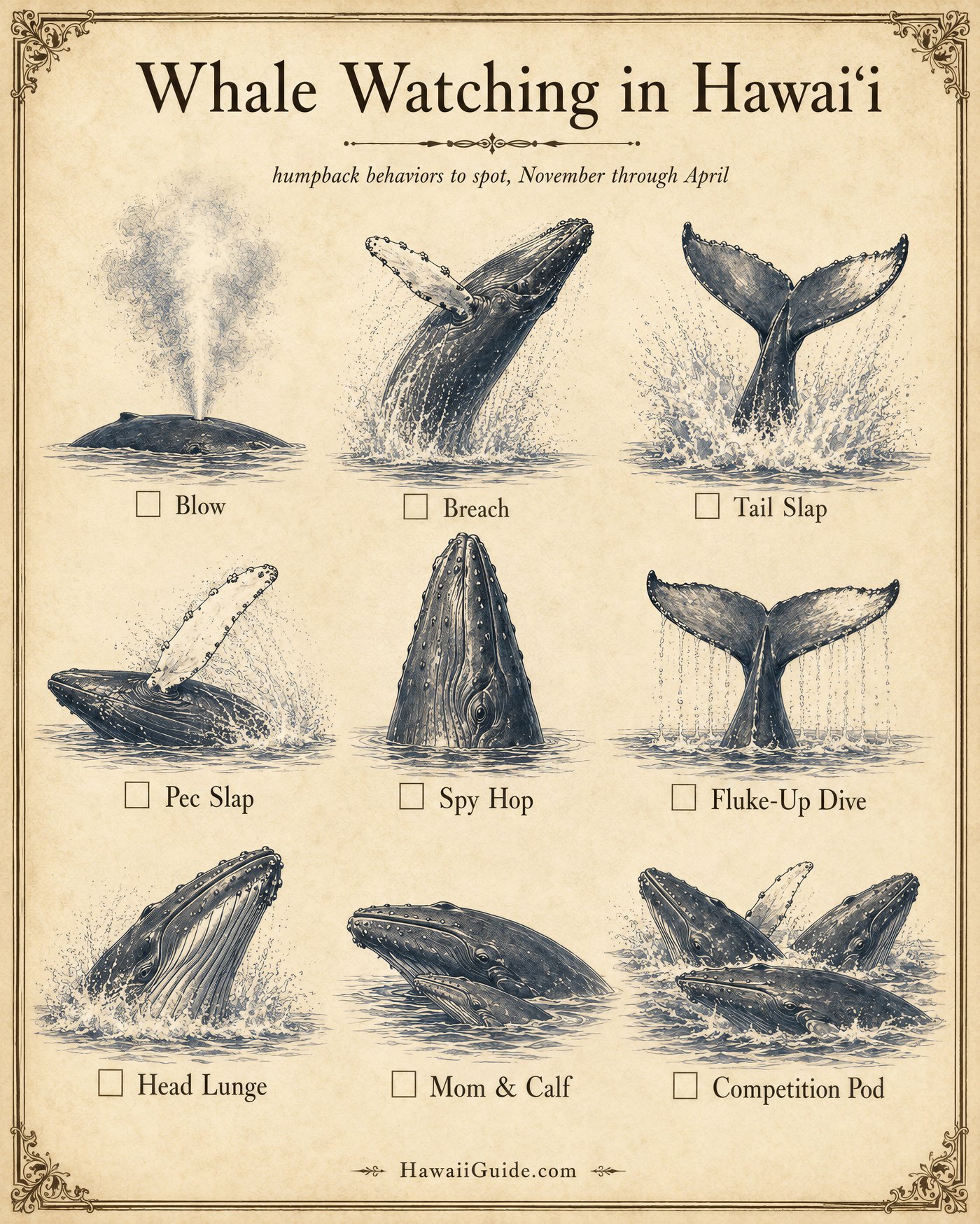
Nine humpback behaviors to spot from shore or a boat. Check off each sighting in the scavenger hunt, then tap for the print-ready PDF.
Many humpback whales that winter in Hawaiʻi migrate from feeding grounds across the North Pacific, including Alaska. NOAA documents that migration and feeding range. Humpbacks breed, give birth, and nurse calves in Hawaiʻi's warm, shallow waters before returning north to feed.
Start with the misty blow. Then watch for a tail or a breach. A fin slap can follow. NOAA identifies these surface signs. Male humpbacks produce complex songs during the breeding season, as described in NOAA's whale behavior guide.
We choose for ocean conditions rather than assuming whales follow a daily schedule. Calmer water makes the ride and horizon scanning easier; rough water or glare can hide a whale at any hour.
Humpback whales are protected under the Marine Mammal Protection Act. In Hawaiʻi, federal law prohibits approaching within 100 yards by any means. The rule applies whether you are on the water, swimming, or using a drone. If a whale approaches, do not pursue or reposition for a closer view; follow the operator's instructions and NOAA's Hawaiʻi viewing guidance.

Published by: John C. Derrick
Founder & certified Hawai'i travel expert with 20+ years in Hawai'i tourism, University of South Carolina climate-research training, and NOAA weather-station experience.

Published by: Tori C. Derrick
President & certified Hawai'i travel expert with 15+ years of experience in Hawai'i tourism.

Need help planning?
Search & Planning Chat →

Trades are breezy right now with scattered showers on the windward side and mountains; the leeward coast stays mostly dry. Tomorrow stays breezy with the same pattern.
A tropical disturbance southeast of the islands is likely to become a tropical storm by mid-week and approach the state Thursday through Saturday. The exact track is still uncertain. If it comes closer, expect heavier rain over a longer stretch; if it stays farther out, impacts will be shorter and lighter. Winds will increase late this week, with potential gusts over 70 miles per hour on the highest summits.
Plan your leeward beach time and snorkeling for today through Tuesday. Save summit drives and offshore water sports for after Saturday, and check updates daily as this develops.
Created with AI from the official NWS forecast discussion · verify with NWS before heading out
Current Time in Hawaiʻi
Hawaiʻi Standard Time · UTC−10 · No Daylight Saving
You’re on Hawaiʻi timeMainland US
International
Aloha Today daily podcast →
Full HST breakdown, FAQ & DST schedule →
Enter your email and we'll send you instant access to our free 2026 Hawaii Starter Guide + Summary Guidesheets.
