

Live USGS HVO status
Checking the current Kīlauea fountaining status…
This panel updates from the newest HVO notice and will show whether lava fountaining is active, ended, paused, or still in precursor activity.
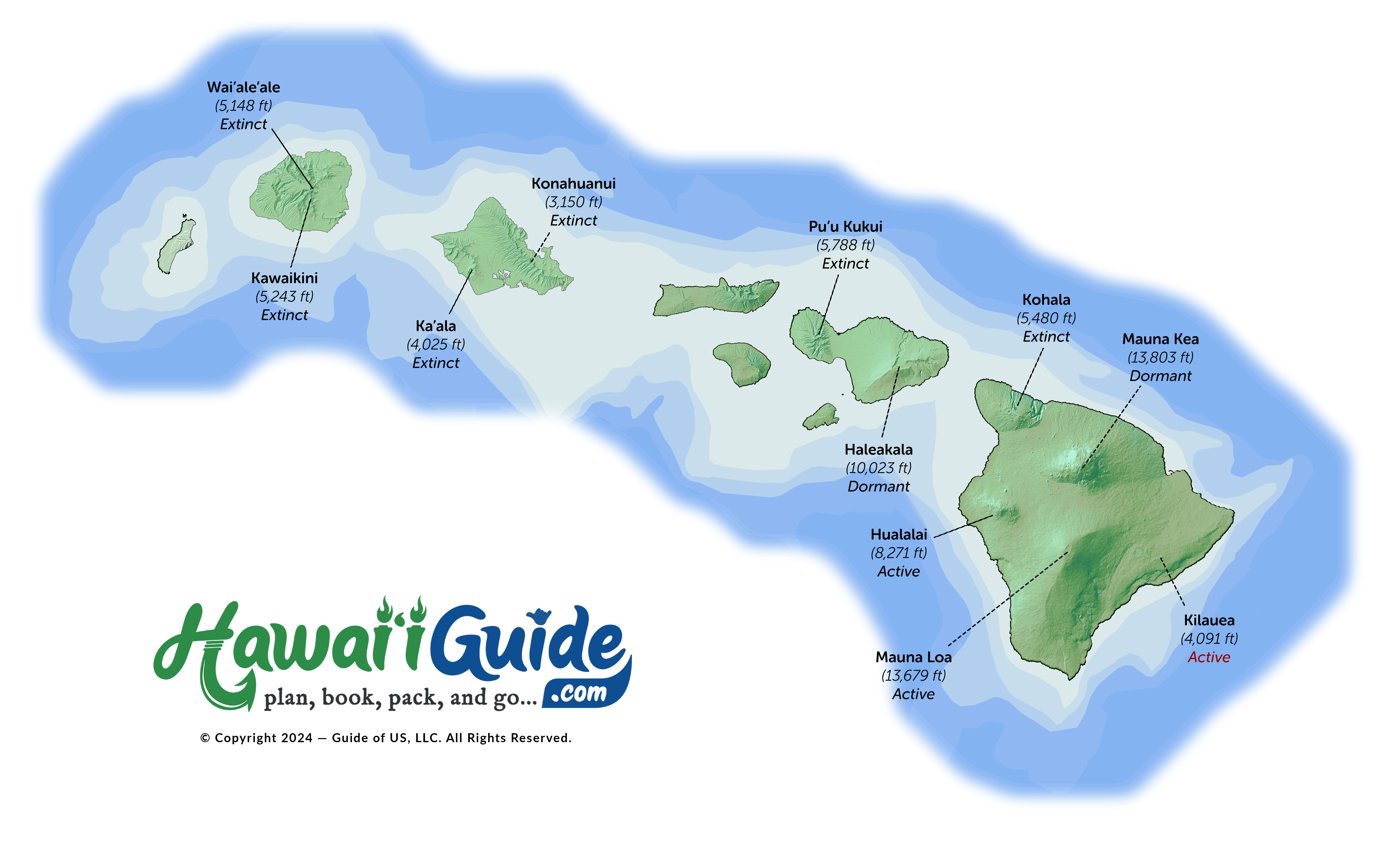
Hawaii Island Volcanoes (click to view entire chain)
Where is the Lava?
Hawaii Eruption Tracker & Updates
Kilauea volcano is intermittently erupting
If you're heading to Hawaii's Big Island, then one of the first questions you may have is, 'Where is the lava? I want to see lava! Wait, or is it magma?' First, yes, typically, it's lava you're looking for - lava is anything that's erupted from the volcano (to the surface), and it comes in two flavors, Pahoehoe and A`a. You can read more about the two lava types on our Hawaii Geology page. If it's still within the volcano, it's known as magma.
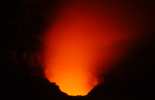
The top photo above is a USGS photo of the previous Kilauea Eruption.
Kilauea Eruption Updates
Current Kilauea Eruption Updates
Lava has returned to Halemaumau Crater at the summit
- Watch a GIF of the initial eruption as it started on the USGS camera on the morning of December 23, 2024 (wait for it, it occurs at 2am)
- See our 'What's Happening on Kilauea Now' section for information on the current Kilauea eruption.
Live Kilauea Eruption Camera — USGS V1cam (West)
USGS restarts these streams from time to time. If this one shows as ended, the current feeds are always at youtube.com/@usgs/streams.
Live Kilauea Eruption Camera — USGS V3cam (South)
USGS restarts these streams from time to time. If this one shows as ended, the current feeds are always at youtube.com/@usgs/streams.

Big Island Lava Flow
Locating the Lava Flows
Now, to answer the question of 'where.' Well, the answer to that question depends on the mood of Pele (the Hawaiian Volcano Goddess). And Madame Pele is very unpredictable.
Hawaii Volcanoes National Park normally operates 24 hours a day, and most of the park is open. Kahuku and its Visitor Contact Station reopened Thursday, Sept. 3, with normal Thursday-through-Sunday hours and most trails available. NPS recommends 4WD above Lower Palm Trailhead because the road is deeply rutted, and upper Kahuku Road remains closed beyond the boot decontamination station. Mauna Loa Road beyond the gate at Kīpukapuaulu, Kīpukapuaulu Trail, and Nāmakanipaio Campground also remain closed. Confirm current cabin availability directly with Volcano House; check tent-campsite access separately before traveling. Check the live NPS alerts before driving.
Ultimately, in our opinion, even if you don't get to see any flowing lava in person, which you might not at times, Hawaii Volcanoes National Park and the Big Island are well worth the time.

2025 Eruption - USGS
Kilauea & Volcanoes National Park Lava Viewing Guide
- Timeline of Events:
- Hike to the lava yourself
- Or check our recommendations for Guided Kilauea Tours
- Helicopter tours over the volcano
- Mauna Loa Eruption Updates - after 38 years, Mauna Loa erupted in late 2022
- All of Hawaii's volcanoes at a glance
- Hawaii Volcanoes National Park Maps
- Hawaii volcano FAQ - quick answers for visitors
Separately, don't forget to review our Hawaii Safety Guide for the Volcano Area (and other important Hawaii safety tips).
Visit it. Stamp it. Wear it.
Collect landmark stamps free with the Hawai'i Guide Passport, then shop the landmark tee collection.

 Shop the landmark tees
Open your free Hawaiʻi Guide Passport
Shop the landmark tees
Open your free Hawai'i Guide Passport
Hawaii's Volcanoes at a Glance
Searching for "the Hawaii volcano" usually means Kīlauea — it's the one erupting — but the Big Island alone is built from five volcanoes, with a sixth growing offshore. Here's the full roster and where each one stands:
| Volcano | Island | Status | Last Eruption |
|---|---|---|---|
| Kīlauea | Big Island | Erupting episodically (this page) | See the current HVO-linked status above |
| Mauna Loa | Big Island | Active, not erupting | November–December 2022 |
| Hualālai | Big Island | Active, not erupting | 1801 |
| Mauna Kea | Big Island | Dormant | About 4,500 years ago |
| Kohala | Big Island | Postshield volcanism probably over; future rejuvenated eruptions possible | Youngest postshield lava: about 120,000 years old |
| Kamaʻehuakanaloa (formerly Lōʻihi) | Submarine, southeast of the Big Island | Active seamount, about 3,200 ft (975 m) below the surface | No eruption has been observed; a major earthquake swarm occurred in 1996 |
| Haleakalā | Maui | Active, not erupting | Between about 1480 and 1600 |
Status and last-eruption dates per the USGS Hawaiian Volcano Observatory. Curious how the whole island chain formed? Our Hawaii Geology & Geography page covers the hotspot that built every one of these.

Kilauea eruption episode
What's Happening Now at Kilauea?
Periodic Kīlauea eruption: lava fountaining turns on and off in episodes
Kīlauea volcano, on the Big Island of Hawaiʻi, has produced short lava-fountaining episodes separated by pauses and precursor activity. Read our Episode 55 visitor update before planning a summit visit. The live USGS HVO panel near the top of this page reports the current phase; use that panel, the HVO cameras, and current NPS access information before driving.
Current conditions, video, images, etc. are additionally included below.
Ongoing Kilauea Eruption - USGS
Current Kilauea Conditions Summary*
Below, we'll post additional updates on eruption activity where you can additionally read about all of Kilauea's recent eruption events.
Activity Summary: Current conditions, updated daily, can be found on the USGS HVO notice feed.
HVNP Status & Closures: Hawaii Volcanoes National Park site
*Activity Summary, Summit Observations, and Lava Lake Observations courtesy of the USGS HVO notice feed and/or NPS
December 2024 - September 2026 Kilauea Eruption Timeline
-Episode 55 precursor activity-
Precursory lava overflows began at Kīlauea’s north vent on September 7, 2026. HVO recorded 104 overflows through September 12. Intermittent spatter bursts September 13–15 built a small cone around the north vent, with frequency and intensity increasing September 14. Six new vents opened in Halemaʻumaʻu September 14–16, then stagnated by 8:30 p.m. HST September 16. HVO’s September 21, 9:28 a.m. HST daily update says the north, south, and west vents continued to glow, with minor intermittent spatter from the established north vent. Strong tremor became continuous over the previous 24 hours and now dominates the summit seismic signal. Summit inflation reached about 15.6 microradians since episode 54 ended. At the current rate, HVO estimates the summit is within roughly 1–2 days of returning to the prior 16-microradian pressure peak, but that estimate changes if inflation slows or deflation returns. HVO says forecast windows can no longer be modeled and lists three possible outcomes after peak pressure: activity could resume at the established vent complex, reactivate vents 1–6, or intrude another weak summit area. Kīlauea remains at WATCH/ORANGE; HVO’s current summary describes minor intermittent spatter from the north vent. Read our Episode 55 visitor update and check the live panel above for later changes.
-Episode 54-
Episode 54 lava fountaining began from Kīlauea's north vent at 10:30 a.m. HST and ended at 7:33 p.m. HST on Tuesday, August 25, 2026, after 9 hours. The north-vent fountain peaked near 500 feet (150 meters) above ground between 12:15 and 1 p.m., while the plume reached about 17,000 feet (5,200 meters) above sea level. Neither the south vent nor the new west vent fountained. Most tephra fell in the park's closed area southwest of the vents, but HVO received one report of trace Peleʻs hair in the Kaʻū district. Kīlauea returned to ADVISORY with the Aviation Color Code at YELLOW after the episode ended. See our Episode 54 visitor update, the official HVO end notice, and live cameras for the latest status.
-Episode 53-
Episode 53 lava fountaining began from the north vent at 3:45 p.m. HST on Wednesday, August 12, 2026, and ended abruptly at 1:23 a.m. HST Thursday, August 13, after 9.6 hours. The north-vent fountain peaked near 500 feet (150 meters), and the plume reached about 18,000 feet (5,500 meters) above sea level. The south vent never fountained, while the new west vent periodically emitted flames. HVO estimates that about 6 million cubic yards (4.6 million cubic meters) of lava covered 40–50% of the Halemaʻumaʻu crater floor. Tephra fall stayed completely inside the park's closed area southwest and west of the vents. HVO lowered Kīlauea to ADVISORY with the Aviation Color Code at YELLOW after the episode ended. Its August 24 update says the next fountaining episode is likely between Tuesday, August 25 and Friday, August 28, with Tuesday to Wednesday most likely if rapid inflation persists; that is a forecast window, not an exact start time. See our Episode 53 activity update, the official HVO notice feed, and live cameras for the latest status.
-Episode 52-
Episode 52 lava fountaining began at 7:10 p.m. HST on Tuesday, July 28, 2026, and ended abruptly at 2:36 a.m. HST on Wednesday, July 29, after 7.4 hours of continuous north-vent fountaining. The north-vent fountain peaked near 500 feet (150 meters), and the plume reached about 19,000 feet (5,800 meters) above sea level. HVO estimates that 6.1 million cubic yards (4.7 million cubic meters) of lava covered about 40–50% of the Halemaʻumaʻu crater floor. All eruptive activity remained confined to the crater, and the plume stayed largely within Hawaiʻi Volcanoes National Park. HVO lowered Kīlauea to ADVISORY with the Aviation Color Code at YELLOW after the episode ended. See our Episode 52 activity update, the official HVO status report, and live cameras for the latest status.
-Episode 51-
Episode 51 of the ongoing Halemaʻumaʻu eruption ended abruptly at 4:46 p.m. HST on Wednesday, July 15, 2026, after 8.3 hours of continuous lava fountaining from the north vent, with the last 2–3 minutes marked by gas jetting. The north-vent fountain peaked near 950 feet (290 meters) around 10:30 a.m., feeding an ash-bearing plume that reached about 18,000 feet (5,500 meters) above sea level; the south vent never fountained but emitted flames and gas jets. HVO's final report estimated 6.6 million cubic yards (5.1 million cubic meters) of lava erupted — effusion peaked near 370 cubic yards per second — covering about 50% of the crater floor, with the Uēkahuna tiltmeter recording roughly 14.7 microradians of deflationary tilt and one locatable earthquake (a shallow magnitude-2 beneath the crater's southeast corner). The plume track stayed largely within Hawaiʻi Volcanoes National Park, most tephra fell in the closed area, and no tephra was reported from any populated areas. The summit flipped from deflation to inflation as the episode ended — a sign another fountaining episode is likely. See our Episode 51 update for the full breakdown.
Episode 51 lava fountaining began at 8:30 a.m. HST on Wednesday, July 15, 2026. Lava fountains erupting from the north vent reached heights of about 160 feet (50 meters) above ground level and fed large lava flows onto the floor of Halemaʻumaʻu crater, with no fountains or flows from the south vent. Peak fountaining typically occurs 1–2 hours after onset. Kīlauea remained at WATCH with the Aviation Color Code at ORANGE, and HVO noted communities may be impacted by wind-blown tephra — low-level winds out of the northeast and higher-level winds from the south. Activity stayed confined to Halemaʻumaʻu inside Hawaiʻi Volcanoes National Park.
Precursory low-level activity for Episode 51 of the ongoing Halemaʻumaʻu eruption began around 2:51 p.m. HST on Tuesday, July 14, 2026, with a lava overflow from the north vent. USGS HVO raised the Volcano Alert Level for Kīlauea from ADVISORY to WATCH and the Aviation Color Code from YELLOW to ORANGE the same afternoon. HVO forecast sustained lava fountaining to begin between July 14 and July 16 — it arrived the next morning. See our Episode 51 update for the full breakdown.
-Episode 50-
Episode 50 of the ongoing Halemaʻumaʻu eruption ended abruptly at 5:10 p.m. HST on June 27, 2026, after about 7 hours of continuous lava fountaining inside the crater. USGS HVO lowered the Volcano Alert Level from WATCH back to ADVISORY and the Aviation Color Code from ORANGE to YELLOW at 6:59 p.m. HST the same evening. HVO noted that tephra carried high into the air during fountaining may have continued to fall on communities and roads in Kaʻū. Activity stayed confined to Halemaʻumaʻu inside Hawaiʻi Volcanoes National Park. See our Episode 50 update for the full breakdown.
Episode 50 sustained lava fountaining began at about 10:10 a.m. HST on Saturday, June 27, 2026, after a precursory lava overflow from the north vent at 9:46 a.m. that followed roughly five minutes of vigorous drainback. Dome fountains grew from about 10 feet (3 meters) to over 50 feet (15 meters) by 10:10 a.m. as summit tremor increased and tilt decreased. As of HVOʻs 10:36 a.m. update, fountains were about 100 feet (30 meters) high and growing, with USGS forecasting growth to over 600 feet (180 meters) within one to two hours. Kīlauea remained at WATCH with the Aviation Color Code at ORANGE, and activity stayed confined to Halemaʻumaʻu crater inside Hawaiʻi Volcanoes National Park.
Precursory low-level activity for Episode 50 increased around 8:50 a.m. HST on Friday, June 26, 2026, with a small lava overflow from the north vent along with rising levels of spattering and gas jetting. USGS HVO raised the Volcano Alert Level for Kīlauea from ADVISORY to WATCH and the Aviation Color Code from YELLOW to ORANGE the same morning. This kind of overflow and spattering is the typical lead-in before sustained lava fountaining begins. See our Episode 50 update for the full breakdown.
-Episode 49-
Episode 49 of the ongoing Halemaʻumaʻu eruption ended abruptly at 5:05 p.m. HST on June 14, 2026, after about 7.5 hours of continuous lava fountaining inside the crater. USGS HVO dropped the Volcano Alert Level from WATCH back to ADVISORY and the Aviation Color Code from ORANGE to YELLOW. Activity stayed confined to Halemaʻumaʻu inside Hawaiʻi Volcanoes National Park. See our Episode 49 update for the full breakdown.
Episode 49 sustained lava fountaining began at 9:32 a.m. HST on June 14, 2026, a little over five hours after precursory low-level overflows started at 4:10 a.m. with dome fountains 10–15 feet high from the north vent. HVO raised the Volcano Alert Level from ADVISORY to WATCH and the Aviation Color Code from YELLOW to ORANGE during the precursory phase. North-northeast winds carried volcanic gas and tephra to the southwest of Halemaʻumaʻu, with trace tephra and Peleʻs Hair possible in communities to the north of the summit.
-Episode 48-
Episode 48 of the ongoing Halemaʻumaʻu eruption ended abruptly at 1:37 p.m. HST on June 1, 2026, after about 9 hours of continuous lava fountaining from the north vent. The episode set a record — the most fountaining episodes ever recorded for a single episodic-fountaining eruption at Kīlauea, passing the 47 episodes of the early Puʻuʻōʻō eruption (Episode 47 on May 14 tied the mark; Episode 48 broke it). An estimated 7.3 million cubic yards of lava covered about 40% of the crater floor, and the ash-rich plume topped 25,000 feet. USGS HVO dropped the Volcano Alert Level from WATCH back to ADVISORY and the Aviation Color Code from ORANGE to YELLOW, citing reduced ground and aviation hazards. See our Episode 48 update for the full breakdown.
Episode 48 lava fountaining began at 4:40 a.m. HST on June 1, 2026, from the north vent inside Halemaʻumaʻu, after more than 90 precursory overflow events from the south vent that started at 5:41 p.m. HST on May 30. Fountains reached more than 650 feet (200 meters) high. Seismic and deformation signals indicate the fountain reached its peak height and effusion rate for the episode early on, though fountaining was forecast to continue for many more hours. USGS HVO kept the Volcano Alert Level at WATCH and the Aviation Color Code at ORANGE. Tephra fall was reported within Hawaiʻi Volcanoes National Park and in surrounding communities to the north. See our Episode 48 update for the full rundown.
-Episode 47-
Episode 47 of the ongoing Halemaʻumaʻu eruption ended abruptly at 12:27 a.m. HST on May 15, 2026, after about 9 hours of continuous lava fountaining from the north vent. Most tephra stayed within the closed area of the park, but sparse reticulite up to 3 inches (5 centimeters) fell at the Uēkahuna and Keanakākoʻi overlooks, while fine ash and Peleʻs Hair reached communities northeast of the summit — Mauna Loa Estates, ʻŌhiʻa Estates, Volcano village, and Royal Hawaiian Estates. USGS HVO dropped Kīlauea from WATCH back to ADVISORY and the Aviation Color Code from ORANGE to YELLOW. See our Episode 47 recap for the full breakdown.
Episode 47 lava fountaining began at 3:27 p.m. HST on May 14, 2026, with activity focused at the north vent while the south vent continued to cyclically overflow. HVO raised the Volcano Alert Level from ADVISORY to WATCH and the Aviation Color Code from YELLOW to ORANGE earlier that day after precursory south-vent overflows began around 3 a.m. HST. Activity stayed confined to Halemaʻumaʻu crater throughout.
-Episode 46-
Episode 46 of the ongoing Halemaʻumaʻu eruption ended abruptly at 5:22 p.m. HST on May 5, 2026, after about 9 hours of continuous lava fountaining. USGS HVO dropped the Volcano Alert Level from WATCH back to ADVISORY and the Aviation Color Code from ORANGE to YELLOW. See our Episode 46 recap for context and what to watch for next.
Episode 46 lava fountaining began at 8:17 a.m. HST on May 5, 2026, inside Halemaʻumaʻu, after precursory overflows started at 1:38 a.m. on May 4. Light and variable winds becoming SE 5–7 mph distributed vog and tephra through the summit area and north/northwest of the crater during the episode. Activity stayed confined to Halemaʻumaʻu crater throughout.
-Episode 45-
Episode 45 of the ongoing Halemaʻumaʻu eruption ended abruptly at 10:01 a.m. HST on April 23, 2026, after 8.5 hours of continuous lava fountaining. USGS HVO dropped the Volcano Alert Level from WATCH back to ADVISORY and the Aviation Color Code from ORANGE to YELLOW the same morning. See our Episode 45 recap for details and what to expect next.
Episode 45 lava fountaining at the Kīlauea summit began at 1:34 a.m. HST on April 23, 2026, approximately 55 hours after the first precursory overflows. Activity was confined to Halemaʻumaʻu crater. Northerly winds directed volcanic gases and tephra south across Kaʻū and Kona during the episode.
Precursory low-level activity for Episode 45 began around 7:46 p.m. HST on April 20, 2026, with several overflows of lava from the north vent. USGS HVO raised the Kīlauea alert level from ADVISORY/YELLOW to WATCH/ORANGE the same evening. Between the end of Episode 44 on April 9 and the start of precursory activity, the Uēkahuna tiltmeter (UWD) tracked approximately 14.9 microradians of inflationary tilt.
-Episode 44-
Episode 44 of the ongoing Halemaʻumaʻu eruption ended abruptly at 7:41 p.m. HST on April 9, 2026, after 8 hours and 31 minutes of continuous lava fountaining from the north vent. The south vent never fountained during this episode, but displayed periodic gas jetting and flames. The highest peak effusion rate of just over 500 cubic yards (390 cubic meters) per second occurred around 12:30 p.m. HST. Episode 44 saw an average effusion rate of 260 cubic yards (200 cubic meters) per second, with an estimated 7.5 million cubic yards (5.8 million cubic meters) of lava erupted and covering about 50% of the Halemaʻumaʻu crater floor. The Uēkahuna tiltmeter (UWD) recorded about 17.6 microradians of deflationary tilt during episode 44.
Episode 44 lava fountaining began at 11:10 a.m. HST on April 9, 2026, almost a week after the onset of precursory lava overflows on April 3. There were approximately 75 precursory overflows from April 3 to the start of fountaining on April 9. The north vent grew slowly to about 330 feet (100 meters) by 12:00 p.m., then reached a maximum of about 800 feet (240 meters) by 12:45 p.m. HST. Afterwards it gradually dropped to 500 feet (150 meters) by 4:00 p.m. and further diminished until the end at 7:41 p.m. HST. The single lava fountain produced a plume that reached a maximum height of about 15,000 feet (4,500 meters) above sea level by 1:30 p.m. HST.
Southerly winds directed the plume and tephra fall north of Halemaʻumaʻu. Tephra as large as 10 inches (25 centimeters) was reported in the Volcano Golf Course subdivision, and fine ash and Peleʻs Hair was reported as far away as Hilo. This eruption was smaller in size than episodes 41–43, but due to steady winds it produced a similar tephra fallout pattern. Report tephra fall: hawaiiash.science
-Episode 43-
Episode 43 lava fountaining from the north and south vents stopped at approximately 6:21 p.m. HST on March 10, 2026. The south fountain dropped suddenly at 6:18 p.m. HST and began irregular jetting. Both vents stopped suddenly at 6:21 p.m. HST after erupting to 500-600 feet (150-200 meters) high for the last hour. Lava fountaining during this episode reached a maximum height of 1,300 feet (400 meters). Episode 43 ended after 9 hours and 4 minutes with both the north and south vents active for most of the eruption. The highest peak or instantaneous effusion rate of 1000 cubic yards (800 cubic meters) per second occurred around 10:30 a.m. HST on March 10. Episode 43 ended with an average effusion rate of 400 cubic yards per second (300 cubic meters per second). An estimated 16 million cubic yards (12 million cubic meters) of lava erupted and covered about 50% of Halemaʻumaʻu crater floor. The Uēkahuna tiltmeter (UWD) recorded about 33.7 microradians of deflationary tilt during episode 43. The total erupted volume since December 2024 is now close to 325 million cubic yards (250 million cubic meters). All activity was confined to Halemaʻumaʻu crater.
Episode 43 of lava fountaining in Halemaʻumaʻu began at the summit of Kīlauea at 9:17 a.m. HST on March 10, 2026.
-Episode 42-
Episode 42 of the ongoing Halemaʻumaʻu eruption ended abruptly at 11:38 p.m. HST on February 15, 2026, after 9 hours and 48 minutes of continuous lava fountaining.
Episode 42 of lava fountaining in Halemaʻumaʻu began at the summit of Kīlauea began at 1:50 p.m. HST on February 15, 2026.
-Episode 41-
Episode 41 of the ongoing Halemaʻumaʻu eruption ended abruptly at 7:29 p.m. HST on January 24, 2026, after over 8 hours of continuous lava fountaining.
Episode 41 of the ongoing Halemaʻumaʻu eruption began around 11:10 a.m. HST on January 24, 2026. North and south vent fountain heights peaked just after 12:30 p.m., with maximum fountain heights estimated around 460 to 480 m (1500-1575 feet). Widespread tephra fall has been reported in the National Park and surrounding areas including communities to the north of the National Park. As of 2:15 p.m., north vent fountains are about 200 m (650 feet) high and south vent fountain is about 300 m (1000 feet) high.
-Episode 40-
Episode 40 of the ongoing Halemaʻumaʻu eruption ended abruptly at 6:04 p.m. HST on January 12, 2026, after 9.7 hours of continuous lava fountaining.
Episode 40 of lava fountaining in Halemaʻumaʻu began at the summit of Kīlauea began at 8:22 a.m. HST on January 12, 2026.
-Episode 39-
Episode 39 of the ongoing Halemaʻumaʻu eruption ended abruptly at 2:13 a.m. HST on December 24, 2025 after 5.9 hours of continuous fountaining (the start time was revised from 8:10 p.m. to 8:20 p.m. HST on December 23 based on tilt and tremor data).
The north vent stopped erupting at approximately 2:00 a.m. HST. The south vent stopped erupting at approximately 2:13 a.m. HST, marking the end of the episode. Lava fountains from the south vent reached up to 1400 ft (420 m) while north vent fountains were just under 1000 feet (280 meters) around 9:30 p.m. HST on December 23. Episode 39 fountains lasted for 5.9 hours and produced an estimated 13 million cubic yards (10 million cubic meters) of lava. The combined average eruption rate was over 250 cubic yards per second (190 cubic meters per second) from the dual fountains. Lava flows from the fountains covered about 60-70% of the floor of Halemaʻumaʻu crater.
Episode 39 of the ongoing Halemaʻumaʻu eruption began at 8:10 p.m. HST on December 23, 2025. Sustained lava fountains approximately 100 feet (30 meters) in height are currently erupting from both north and south vents. Fountain heights are currently increasing.
Past episodes have produced incandescent lava fountains over 1000 feet (300 meters) high that produce eruptive plumes up to 20,000 feet (6000 meters) above ground level. According to the National Weather Service, winds are blowing from the northeast direction, which suggests that volcanic gas emissions and volcanic material may be distributed to the southwest.
-Episode 38-
Episode 38 of the ongoing Halemaʻumaʻu eruption ended abruptly at 8:52 p.m. HST on December 6, 2025, after 12.1 hours of continuous lava fountaining.
The south vent stopped erupting at approximately 8:52 p.m. HST, marking the end of the episode. The dual north vents stopped erupting much earlier at approximately 11:50 a.m. Lava fountains reached heights of up to 1,000-1,200 ft (300-370 m) during episode 38. Fountains were down to about 400 feet (120 meters) high just before the abrupt end of the eruption. Lava fountaining lasted for 12.1 hours and produced an estimated 16 million cubic yards (12 million cubic meters) of lava. The combined average eruption rate was over 250 cubic yards per second (190 cubic meters per second) from the lava fountains.
Episode 38 of the ongoing Halemaʻumaʻu eruption began at 8:45 a.m. HST on December 6, 2025 with steeping increasing tremor and decreasing tilt. Sustained lava fountains approximately 50-100 feet (15-30 meters) in height are currently erupting from the north vent. Fountain heights are increasing rapidly and are coming from both the left and right vents within the north cone.
-Episode 37-
Episode 37 of the ongoing Halemaʻumaʻu eruption ended abruptly at 11:39 p.m. HST on November 25, 2025 after 9.2 hours of continuous fountaining.
The north vent stopped erupting at approximately 11:39 p.m. HST marking the end of episode 37. No lava fountains or flows erupted from the south vent during episode 37. Dual lava fountains from the north vent reached maximum heights of 500-600 ft (150-180 m). Continuous fountaining lasted for 9.2 hours and produced an estimated 8.2 million cubic yards (6.3 million cubic meters) of lava. The combined average eruption rate was over 200 cubic yards per second (190 cubic meters per second). Lava flows from the fountains covered about 75% of the floor of Halemaʻumaʻu crater.
The eruptive plume reached heights of more than 14,000 ft (4,200 m) above sea level during episode 37. Volcanic gas emissions greatly decreased after lava fountaining ended.
Episode 37 of the ongoing Halemaʻumaʻu eruption began at 2:30 p.m. HST on November 25, 2025. Sustained lava fountains approximately 400 feet (120 meters) in height are currently erupting from the north vent. Fountain heights are increasing rapidly.
-Episode 36-
Episode 36 of the ongoing Halemaʻumaʻu eruption ended abruptly at 4:16 p.m. HST on November 9, 2025, after just under 5 hours of continuous fountaining.
The north vent stopped erupting at approximately 3:38 p.m. HST. The south vent dropped from 1000 to 500 feet (300-150 meters) around 3:48 p.m. HST and held steady for a while. The south vent slowly declined and eventually stopped erupting at approximately 4:16 p.m. HST, marking the end of the episode. Lava fountains reached a maximum of 1000-1100 ft (300-330 m) during this episode. The episode 36 fountains lasted for just over 5 hours and produced an estimated 10-11 million cubic yards (8-9 million cubic meters) of lava. The combined average eruption rate was over 650 cubic yards per second (500 cubic meters per second) from the dual fountains, which is the highest effusion rate recorded during this eruption. Lava flows from the fountains covered about 60- 80% of the floor of Halemaʻumaʻu crater.
Episode 36 of the ongoing Halemaʻumaʻu eruption began at 11:15 a.m HST on November 9, 2025, and is currently fountaining from both the north and south vents.
-Episode 35-
Episode 35 of the ongoing Halemaʻumaʻu eruption ended abruptly at 3:32 a.m.. HST on October 18, 2025 after 7.5 hours of continuous fountaining.
The south vent stopped erupting at approximately 3:29 a.m. HST. followed by the north vent at 3:32 a.m. HST, marking the end of episode 35. Lava fountains reached up to nearly 1500 ft (460 m) during this episode from the south vent, and 1100 ft (330 m) from the north vent. The episode 35 fountains lasted for 7.5 hours and produced an estimated 13 million cubic yards (10 million cubic meters) of lava. The combined average eruption rate was over 500 cubic yards per second (400 cubic meters per second) from the dual fountains. Lava flows from the fountains covered about two thirds of the floor of Halemaʻumaʻu crater.
Episode 35 of the ongoing Halemaʻumaʻu eruption began at approximately 8:05 p.m. HST on October 17, 2025. Sustained lava fountains approximately 500 feet (150 meters) in height are currently erupting from the north vent. Fountain heights are increasing rapidly and angled to the northeast.
-Episode 34-
Episode 34 of the ongoing Halemaʻumaʻu eruption ended abruptly at 7:03 a.m. HST on October 1 after just over 6 hours of continuous fountaining.
Episode 34 of the ongoing Halemaʻumaʻu eruption began at 12:53 a.m. HST on October 1. Low lava fountains, approximately 30 feet (10 meters) high began feeding lava flows from the north vent at 11:43 p.m. HST on September 30. Fountains began to increase in size and volume along with the onset of deflation at 12:53 a.m. HST October 1. Fountains are currently up to 330 feet or 100 meters and inclined slightly to the northeast.
-Episode 33-
Episode 33 of the ongoing Halemaʻumaʻu eruption began at 3:11 a.m. HST on September 19 and is currently fountaining within the summit caldera. Current fountain height is greater than 500 feet (150 meters) and the convective plume is about 10,000 feet AGL (3000 meters AGL). Past episodes have produced incandescent lava fountains over 1000 feet (300 meters) high that can produce eruptive plumes up to 20,000 feet (6000 meters) above ground level.
-Episode 32-
Episode 32 of the ongoing Halemaʻumaʻu eruption ended abruptly at 8:01 p.m. HST on September 2, 2025, after 13.4 hours of continuous fountaining.
The north vent stopped erupting at approximately 7:49 p.m. HST. The smaller middle and south vents stopped erupting at approximately 8:01 p.m. HST with a few minutes of jetting, marking the end of episode 32. Lava fountains reached up to 500 ft (150 m) during this episode and averaged more than 250 cubic yards per sec (>200 cubic meters per sec) and produced over 12.5 million cubic yards (9.6 million cubic meters) of lava, the highest output for a short-lived fountain episode.
Episode 32 of the ongoing Halemaʻumaʻu eruption began at 6:35 a.m. HST on September 2. At that time, north vent dome fountains transitioned into taller lava fountains, which have since become inclined at about 45 degrees northeast, similar to but less inclined than those of episode 31. Current fountains are about 500 feet (150 meters) high and arcing an equivalent distance into Halemaʻumaʻu crater.
-Episode 31-
Episode 31 of the ongoing Halemaʻumaʻu eruption ended abruptly at 2:52 a.m. HST on August 23, 2025, after 12.6 hours of continuous fountaining.
The north vent stopped erupting at approximately 2:52 a.m. HST marking the end of episode 31. The south and intermediate vents stopped erupting earlier at approximately 12:40 a.m. and 2:46 a.m. HST. Lava fountains from the north vent reached up to 325 ft (100 m) and sustained this height during most of this episode. Fountains from the south and intermediate vents remained small, less than 33 feet (10 meters) for most of the time, but the intermediate vent fountains increased to 60-100 ft (20-30 m) by the evening of August 22. Approximately 10,900,000 cubic yards (8,400,000 cubic meters) of lava were erupted at an average of 240 cubic yards per second (185 cubic meters per second) during the fountaining phase. Lava flows from this episode covered more than 75% of the floor of Halemaʻumaʻu within the southern part of Kaluapele (Kīlauea caldera).
Episode 31 of the ongoing Halemaʻumaʻu eruption began at 2:04 p.m. HST on August 22, 2025, and is currently fountaining from the north vent. Past episodes have produced incandescent lava fountains over 1000 feet (300 meters) high that produce eruptive plumes up to 20,000 feet (6000 meters) above ground level.
-Episode 30-
Episode 30 of the ongoing Halemaʻumaʻu eruption ended abruptly at 12:55 p.m. HST on August 6, 2025, after 12 hours of continuous fountaining. Lava flows continued to drain down the north cone for about 5 minutes after fountaining ceased.
The north vent stopped vigorous fountaining at approximately 12:55 p.m. HST marking the end of the episode. The south vent stopped erupting at approximately 12:50 p.m. HST, Lava fountains reached up to 300 ft (90 m) during this episode. A new fissure vent that transected the south wall of Halemaʻumaʻu ceased erupting at 4:40 a.m. HST on the morning of August 6, 2025.
Episode 30 vigorous fountaining of the ongoing Halemaʻumaʻu eruption began at approximately 1:20 a.m. HST on August 6, 2025, and is currently producing broad fountains150-300 feet (45-90 meters) high from the north vent. Lava flows from the north vent have covered about 20% of the floor of Halemaʻumaʻu crater. There is a line of small fountains that formed south of the old south vent area that are producing lower volume flows. This appears to be a new vent for this eruption and seems to be associated with a cluster of small earthquakes just south of Halemaʻumaʻu. Past episodes have produced incandescent lava fountains over 1000 feet (300 meters) high that produce eruptive plumes up to 20,000 feet (6000 meters) above ground level.
-Episode 29-
Episode 29 of the ongoing Halemaʻumaʻu eruption ended abruptly around 6:35 p.m. HST on July 20, 2025, after over 13 hours of continuous lava fountaining.
The north vent stopped erupting around 6:35 p.m. HST, marking the end of the episode; the weakly-active south vent had stopped erupting several hours earlier. Lava fountains did not exceed 330 feet (100 meters) during this episode, as most lava was sprayed laterally within Halemaʻumaʻu crater. An estimated 1.8 billion gallons (7 million cubic meters) of lava erupted during the episode, covering approximately 80% of the crater floor.
Episode 29 high fountains of the ongoing Halemaʻumaʻu eruption began around 5:15 a.m. HST on July 20, 2025. Lava fountains from the north vent gradually transitioned from low dome fountains less than 100 feet (30 meters high) to vertical fountains exceeding 200 feet (60 meters) around that time, accompanied by the onset of summit deflationary tilt and heightened seismic tremor. Past episodes have produced incandescent lava fountains over 1,000 feet (300 meters) high and eruptive plumes up to 20,000 feet (6,000 meters) above ground level; similar behavior may be expected within the next couple hours.
More information and a timeline of Kilauea's historical events (including the current eruption, when applicable) are included below.

December 2024 Eruption Location Map
Follow HVNP for additional updates
This situation is rapidly evolving and the Hawaii Volcanoes Observatory will continue to issue statements when more information is available to the public. For now, you can receive ongoing eruption updates by following the social media accounts of the Hawaii Volcanoes National Park (Facebook, Instagram, and X).
- View the USGS live streams from the Kīlauea summit.
- Additional updates can be found on the Hawaii Volcanoes National park website.
- Animated GIF of the latest webcam footage from the current eruption
Additional video footage and imagery, of the current eruption at Halemaumau Crater in Hawaii Volcanoes National Park, can be found below.
Big Island Volcano Tour Suggestions
Recent Events at Kilauea Volcano
Click any link below to learn more...
- December 2024 - Periodically Ongoing Eruption - lava returns to Halemaumau crater at the summit
This section will be updated accordingly. More Kilauea & Mauna Loa eruption history events can be found on our Big Island Historical Eruptions page.
As noted previously, additional Kilauea & Mauna Loa eruption history events can now be found on our Big Island Historical Eruptions page.

Hiking to Lava
Lava Viewing Guide
Hiking to Lava
Check THIS SITE for updates on lava flows and Kilauea activity. We've also included some maps below to generally help provide you an overview of the park and where the lava might be located during your visit. Just remember, this is an active living and breathing volcano and things regularly change, the maps are always out of date for that reason to some extent.
If the flows have recently been near the surface within the Park and IF it's safe to access (check with the Rangers), it's pretty easy to locate the lava yourself - so don't feel like you HAVE to join a tour to experience a lava flow. Before heading out, be sure you've prepared accordingly - dress appropriately with the right footwear for your adventure; be sure to keep water with you at all times, it can be easy to get dehydrated on the lava fields. Sunscreen is also your best friend on this part of the island.
As always, remember that lava flows outside the Park's boundary are on private property and you should not explore these locations without a guide who has permission to properly access the property.
Between fountaining episodes, the best way to experience the volcano on foot is the Kīlauea Iki Trail — you descend 400 feet and walk across a crater floor that was a churning lava lake in 1959, steam vents and all. Pair it with our Crater Rim Drive route for the summit overlooks and our Chain of Craters Road route for the drive down to the coast. Want to stand on the newest land on Earth? The Puna Lava Coast route covers the 2018 flows in lower Puna outside the park.

Kilauea Volcano Tours
Our recommendation for Kilauea & lava tours is to contact Scott at The Volcano Van. The operator offers private volcano tours with departures from Kona, Waikoloa, and Kohala. Check the current itinerary and park access before booking; a tour cannot guarantee visible lava.

View Lava from Above
Helicopter Volcano Tours
Another great option is to take a helicopter tour over Pu`u O`o for a look into the bowels of the earth. While that too could change tomorrow, as lava has a mind of its own - a helicopter tour is your BEST opportunity to see lava.
Our recommendation for helicopter tours is to fly with Safari Helicopters. Review its current Big Island tour options if you want to compare an aerial Kīlauea experience.

Mauna Loa 2022 Eruption
Mauna Loa Eruption
Mauna Loa Eruption Updates
Last Activity: November 2022 - December 2022
After 38 years, Mauna Loa briefly erupted
- More Mauna Loa eruption history events can be found on our Big Island Historical Eruptions page.
Latest Mauna Loa Developments
Updates provided by the USGS
Current daily updates on the status of Mauna Loa can be found on the USGS HVO notice feed.
See the USGS eruption map to visualize the current eruption location, or view these incredible USGS photos of the recent Mauna Loa eruption.
Previous Mauna Loa Eruption Photos

Lava channel on Dec 4th - USGS

Mauna Loa Fissure 3 - Dec 4th - USGS

Mauna Loa eruption on Nov. 30th - Credit: USGS

Mauna Loa eruption on Nov. 30th - Credit: USGS

Mauna Loa Lava Fountains - USGS

Northeast Rift Zone Eruption - USGS
Hawaii Volcanoes National Park Overview Maps
~ Click to enlarge any map ~
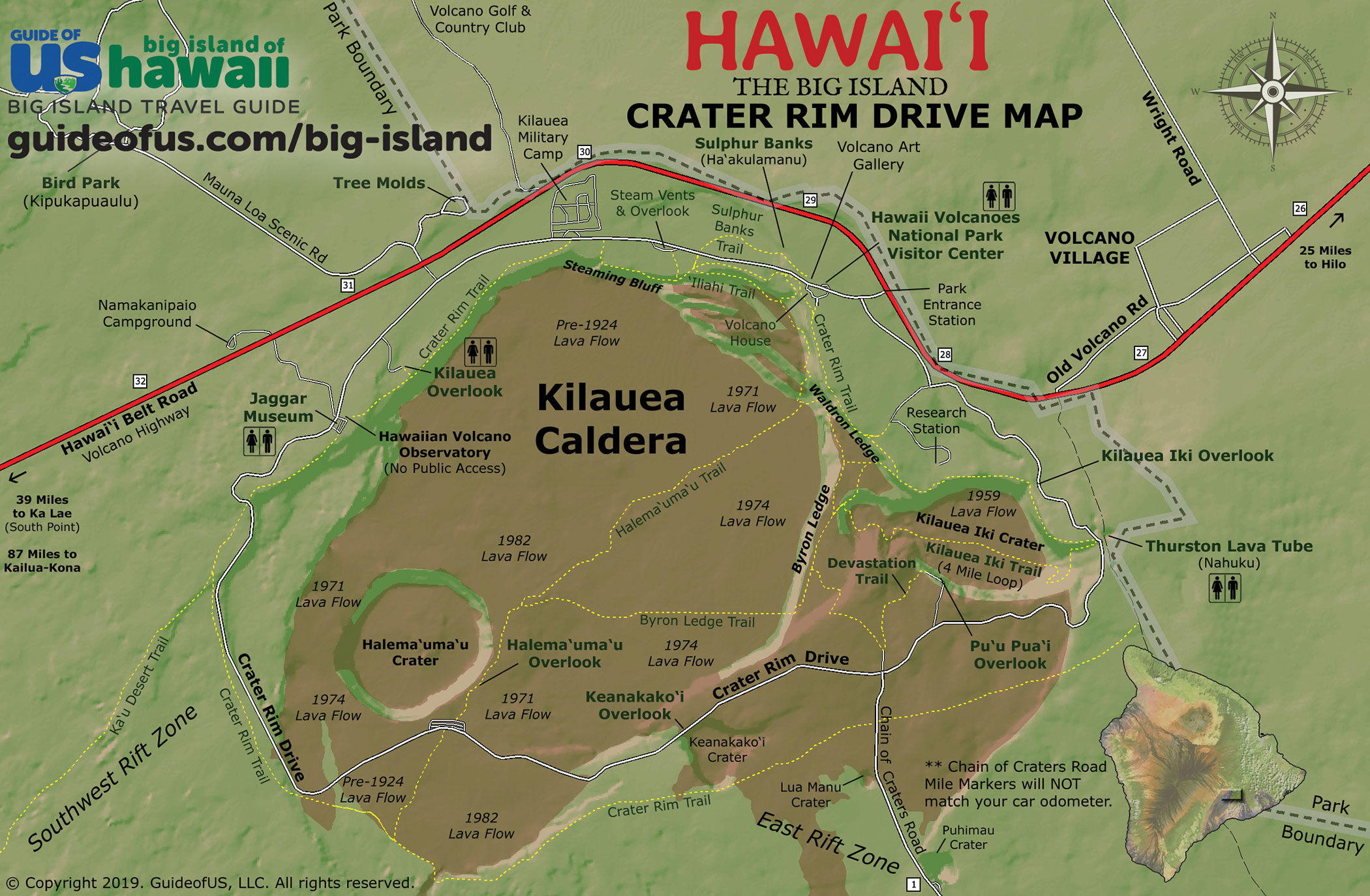
Crater Rim Drive (before the 2008-2018 summit eruption)
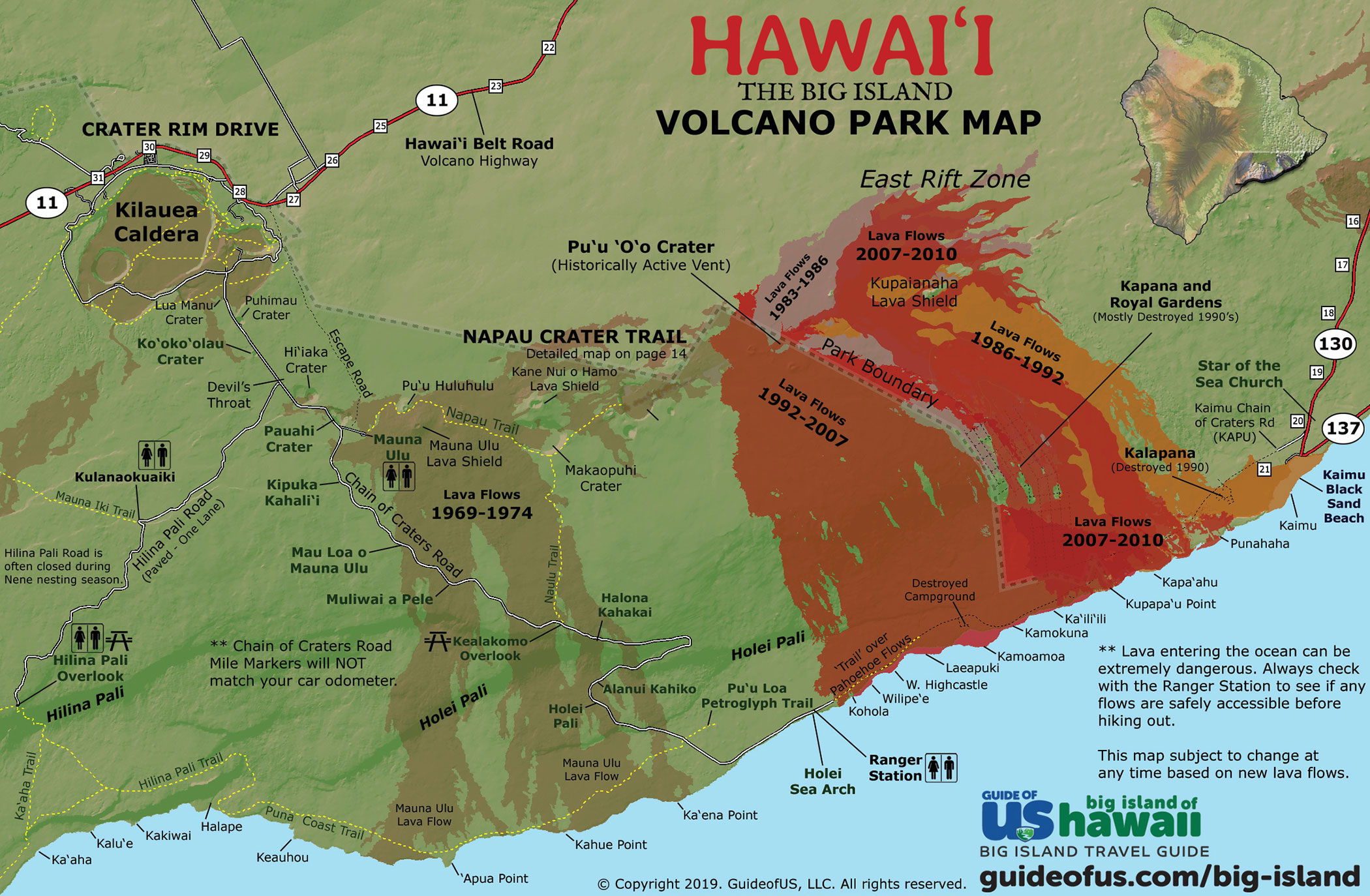
HVNP Overview (showing lava flows through 2010)
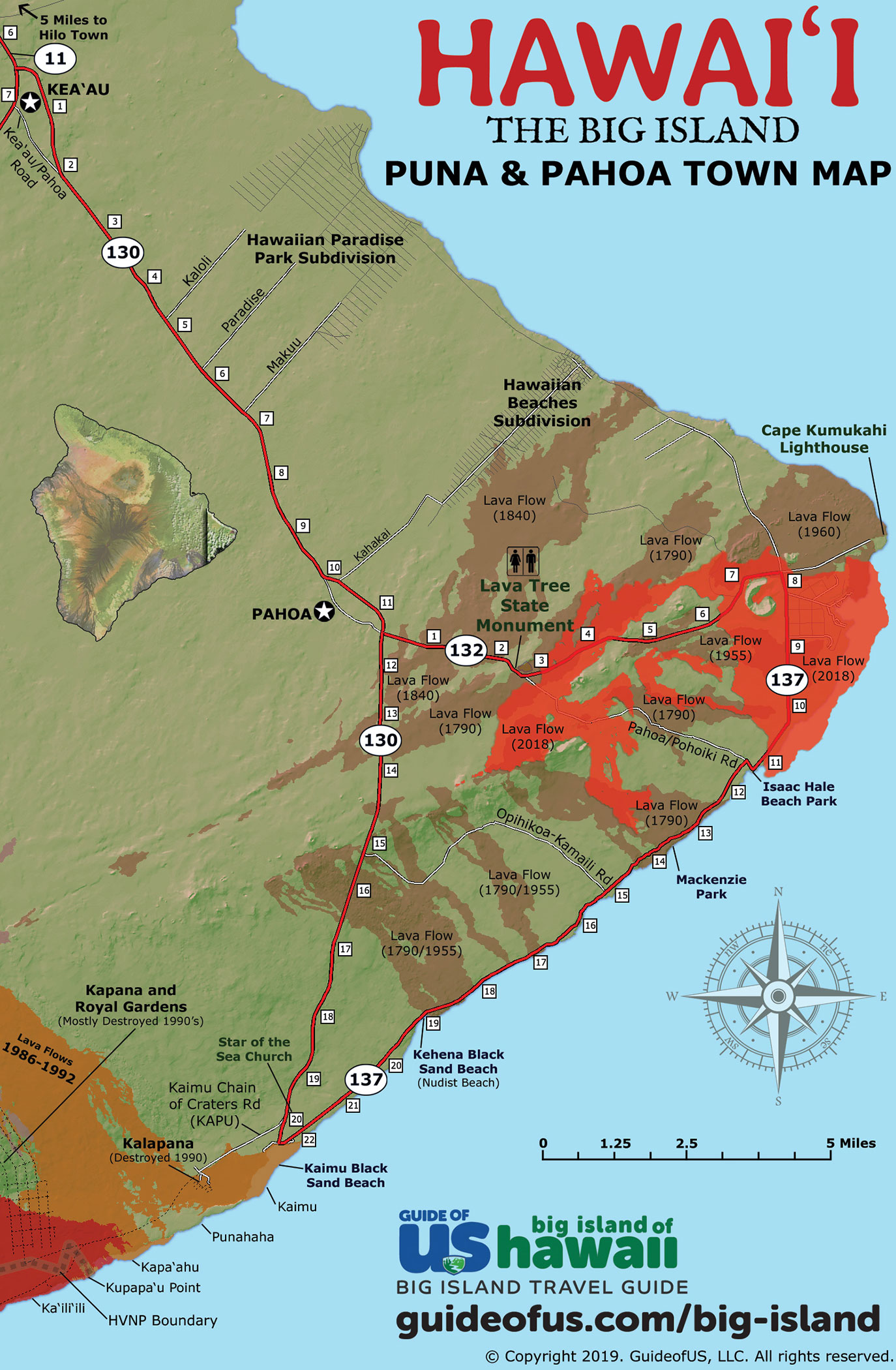
2018 Lava Flow in Puna
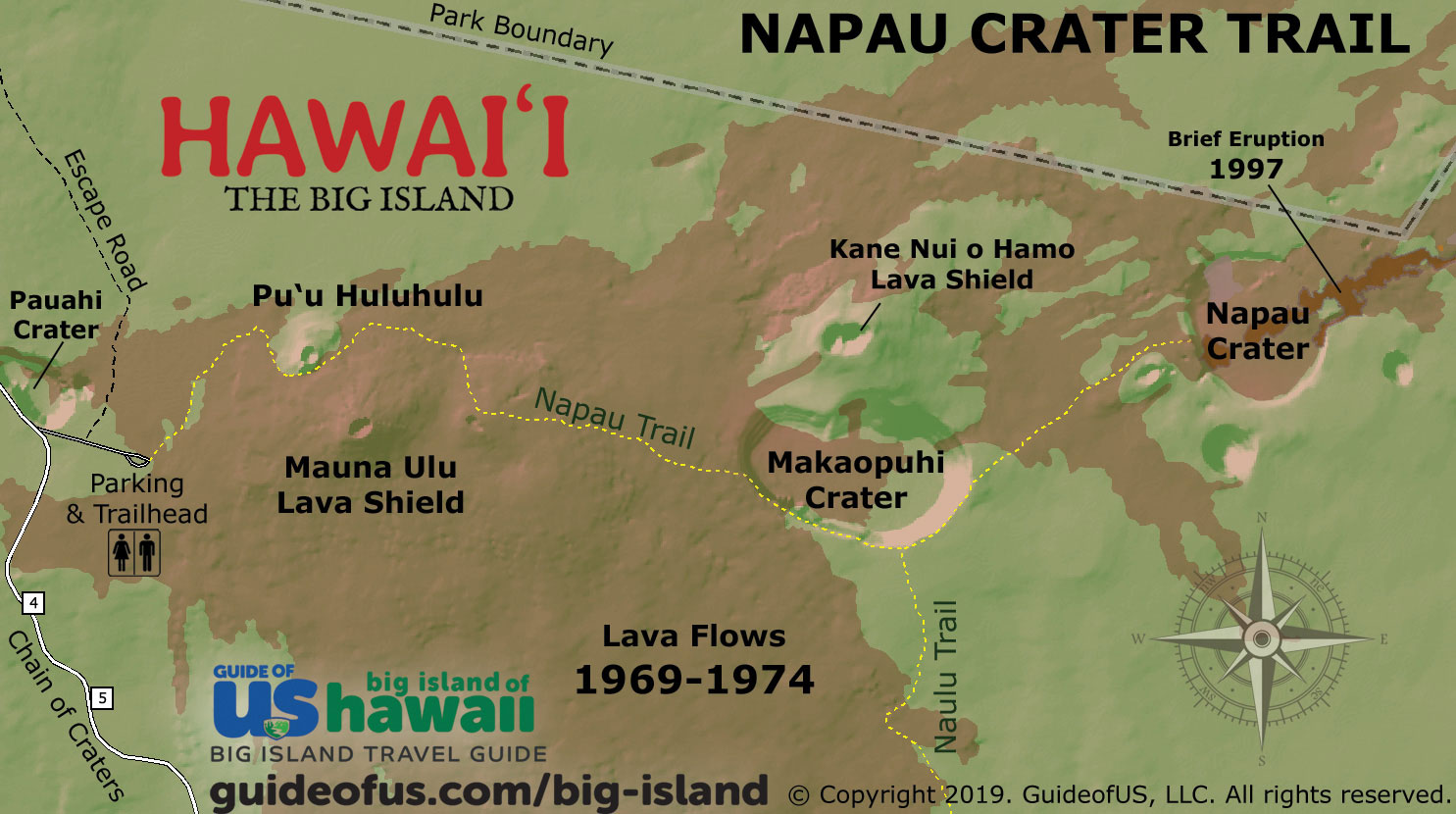
Napau Crater Trail