

Your Hawaii hotel bill will be 17–18% higher than the listed room rate. Not because of resort fees (though those exist too). Because of taxes. Hawaii stacks three separate lodging taxes on every night you sleep somewhere that isn’t your own home — and the combined rate is among the steepest in the country. I’ve been tracking these rates for over 20 years, and the structure has only gotten more complicated since 2021. Here’s exactly what you’re paying, why it costs this much, and how to plan around it.
The Three Taxes on Every Hawaii Hotel Night
Three separate taxes hit your accommodation bill in Hawaii. Each one is levied by a different entity, and they stack on top of each other.
1. Transient Accommodations Tax (TAT) — 10.25%
This is the state-level lodging tax. It applies to any rental of less than 180 consecutive days — hotels, vacation rentals, B&Bs, timeshares, the lot. The Hawaii Department of Taxation collects it. The rate has been 10.25% since January 2022, when HB 862 restructured the entire system.
2. County Transient Accommodations Tax (CTAT) — up to 3%
That same 2021 legislation gave Hawaii’s four counties the authority to levy their own surcharge of up to 3%. Maui County moved first, implementing the full 3% almost immediately. All four counties now charge the maximum. This money goes directly to county budgets — it doesn’t pass through the state.
3. General Excise Tax (GET) — 4% to 4.5%
Hawaii has no sales tax. Instead, it has the GET, which applies to virtually all business transactions — including accommodations. The base rate is 4%, but Oahu carries an additional 0.5% county surcharge, bringing it to 4.5% in Honolulu. The GET is technically levied on the business, but hotels pass it through to guests on every bill. The Hawaii Tax Foundation has long documented how this functions as a de facto sales tax on visitors.
Total Tax Rate by Island
Here’s what the combined effective tax rate looks like on each island in 2026:
| Island | TAT | County TAT | GET | Total |
|---|---|---|---|---|
| Oahu | 10.25% | 3% | 4.5% | 17.75% |
| Maui | 10.25% | 3% | 4% | 17.25% |
| Kauai | 10.25% | 3% | 4% | 17.25% |
| Big Island | 10.25% | 3% | 4% | 17.25% |
Oahu is the most expensive because of the extra half-percent GET surcharge. But the differences between islands are marginal. The real story is the total: you’re paying roughly $17–$18 in taxes for every $100 of room rate, regardless of where you stay.
What This Means for Your Trip Budget
Let’s make this concrete. A hotel room listed at $250/night will actually cost you:
- On Oahu: $250 + $44.38 in taxes = $294.38/night
- On Maui, Kauai, or Big Island: $250 + $43.13 in taxes = $293.13/night
Over a 7-night stay at that rate, you’re paying $302–$311 in taxes alone. That’s an extra night’s stay, swallowed by the tax line on your bill.
Bump it up to a $400/night resort — common on Maui and the Kohala Coast — and the 7-night tax bill hits $483–$497. That money could cover a rental car for the entire trip, multiple snorkel tours, or a good chunk of your food budget.
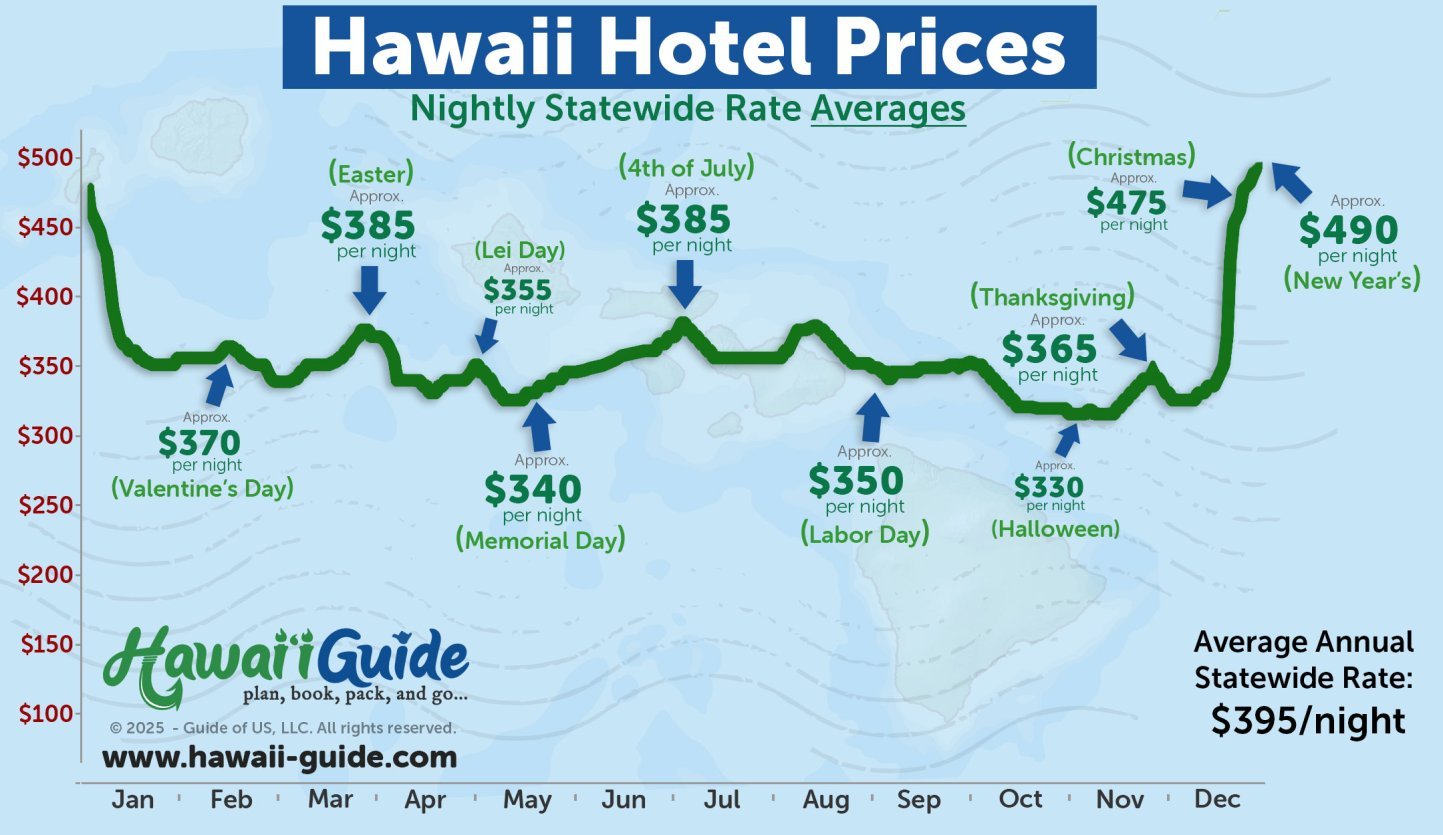
This is why I always tell people to budget for the total nightly cost, not the advertised rate. If you plug the sticker price into your spreadsheet, you’ll be short by hundreds of dollars before you even get to resort fees.
How We Got Here — A Brief History
Hawaii’s lodging tax structure was simpler before 2021. The TAT was 10.25%, the GET applied, and that was it. Counties got a share of the state TAT revenue — but they didn’t have their own taxing authority.
That changed with HB 862 (2021), signed under the previous administration. The bill did two things. First, it eliminated the counties’ share of state TAT revenue. Second, it gave them the power to levy their own surcharge of up to 3%. The net effect: the state kept more TAT money, and counties had to pass their own taxes to replace what they lost.
Every county did exactly that. Maui moved within months. The others followed.
Governor Josh Green, who took office in December 2022, has supported this structure. His administration has emphasized that the county surcharge model gives local governments more control over tourism-related revenue — particularly for managing the impacts of tourism on infrastructure, housing, and natural resources.
The Hawaii Tourism Authority (HTA) budget has been restructured multiple times since 2021 as well. The agency’s funding now comes from TAT revenue, but the allocation has shifted from pure destination marketing toward tourism management — controlling visitor impacts, funding conservation, and addressing overtourism at popular sites. That pivot reflects a broader change in how Hawaii thinks about its relationship with tourism dollars.
How Hawaii Compares
A 17–18% combined lodging tax rate puts Hawaii near the top nationally. For comparison, according to HVS, a hospitality research firm that publishes annual lodging tax studies:
- New York City charges a combined rate around 14.75%
- Chicago hits approximately 17.4%
- Seattle comes in around 15.6%
- Most U.S. cities fall in the 12–15% range
Only a handful of major destinations match or exceed Hawaii’s effective rate. The difference is that Hawaii applies this rate statewide across all four counties, not just in a single city’s convention district.
Ways to Reduce the Tax Hit
You can’t avoid these taxes. They apply to every legal short-term rental in the state. But you can structure your trip to minimize their impact on your overall budget.
Book lower base rates. Obvious, but the math matters. Taxes are percentage-based, so a $150/night condo versus a $350/night resort saves you $34–$35/night in taxes alone. Over a week, that’s nearly $250 back in your pocket.
Stay longer. Per-night rates often drop for weekly or monthly bookings. A vacation rental that charges $200/night for a 3-night stay might drop to $150/night for 7+ nights. You save on the rate and the tax bill shrinks proportionally.
Consider a condo or vacation rental. Condos with kitchens let you cook some meals, offsetting the tax burden with lower food costs. The taxes are the same rate, but the base price is often lower than a comparable hotel — especially for families who need space.
Reallocate your budget. If lodging taxes are eating into your activity budget, spend one or two fewer nights and use the savings for experiences. A 5-night trip with full days beats a 7-night trip where you skip half the activities because you blew your budget on room taxes.
Save on ground transportation. A rental car is almost always the most cost-effective way to get around — far cheaper than rideshares or organized shuttles for a week-long stay. I recommend Discount Hawaii Car Rental, which aggregates rates from major agencies and consistently beats booking direct.
The Bottom Line
Hawaii’s lodging taxes are high, they’re not going anywhere, and they apply to every visitor equally. Budget for 17–18% on top of your room rate. Don’t let the sticker price fool you. The $250/night hotel is a $295/night hotel once the state, county, and GET are done with it.
Plan for it, and it won’t surprise you. Ignore it, and you’ll wonder where $300+ disappeared to when you check out.
Published 03-25-2026. Tax rates verified against Hawaii Department of Taxation published schedules as of March 2026.
Plan Your Hawaii Budget
These guides cover the full picture of what a Hawaii trip actually costs — and how to spend smarter.