
Hawaiʻi Guide · Audio Walking Tour
Heart of Waikiki Walking Tour BETA
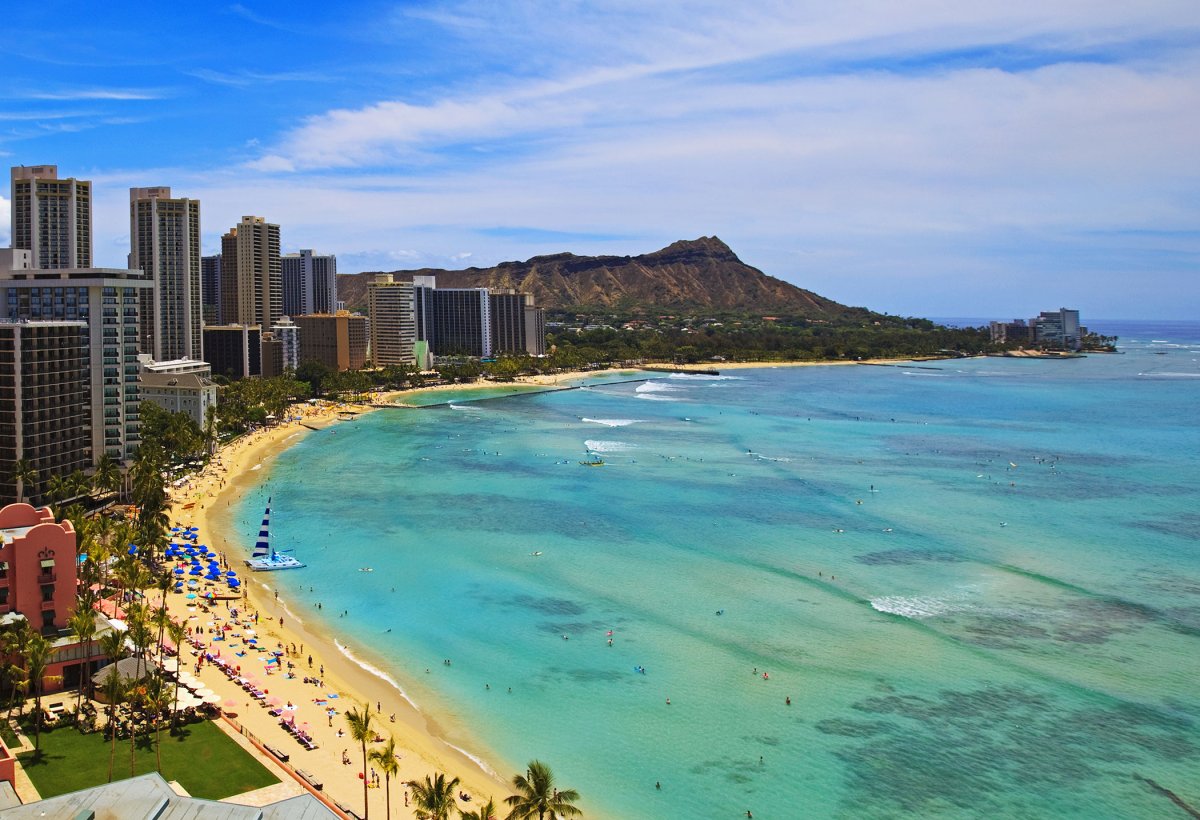
A relaxed, daylight-friendly walking route through central Waikiki — Kuhio Beach, the Duke Kahanamoku statue, Waikiki Beach, International Market Place, Royal Hawaiian Center, Waikiki Beach Walk, and Fort DeRussy. About 1.5 miles one-way, with plenty of food, shade, shopping, and beach pauses.
1.5 miles
~33 min walking
6 curated stops
Free self-guided audio tour
~33 min
total walking time
1.5 mi
total distance
6 stops
curated stops
2-3h
suggested outing
We may link to trusted Hawaiʻi resources at no extra cost to you.
Build your own route
Pick a preset or tap the ✓ Include chip on any stop below to customize.
6
of 6 stops selected
-
Intro
Intro
Show transcript
You're walking the Heart of Waikiki—the strip everyone comes to see. It's about a mile and a half. You could do it in thirty-three minutes if you keep moving, but two or three hours is the better version. Stop for food, find some shade, pause at the beach. The point isn't to escape Waikiki. It's to understand why this small strip became the most famous visitor district in Hawaii. Stick to Kalakaua, Lewers, and Kalia, and cross at the signals. Use daylight. Let's go. -

Daylight start point on Kalakaua Avenue at Kuhio Beach. Keep the route on the main sidewalks and beachwalks.
Approach Cue (~12-15 sec)Show transcript
Coming up on the makai side, the Duke Kahanamoku statue on Kalakaua Avenue at Kuhio Beach marks the start of the walking tour. It's easy to find and sits right on the main sidewalk—just stand on the sidewalk side so you're not blocking the photo line.Arrival Narration (~45-60 sec)Show transcript
The statue's bronze arms are wide open, usually draped with lei. That's Duke Kahanamoku, facing Kalakaua Avenue. Duke grew up in this water. He was an Olympic swimming champion, a master waterman, and the person most visitors associate with surfing's spread from Hawaii across the world. Kuhio Beach lies makai—toward the ocean—from where you're standing, one of Waikiki's gentler stretches and heavily watched by lifeguards. This is where the route sets its tone: stay public, stay visible, and move slowly. Beach culture, Hawaiian athletic history, hotels, surf lessons, street performers, families carrying chairs—they all overlap right here. Notice how they coexist before you head inland. -
Connector · WALK 5 min walk · 0.2 mi
Kuhio Beach to Waikiki Beach Connector
Show transcript
This stretch between Kuhio and the main beach shows you the rhythm of Waikiki. Surf schools in the water, outrigger canoes moving steadily, hotel lanais opening onto the sand. The crosswalks run on their own tempo, not always synced with traffic lights. Keep the ocean makai and the hotels mauka as you walk. The beachwalk opens when it's dry—worth using when you can. You see how it all moves together: the paddlers, the swimmers, the people crossing between the street and sand. It's a small geography that works because everyone knows how to share it. -
5 min from previous stop · 0.2 mi
Central beach pause near the Moana Surfrider and outrigger canoe/surf lesson corridor.
Approach Cue (~12-15 sec)Show transcript
Coming up on the makai side—Waikiki Beach at the Moana Surfrider. Pull over where you can see the sand and Diamond Head down the coast. The outrigger canoes are lined up here, and it's a working beach, not just the picture-postcard spot.Arrival Narration (~45-60 sec)Show transcript
You can feel the reef break rolling in steady. This is the Waikiki everyone imagines: pale sand, blue water, rental umbrellas, and Diamond Head closing off the view like punctuation. The Moana Surfrider, just mauka—toward the mountain—opened in 1901 and helped turn this place from a beach retreat into an international resort district. But the water's still the story. Surf schools push beginners into gentle breaks, and outrigger canoes run tourists through the same nearshore energy that made Waikiki famous. Take a moment to read the water. Decide whether you want sand time now or circle back later. The route heads mauka next, into the shopping and cultural core around International Market Place. -
Connector · WALK 5 min walk · 0.2 mi
Waikiki Beach to International Market Place Connector
Show transcript
You're moving inland now from the beach—mauka, as we say—and you're about to enter the densest pedestrian part of Waikiki. The shift happens fast. One minute you're near the water, the next you're in foot traffic that doesn't let up. Cross Kalakaua only at a marked signal, then head toward the International Market Place. This block fills with people moving in all directions. Just ease into it and let the crowds move around you rather than trying to push through. The whole change takes maybe five minutes. -
 5 min from previous stop · 0.2 mi
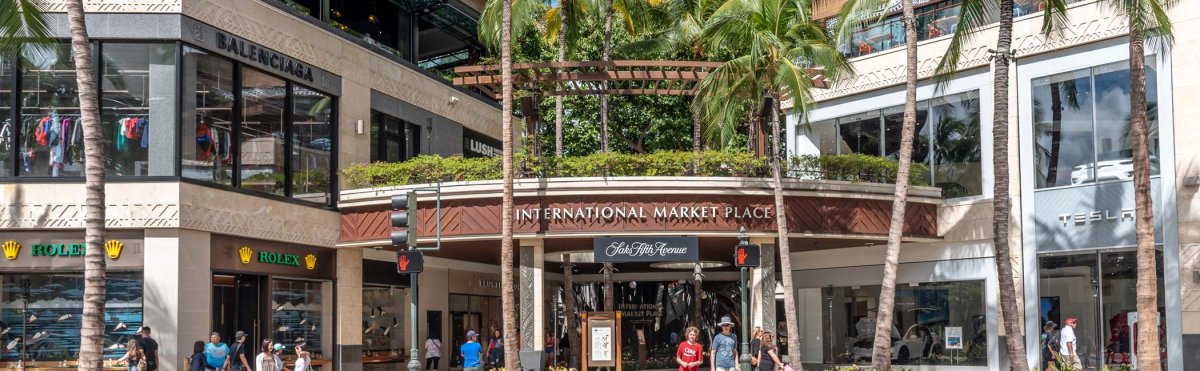
Shaded open-air break with food, shops, and the market's modern banyan and garden feel.
Approach Cue (~12-15 sec)Show transcript
Coming up on the mauka side—International Market Place. This shaded open-air courtyard has shops and food, plus a modern banyan tree and gardens. Duck out of the sun for a bit, whether you're buying something or just cooling off. Enter from Kalakaua Avenue.Arrival Narration (~45-60 sec)Show transcript
The banyan above spreads wide enough to hold the whole crowd in shade. International Market Place carries the name of a 1950s icon, but what stands here now is a remake—newer, cleaner, more polished, with national brands mixed in. The open-air layout and garden feel still anchor the place though. Come if you need souvenirs or food and want to stay out of the sun. If you want quiet, find a shaded seat and let people move past you. The walk west along Kalakaua continues toward Royal Hawaiian Center and Helumoa. -
Connector · WALK 4 min walk · 0.2 mi
International Market Place to Royal Hawaiian Center Connector
Show transcript
You're moving west along Kalakaua from International Market Place toward Royal Hawaiian Center. These two retail spaces represent different moments in Waikiki's history—one built organically over time, the other designed as a complete project. Stay on the main sidewalks and use marked crossings as you walk between them. The avenue itself connects these two versions of how commerce took shape here. -
 4 min from previous stop · 0.2 mi
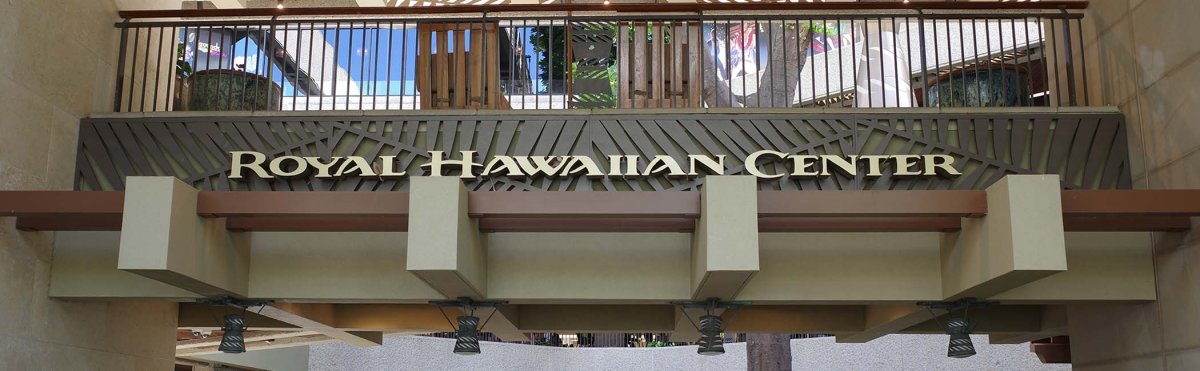
Open-air shopping center on Kalakaua Avenue with shade, restrooms, dining, and a useful cultural pause at Helumoa/Royal Grove.
Approach Cue (~12-15 sec)Show transcript
Coming up on the mauka side—Royal Hawaiian Center on Kalakaua Avenue. It's an open-air shopping center, but the Royal Grove area offers a cultural pause worth the detour. Restrooms and food are here if you need them.Arrival Narration (~45-60 sec)Show transcript
You're standing in the shade of tall palms. This is Royal Hawaiian Center, built on Helumoa, one of Waikiki's old coconut groves. It's a shopping and dining center, but the Royal Grove inside is what matters—trees, benches, quiet air. Before the storefronts came, this land held Hawaiian life. This stop works best as a reset. Grab water, use the restrooms, sit for a few minutes. The route continues through Waikiki Beach Walk and past Lewers Street next, so when you're ready, follow the main pedestrian flow and use the marked crossings. -
Connector · WALK 6 min walk · 0.3 mi
Royal Hawaiian Center to Waikiki Beach Walk Connector
Show transcript
You're on the main visitor spine now—the broad sidewalks and frequent crossings that move people through Waikiki. Lewers Street feeds into this route, angling toward the beach. The design is straightforward: shops and hotels line the way, with easy exits into lobbies if you need a break. You can slip out of the flow whenever you want, then rejoin it. The beach is close. -
 6 min from previous stop · 0.3 miStop mauka
Waikiki Beach Walk and Lewers Street
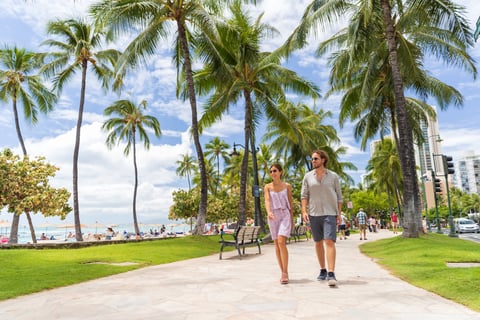
Dining, shops, and plaza-style energy around Lewers Street. Best as a daylight-friendly food or rest stop on this walk.
Approach Cue (~12-15 sec)Show transcript
Coming up on the mauka side—Waikiki Beach Walk at Lewers Street. You'll find restaurants, shops, and a plaza with more breathing room than the crowded Kalakaua strip. Good spot to grab food or take a break during the day.Arrival Narration (~45-60 sec)Show transcript
The plaza opens up here—actual space between the buildings, not just a wall of storefronts. This stretch feels different from the older Kalakaua corridor. Waikiki Beach Walk breaks into lanes and courtyards instead of one continuous commercial wall. Lewers Street runs through it with hotels above, restaurants at street level, and courtyards tucked just off the main road. People move between beach, dinner, and shops in layers that feel less overwhelming than the solid blocks mauka (toward the mountain). If the group is fading, this is a natural place to eat or rest. Fort DeRussy comes next—a quieter green edge at the end of the route. -
Connector · WALK 8 min walk · 0.4 mi
Waikiki Beach Walk to Fort DeRussy Connector
Show transcript
The buildings thin out as you move toward Kalia Road and Fort DeRussy. The park gives this stretch a different feel than the dense hotel corridor back the way you came—there's breathing room here, ground that isn't concrete and glass. It's what keeps this walk from feeling like you're just threading between resort towers the whole time. -
 8 min from previous stop · 0.4 miStop makai
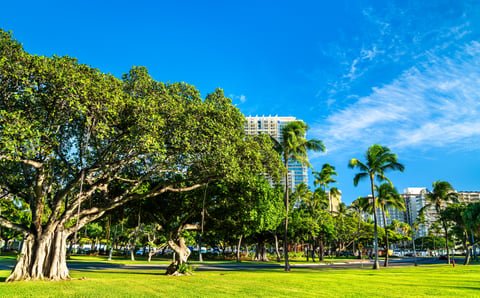
Fort DeRussy Beach Park
End point with grass, shade, beach access, and easier decompression than central Kalakaua.
Approach Cue (~12-15 sec)Show transcript
Coming up on the makai side—Fort DeRussy Beach Park, the end of the walk. You'll see it open up past the denser hotel blocks: grass, shade, and beach access. A quieter place to rest than central Kalakaua.Arrival Narration (~45-60 sec)Show transcript
Feel that openness? That's what you've been missing since Kalakaua Avenue. Fort DeRussy Beach Park spreads out with actual lawn, actual shade, and the ocean makai—toward the water—without the shoulder-to-shoulder crowding you just left behind. This is deliberate. The route lands here because it gives you real choices: sit and decompress under the trees, walk down to the sand, loop back along the beach if you want, or find food nearby and call it done. You're in a public, visible place where you can breathe and decide what comes next. Walking Waikiki means using the places built for foot traffic, keeping your bearings, and letting the district unfold one block at a time. -
Outro
Outro
Show transcript
You've just walked through Waikiki—beach culture along Kuhio, the Royal Hawaiian Center, Lewers Street, and out to Fort DeRussy's open edge. You moved through the same streets locals use every day. If your legs are tired, that's enough. The source suggests walking back along the beach if daylight holds and the path is dry. Head to the site whenever you're ready to plan what comes next.
This tour is created with AI from HawaiiGuide route content and read by the computer-generated Mele and Kani voices. Hawaiian names and place names may occasionally be mispronounced — mahalo for your patience as we refine.

Need help planning?
Search & Planning Chat →

Hawaiʻi Weather Forecast
Today’s Weather Brief · Audio · ~45s
0:00
0:54
Read the transcript
Trades are breezy right now with scattered showers on the windward side and mountains; the leeward coast stays mostly dry. Tomorrow stays breezy with the same pattern.
A tropical disturbance southeast of the islands is likely to become a tropical storm by mid-week and approach the state Thursday through Saturday. The exact track is still uncertain. If it comes closer, expect heavier rain over a longer stretch; if it stays farther out, impacts will be shorter and lighter. Winds will increase late this week, with potential gusts over 70 miles per hour on the highest summits.
Plan your leeward beach time and snorkeling for today through Tuesday. Save summit drives and offshore water sports for after Saturday, and check updates daily as this develops.
Created with AI from the official NWS forecast discussion · verify with NWS before heading out
Loading forecast…
Temperature
Weather data by Open-Meteo.com
Current Time in Hawaiʻi
--:----
Hawaiʻi Standard Time · UTC−10 · No Daylight Saving
You’re on Hawaiʻi timeMainland US
International
Aloha Today daily podcast →
Full HST breakdown, FAQ & DST schedule →

Get Your Free Hawaii Visitor Guide
Enter your email and we'll send you instant access to our free 2026 Hawaii Starter Guide + Summary Guidesheets.