
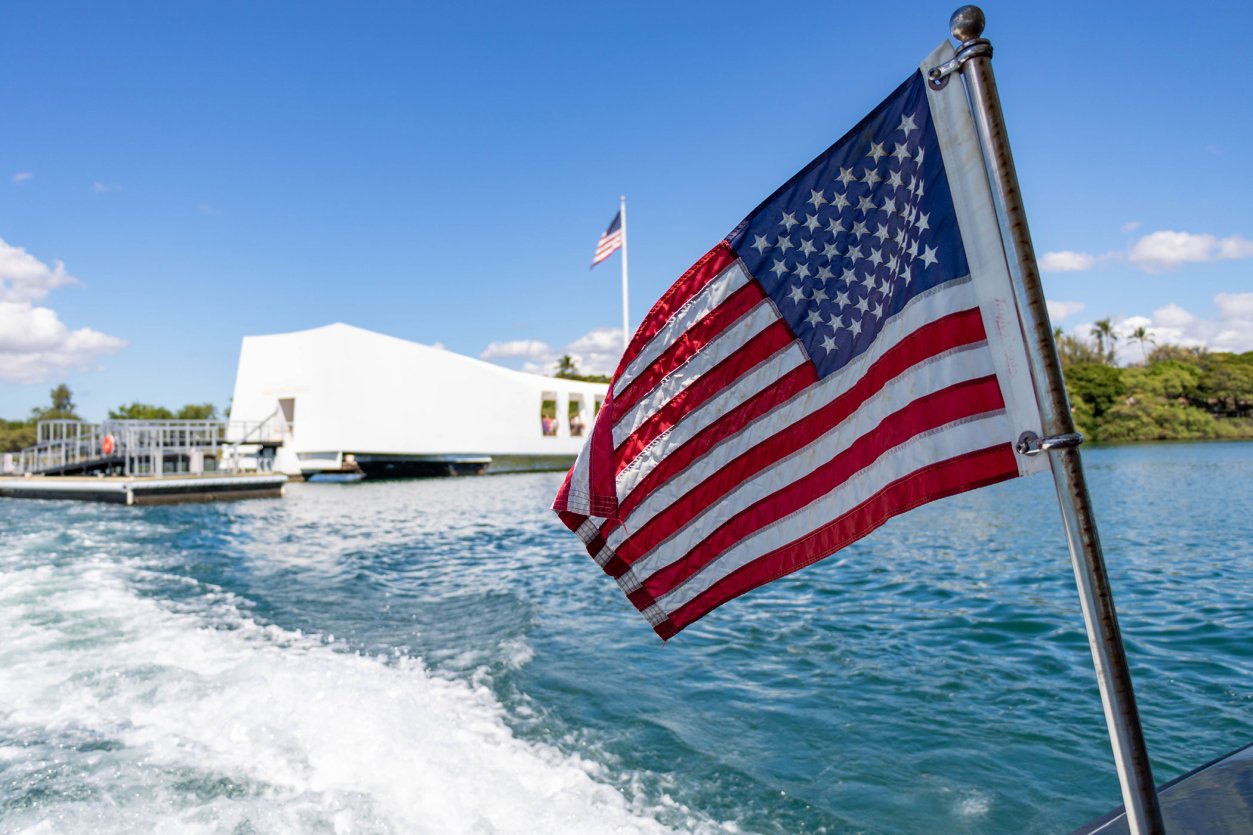
Hawaiʻi Guide · Audio Walking Tour
Pearl Harbor Walking Tour BETA
A respectful, daylight-friendly walking circuit of the four historic sites at Pearl Harbor — the NPS Visitor Center and USS Arizona Memorial (free), the Pacific Fleet Submarine Museum and USS Bowfin (paid), and on Ford Island via the free NPS shuttle, the USS Oklahoma Memorial, the Battleship Missouri (paid), and the Pearl Harbor Aviation Museum (paid). Plan four to five hours for a comprehensive visit. ~7 curated stops.
2.5 miles
~4h walking
7 curated stops
Free self-guided audio tour
~4h
total walking time
2.5 mi
total distance
7 stops
curated stops
4-5h
suggested outing
We may link to trusted Hawaiʻi resources at no extra cost to you.
Build your own route
Pick a preset or tap the ✓ Include chip on any stop below to customize.
7
of 7 stops selected
-
Intro
Intro
Show transcript
Pearl Harbor sits about ten miles west of Waikiki on Oahu's south shore. Four independent organizations run the visitor complex — the National Park Service handles the Visitor Center and the USS Arizona Memorial; the Pacific Fleet Submarine Museum operates the USS Bowfin (renamed in 2021, so older guidebooks may say "Bowfin Submarine Museum" — that's the same place); the USS Missouri Memorial Association runs the Battleship Missouri on Ford Island; and the Pearl Harbor Aviation Museum, also on Ford Island, is its own nonprofit. NPS-run stops are free. The other three are paid. Plan four to five hours minimum for a comprehensive visit. Three things to know before we go. The USS Arizona Memorial boat program is free but uses a timed-ticket system on recreation.gov — bookings open eight weeks in advance at 3 PM Hawaii time, with an extra batch released the day before at the same time. There's a one-dollar service fee. Walk-in standby exists but isn't reliable in peak season. Next — bags larger than a 1.5-by-2.25-by-5.5-inch footprint are not allowed on the grounds. That's most purses, backpacks, and diaper bags. Bag storage is at the entrance — seven dollars per bag, ten if it's oversized. Build twenty minutes into your arrival for this. And third — Ford Island is active military. You can't drive there. The free NPS shuttle leaves every fifteen minutes starting at 8 AM, and that's the only way to reach the Missouri and the Aviation Museum. Let's go. -
 ARTYOORAN / Shutterstock.com
Stop makai
ARTYOORAN / Shutterstock.com
Stop makaiPearl Harbor Visitor Center
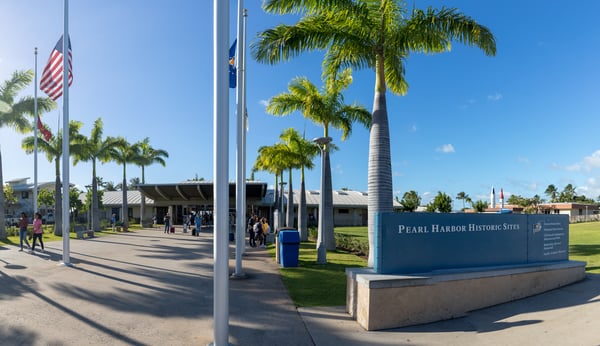
Pearl Harbor Visitor Center at 1 Arizona Memorial Place, Honolulu, HI 96818. Phone (808) 422-3399. Operated by NPS. Open daily 7 AM – 5 PM, free admission. Parking $7/day via mobile app or onsite kiosk. Bag storage to the right at the entrance: $7 standard, $10 oversized. Bags > 1.5"×2.25"×5.5" not allowed. Inside: bookstore, Road to War + Attack exhibits, Remembrance Circle. Source: nps.gov/perl
Approach Cue (~12-15 sec)Show transcript
Coming up on the Pearl Harbor Visitor Center. Parking is in the main visitor lot — seven dollars for the day via mobile app or onsite kiosk. Walk to the entrance plaza. Bag check is the first thing you'll do; it's to the right as you walk in. Seven dollars per standard bag, ten for oversized. Plan twenty minutes for this step during peak hours.Arrival Narration (~45-60 sec)Show transcript
You're at the entrance plaza of Pearl Harbor National Memorial. Twenty-one acres, run by the National Park Service. The site separated from the larger World War II Valor in the Pacific National Monument in March 2019 and now operates as its own national memorial. The plaza is the spine of the complex. The bookstore and main exhibits are straight ahead; the Remembrance Circle — the contemplation area with the names of those killed — is to your right; the Arizona Memorial boat dock is to the left at the far end. The Pacific Fleet Submarine Museum is the next cluster east. The Ford Island shuttle stop for the Missouri and Aviation Museum is also out that way. Pick up your reserved Arizona Memorial ticket at the will-call window — that's the timed boat slot you booked on recreation.gov. Show up fifteen minutes before your assigned time. One more thing before we walk on. The harbor in front of you was known as Wai Momi, "pearl water," and Puʻuloa, "long hill," in pre-contact Hawaiian. More than twenty fishponds lined these shores. The oyster beds here were unique in the islands. By 1908 — when the US Navy officially established the base — the oyster beds were nearly extinct from European pearl harvesting and the fishponds had been converted to other uses. The history that brought you here is layered. -
Connector · WALK
Connector Plaza To Galleries
Show transcript
The two NPS galleries — Road to War and Attack — are inside the visitor center building you're already standing in front of. Walk through the entrance and they flank the central lobby, one on each side. No driving here — fifteen seconds of walking from where you are now. Self-guided, no timed entry. Plan thirty to forty-five minutes for both. -
0 min from previous stop · 0.0 miStop makai
NPS Exhibit Galleries
Pearl Harbor NPS exhibits: "Road to War" and "Attack." Two galleries inside the visitor center building. Self-guided, free with visitor center entry. Road to War covers the 1930s lead-up; Attack covers the December 7, 1941 sequence. Photography permitted. Plan 30-45 minutes total. Source: nps.gov/perl/learn/historyculture/index.htm
Approach Cue (~12-15 sec)Show transcript
The two galleries are inside the main building on either side of the central lobby. Both are self-guided, free with visitor center entry, and photography is allowed.Arrival Narration (~45-60 sec)Show transcript
Road to War walks through the 1930s — Japan's expansion into Manchuria, the embargoes, the diplomatic breakdown that brought the United States and Japan to the morning of December 7, 1941. The Attack gallery covers the attack itself. That morning's timeline: at 7:48 AM Hawaii time, the first wave began their run. At 7:55, the first dive bomber appeared over the harbor and the coordinated attack began. At 8:10, a bomb penetrated the forward magazine of the USS Arizona, and the ship exploded. At 8:54, the second wave — about 170 planes — began. By 10 AM, the Japanese planes had headed back to their carriers. Across both waves, 353 Japanese aircraft attacked from six carriers. American casualties: 2,403 killed, 1,178 wounded. One hundred eighty-plus US aircraft destroyed. Eighteen ships sunk or run aground. The Japanese lost 29 aircraft, five midget submarines, and 129 personnel. The next day, December 8, FDR delivered the "Infamy Speech" to Congress, asking for a declaration of war. The galleries are dense — allow thirty to forty-five minutes. The artifacts include personal effects recovered from the harbor, oral histories from survivors and witnesses, and a wall of period photographs you'll want to look at slowly. -
Connector · WALK 2 min walk · 1.1 mi
Connector Galleries To Arizona
Show transcript
At your assigned boat time, head to the boat dock at the far left end of the plaza. The boat ride is about eight minutes each way. The full program runs forty-five minutes. Show up fifteen minutes before your slot. -
 2 min from previous stop · 1.1 miStop makai
USS Arizona Memorial
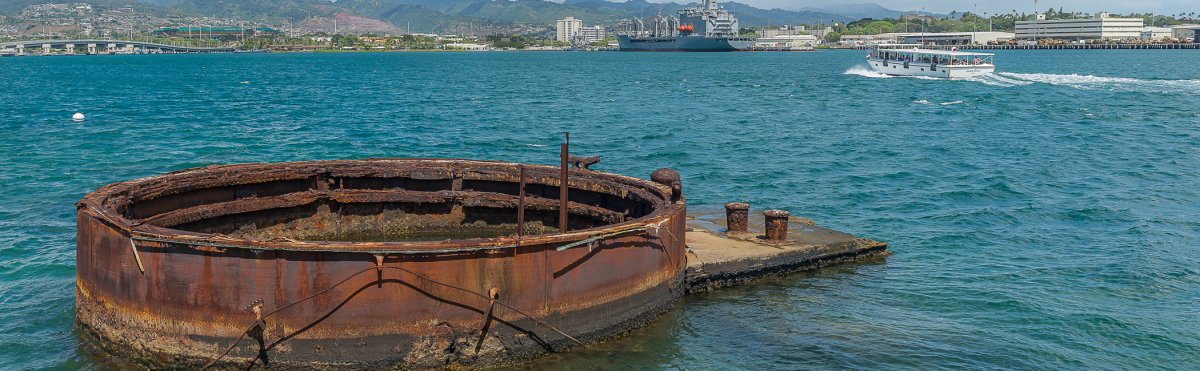
USS Arizona Memorial — operated by NPS. Reached via free boat shuttle from visitor center; reservations via recreation.gov (facility 233338), $1 service fee, 8-week advance window plus day-prior batch (3 PM HST release). Memorial dedicated May 30, 1962. Architect Alfred Preis, Austrian-born Hawaii resident. 184 feet long, sags in the center between two peaks. Built over the sunken wreck of USS Arizona (BB-39). 1,177 sailors and Marines killed in the attack. 1,102 still entombed in the wreck. Designated active war grave. Ship still leaks 7-9 quarts of oil per day ("Black Tears"). Survivor interment program 1982-2019: 44 USS Arizona survivors interred inside gun turret No. 4. Lauren Bruner (Dec 2019) was the 44th and last. Lou Conter, the final living survivor, died April 2024 at age 102. Source: nps.gov/perl, en.wikipedia.org/wiki/USS_Arizona_Memorial
Approach Cue (~12-15 sec)Show transcript
The boat trip is about eight minutes. You're crossing toward the white memorial structure — it sits directly over the sunken wreck of USS Arizona. Once you're there, you have fifteen to twenty minutes before the boat returns to pick you up. Photography is allowed except in the Shrine Room at the far end. Hats off inside. Speak quietly. This is an active war grave.Arrival Narration (~45-60 sec)Show transcript
You're standing on the USS Arizona Memorial. The white structure was dedicated May 30, 1962, designed by Alfred Preis — an Austrian-born architect who immigrated to Hawaii in 1939 and was himself briefly interned as an enemy alien after the attack. The design is 184 feet long and intentionally sags in the center. Preis explained the shape as "the initial defeat and ultimate victory" — high at the beginning and the end of the war, lower in the middle. Below you, in the water, is the wreck of USS Arizona. 1,177 sailors and Marines were killed when the ship exploded at 8:10 AM on December 7, 1941. 1,102 of them are still entombed in the hull beneath your feet. The ship carried 1.5 million gallons of fuel oil on December 6. About 500,000 gallons remained in the hull after the attack. The wreck still leaks seven to nine quarts of oil per day — the "Black Tears." NPS does not stop the leak because the wreck is an active war grave; disturbing it is off-limits. At the far end of the memorial, in the Shrine Room, is a marble wall with the names of all 1,177 who were killed. To the right of the names wall is a smaller plaque listing the 44 USS Arizona survivors who chose to be interred with their shipmates after their deaths — from 1982 through Lauren Bruner in December 2019, the last interment. Lou Conter, the final living survivor, died April 1, 2024, at age 102. The interment program is now closed. No survivor will follow. -
Connector · WALK 2 min walk · 1.2 mi
Connector Arizona To Submarine Museum
Show transcript
The boat returns to the visitor center dock. Walk east — back through the plaza, past the bookstore, about a hundred and fifty yards. Tickets are at the entrance. No advance reservation needed. -
 2 min from previous stop · 1.2 miStop makai
Pacific Fleet Submarine Museum
Pacific Fleet Submarine Museum at 11 Arizona Memorial Drive, Honolulu, HI 96818. Phone (808) 423-1341. Open daily 7 AM – 5 PM, last admission 4:30 PM. Closed New Year's Day, Thanksgiving, Christmas. Admission: Adult $25.99 / Child (4-12) $14.99 / Military & Kamaʻāina Adult $18.99 / Child $9.99 / Active-duty in uniform FREE. Children under 4 cannot board the sub (safety). Includes sub deck + interior, three museum galleries, outdoor exhibits, complimentary audio guides in 7 languages. Operated by Pacific Fleet Submarine Memorial Association (PFSMA). Renamed in 2021 from "USS Bowfin Submarine Museum & Park" after extensive renovations. Source: bowfin.org
Approach Cue (~12-15 sec)Show transcript
Coming up on the Pacific Fleet Submarine Museum. The site used to be called "USS Bowfin Submarine Museum and Park" — the sub is still USS Bowfin, but the museum complex was renamed and expanded in 2021. Tickets at the entrance, no reservations needed. Adult $25.99, child $14.99. Active military in uniform are free. Kids under four can't board the sub.Arrival Narration (~45-60 sec)Show transcript
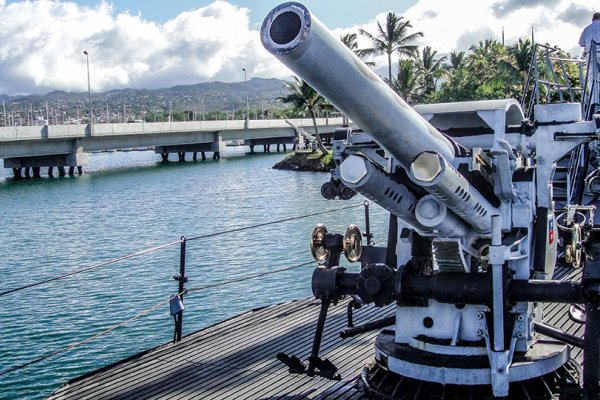
USS Bowfin is a WWII Balao-class fleet submarine, launched on December 7, 1942 — one year to the day after the Pearl Harbor attack — which earned her the nickname the "Pearl Harbor Avenger." Commissioned the following May, she made nine war patrols in the Pacific. The complex now has three indoor galleries covering submarine warfare from the Civil War forward, an outdoor weapons display with torpedoes and deck guns and periscopes you can actually look through, and the sub itself — both the topside deck and the interior. The interior tour is the one most visitors come for. It's narrow, has steep ladders between compartments, and is close-quartered. This is the actual living space where seventy-five men lived for sixty-day patrols. Complimentary audio guides in seven languages are included. Plan about an hour for a full visit; longer if you have a personal interest in submarine engineering or naval history. -
Connector · WALK 4 min walk · 1.9 mi
Connector Bowfin To Ford Island Shuttle
Show transcript
From the Pacific Fleet Submarine Museum, walk back to the visitor center plaza. The Ford Island shuttle stop is marked. NPS-run, free, departs every fifteen minutes from 8 AM. Last return from the museums is around 5 PM. Three- to four-minute ride across the bridge. Show your Missouri or Aviation Museum ticket when boarding. -
 Page Light Studios / Shutterstock.com
4 min from previous stop · 1.9 miStop makai
Page Light Studios / Shutterstock.com
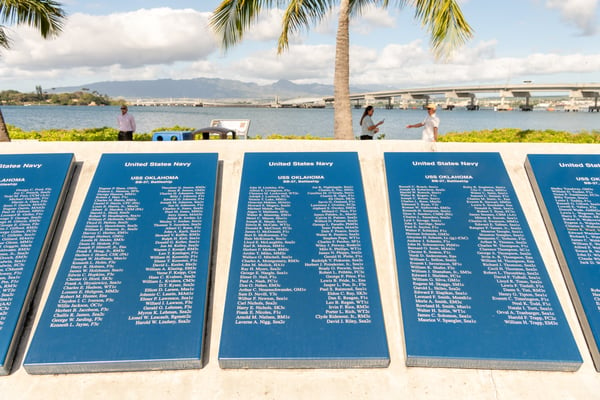
4 min from previous stop · 1.9 miStop makaiUSS Oklahoma Memorial
USS Oklahoma Memorial — Ford Island, just outside the Battleship Missouri entrance. Dedicated December 7, 2007 (66th anniversary of the attack). Black granite walls with white marble posts inscribed with the names of the 429 sailors and Marines killed when the USS Oklahoma (BB-37) capsized within minutes of the attack — second-largest casualty count of December 7. 9 of 12 launched torpedoes struck the hull. Often overshadowed by the Arizona Memorial but historically and emotionally significant. Access included with Battleship Missouri ticket; on the walking path between the shuttle stop and the Missouri. Source: nps.gov/places/uss-oklahoma-memorial.htm
Approach Cue (~12-15 sec)Show transcript
Stepping off the shuttle on Ford Island. The USS Oklahoma Memorial is on the walking path between the shuttle stop and the Battleship Missouri entrance. Brief stop — five to ten minutes. Open-air, included with your Missouri ticket. Most visitors walk past it. Don't be most visitors.Arrival Narration (~45-60 sec)Show transcript
You're at the USS Oklahoma Memorial. Dedicated December 7, 2007, on the sixty-sixth anniversary of the attack. The black granite walls list the names of the 429 sailors and Marines killed when the USS Oklahoma capsized within minutes of the attack — the second-largest casualty count of December 7, after the Arizona. Nine of twelve launched torpedoes struck the hull. The ship rolled over so quickly that most of the dead were trapped below deck; rescue teams worked through the next several days to cut into the hull from below and free survivors. The standing white marble posts represent the ranks of sailors. The Oklahoma is often overshadowed by the Arizona Memorial — Arizona's 1,177 dead and her status as an active war grave dominate the public memory of December 7. But the Oklahoma's story is its own. Of the 429 killed, only 35 were identified in the years immediately after the attack. In recent years, the Defense POW/MIA Accounting Agency has disinterred and identified additional remains using modern DNA techniques. Hundreds of families finally have an answer after eighty-plus years. -
Connector · WALK 1 min walk · 0.5 mi
Connector Oklahoma To Missouri
Show transcript
Continue down the walking path. The Battleship Missouri entrance is about two hundred yards ahead. Tickets at the entrance — adult $39.99, child $19.99 (web-store discount: $37.99 and $18.99). A free guided tour is included with general admission, usually every thirty minutes. Two premium upgrades available — Chief Engineer's Tour and Captain's Tour, $32 each, ages ten and up. -
 1 min from previous stop · 0.5 miStop makai
Battleship Missouri Memorial
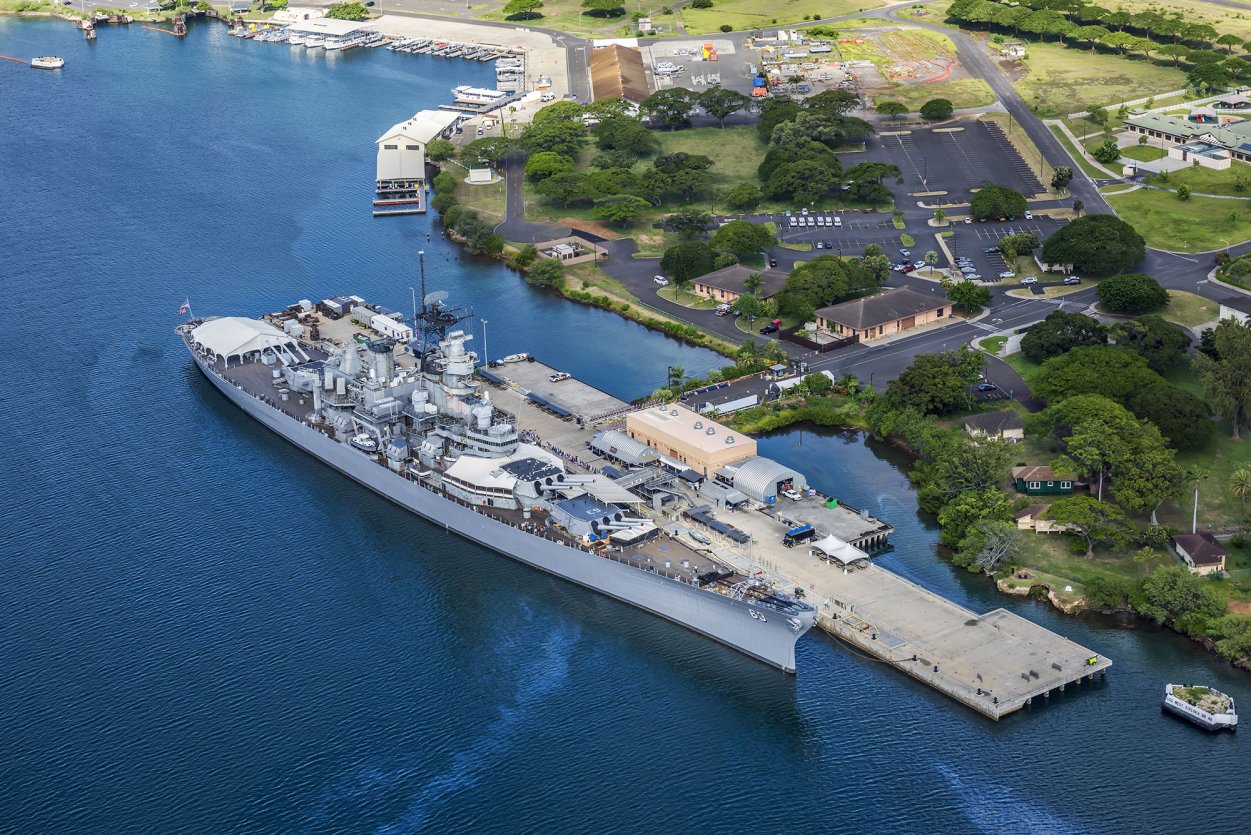
Battleship Missouri Memorial — Ford Island. Operated by USS Missouri Memorial Association. Hours 8 AM – 4 PM daily. Closed Thanksgiving, Christmas, New Year's Day. Admission: Adult $39.99 / Child (4-12) $19.99 (web-store: $37.99 / $18.99). Includes free guided tour with general admission. Premium upgrades $32 each (ages 10+): Chief Engineer's Tour (60 min, engine rooms), Captain's Tour (45 min, command spaces + gun turrets). Launched 1944. Served WWII Pacific, Korea, Gulf War (1991). Japanese Instrument of Surrender signed on her deck Sept 2, 1945, in Tokyo Bay. Commemorative plaque marks the exact signing location. Now moored in clear sight of USS Arizona Memorial — "bookend" symbolism of WWII for the United States. Source: ussmissouri.org
Approach Cue (~12-15 sec)Show transcript
Coming up on the Battleship Missouri entrance. Tickets at the gate. Adult $39.99, child $19.99 — a buck or two cheaper if you bought online beforehand. General admission includes a free guided tour that leaves every thirty minutes. Two premium upgrades — the Chief Engineer's Tour through the engine rooms and the Captain's Tour through the command spaces and gun turrets. Both $32, ages ten and up.Arrival Narration (~45-60 sec)Show transcript
You're standing in front of USS Missouri, the "Mighty Mo." She's an Iowa-class battleship, launched in 1944 at the New York Naval Shipyard in Brooklyn. She served in the Pacific in WWII, then Korea, then the 1991 Gulf War — three wars across nearly five decades of service. The moment that defines her happened on her deck on September 2, 1945, in Tokyo Bay. The Japanese Instrument of Surrender — the document that formally ended World War II — was signed on a table on the Missouri's veranda deck. The ceremony began just after 9 AM local time, took effect at 9:25 AM, lasted twenty-three minutes total, and was broadcast worldwide. Foreign Minister Mamoru Shigemitsu signed first for Japan, then General Yoshijiro Umezu. General Douglas MacArthur signed for the Allies, followed by representatives from the United States, China, the United Kingdom, the Soviet Union, Australia, Canada, France, the Netherlands, and New Zealand. A commemorative plaque marks the exact signing spot today — your guided tour will take you there. Look across the harbor from the Missouri's deck and you'll see the white Arizona Memorial. The Missouri is intentionally moored where she can see it. The symbolism is the editorial spine of Pearl Harbor — the Arizona marks the day the United States entered the war; the Missouri marks the day it ended. Plan an hour to ninety minutes for the general visit; add forty-five to sixty minutes if you upgrade to either premium tour. -
Connector · WALK
Connector Missouri To Aviation
Show transcript
The Pearl Harbor Aviation Museum is a short walk from the Missouri — about a five-minute walk down Lexington Boulevard to 319. Same Ford Island side, no shuttle wait. Last shuttle back to the visitor center leaves at 5 PM. Plan to arrive at the museum no later than 4 PM if you want a full visit. -
 0 min from previous stop · 0.4 miStop makai
Pearl Harbor Aviation Museum
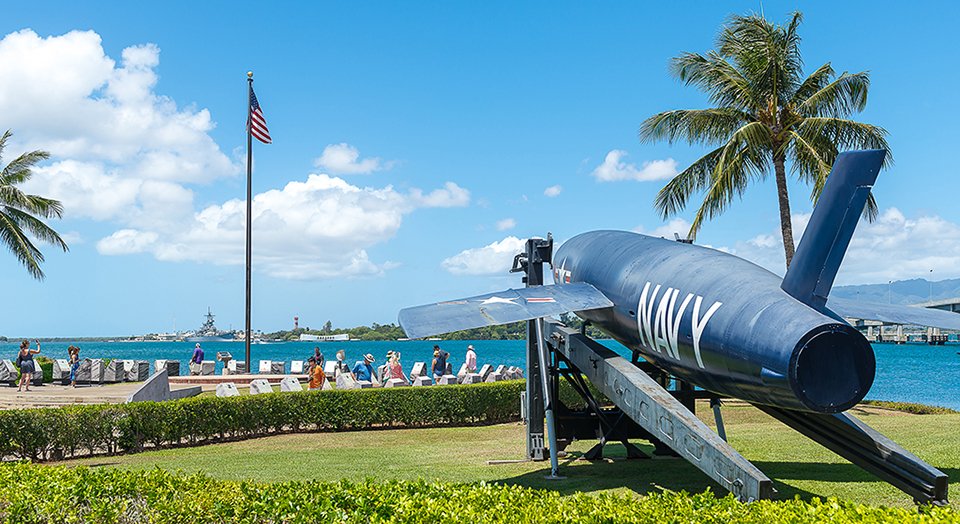
Pearl Harbor Aviation Museum at 319 Lexington Boulevard, Historic Ford Island, Honolulu, HI 96818. Phone (808) 441-1000. Hours 9 AM – 5 PM daily. Admission: Adult $29.99 / Child (4-12) $17.99 / Under 3 FREE / Kamaʻāina & Military Adult $20.99 / Child $10.99 (onsite only, valid ID required). General includes Hangar 37, Hangar 79, outdoor exhibits, Rooftop Terrace. Upgrades: Tower View Experience $10 (10 am-4 pm, first-come), Guided Tower Tour $20 (9:30, 1:30, 2:30, 4:00), Fighter Ace 360° Flight Simulator $10.99 shared / $21.99 solo. Hangar 37 — WWII-era seaplane hangar. Hangar 79 — pre-war hangar, still has bullet scars from the December 7 attack. Ford Island Control Tower — under construction during the attack, completed 1942. Source: pearlharboraviationmuseum.org
Approach Cue (~12-15 sec)Show transcript
Coming up on the Pearl Harbor Aviation Museum. Tickets at the entrance. Adult $29.99, child $17.99. Military and kamaʻāina with valid ID get adult $20.99 / child $10.99. General admission includes both hangars, the outdoor exhibits, and the Rooftop Terrace. Two upgrade options — the Tower View Experience at $10 for self-guided access to the Ford Island Control Tower observation deck, or the Guided Tower Tour at $20 with a docent at fixed times.Arrival Narration (~45-60 sec)Show transcript
The Aviation Museum sits inside two of the original Naval Air Station hangars. Hangar 37, a WWII-era seaplane hangar, now houses the museum's main galleries — restored aircraft (including a Stearman N2S trainer once piloted by President George H. W. Bush as a young naval aviator), the Pearl Harbor combat film, and a walk-through of the early years of US naval aviation. Hangar 79 is the more arresting space. It survived the attack, and the glass-panel doors still show the bullet impacts from the strafing runs that morning. The hangar is preserved with the bullet holes intact — behind protective coverings now, but you can still see them. The aircraft inside Hangar 79 include later twentieth-century jet fighters, helicopters from Korea and Vietnam, and a B-25 Mitchell bomber displayed in a flight pose. The Ford Island Control Tower — visible from anywhere on the museum grounds — was still under construction during the attack and was completed in 1942. That famous phrase "Tora! Tora! Tora!" was strike leader Mitsuo Fuchida's coded radio signal back to the Japanese fleet confirming the attack had achieved surprise — not anything received at this tower. The observation deck is open for the $10 self-guided upgrade and on the guided tour schedule. Plan an hour and a half for a comprehensive visit; longer with either tower upgrade. -
Outro
Outro
Show transcript
That's the Pearl Harbor walking tour. From the Aviation Museum, take the Ford Island shuttle back to the visitor center — last shuttle leaves at 5 PM. From the parking lot, you're back on Kamehameha Highway. Twenty-five minutes east in normal traffic gets you back to Waikiki. The symbolism here is intentional. The USS Arizona, where 1,177 sailors and Marines were killed at 8:10 AM on December 7, 1941, and the USS Missouri, where the Japanese Instrument of Surrender was signed at 9:25 AM on September 2, 1945. The two ships are moored in clear sight of each other. The war that began with the attack on the Arizona ended with the signing on the Missouri's deck. The "bookends" framing is how Pearl Harbor reads itself. The Oklahoma Memorial, the Bowfin, and the Aviation Museum sit between those two moments. They add context. The broader cost. The broader effort. The broader machinery of the Pacific war. And underneath all of that — the harbor itself, Wai Momi, Puʻuloa, was here before, was something else before. That history is also worth carrying with you. Mahalo for riding along.
This tour is created with AI from HawaiiGuide route content and read by the computer-generated Mele and Kani voices. Hawaiian names and place names may occasionally be mispronounced — mahalo for your patience as we refine.

Need help planning?
Search & Planning Chat →

Hawaiʻi Weather Forecast
Today’s Weather Brief · Audio · ~45s
0:00
0:54
Read the transcript
Trades are breezy right now with scattered showers on the windward side and mountains; the leeward coast stays mostly dry. Tomorrow stays breezy with the same pattern.
A tropical disturbance southeast of the islands is likely to become a tropical storm by mid-week and approach the state Thursday through Saturday. The exact track is still uncertain. If it comes closer, expect heavier rain over a longer stretch; if it stays farther out, impacts will be shorter and lighter. Winds will increase late this week, with potential gusts over 70 miles per hour on the highest summits.
Plan your leeward beach time and snorkeling for today through Tuesday. Save summit drives and offshore water sports for after Saturday, and check updates daily as this develops.
Created with AI from the official NWS forecast discussion · verify with NWS before heading out
Loading forecast…
Temperature
Weather data by Open-Meteo.com
Current Time in Hawaiʻi
--:----
Hawaiʻi Standard Time · UTC−10 · No Daylight Saving
You’re on Hawaiʻi timeMainland US
International
Aloha Today daily podcast →
Full HST breakdown, FAQ & DST schedule →

Get Your Free Hawaii Visitor Guide
Enter your email and we'll send you instant access to our free 2026 Hawaii Starter Guide + Summary Guidesheets.