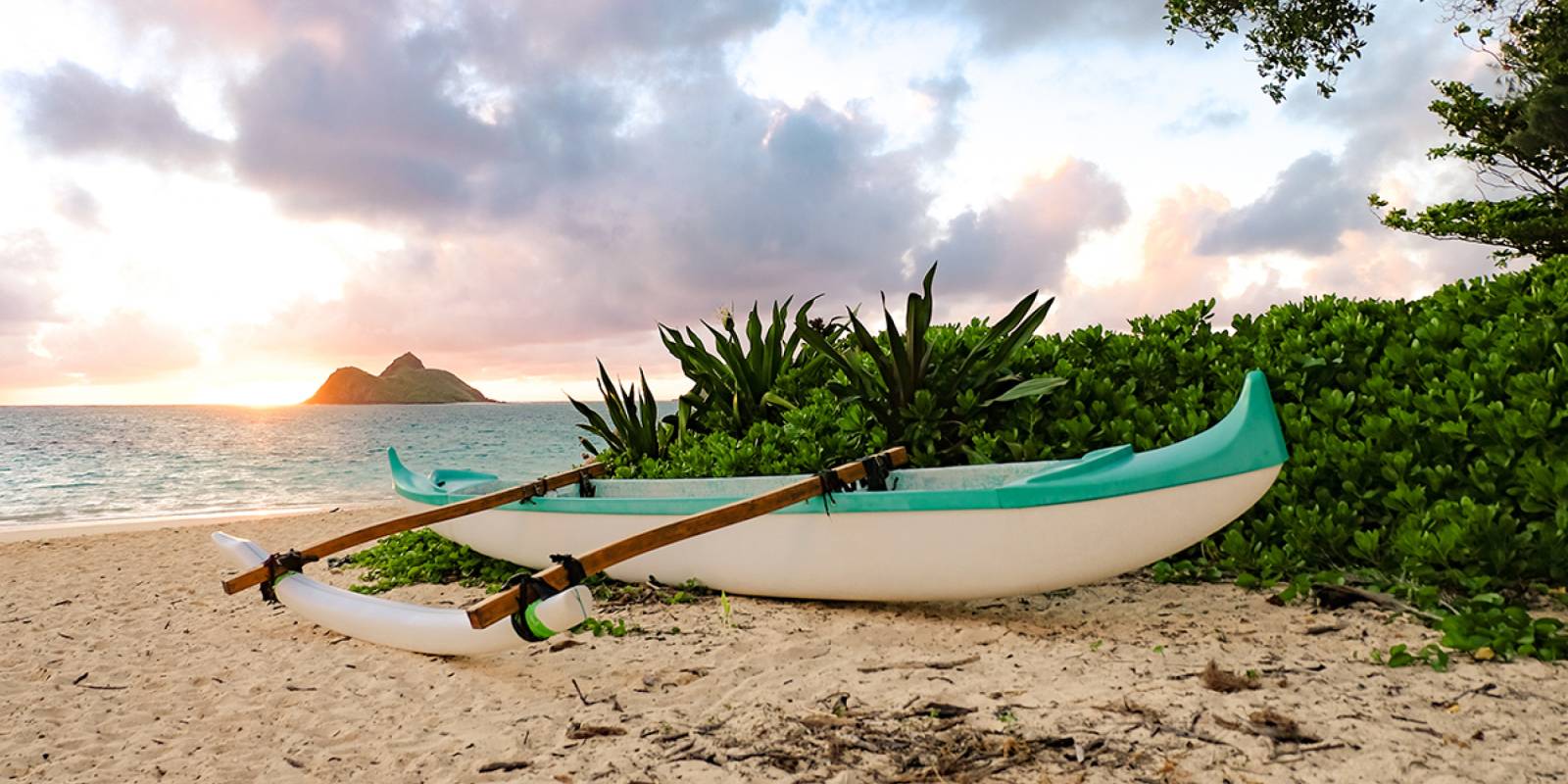

Most visitors to Hawaiʻi never figure out that there’s a state team sport, let alone that it runs every Saturday all summer at a different beach park. The Hawaii outrigger canoe regatta season is the closest a visitor gets to the sport without joining a club. Bring a chair and a cooler, and you’ll see something almost no tourist itinerary turns up: an entire community on the water. Hawaiian outrigger canoe paddling has been the official team sport of the State of Hawaiʻi since 1986, written into Hawaiʻi Revised Statutes §5-17. The regatta season — sprint racing in six-paddler outriggers off a host beach park — runs from early June through the first weekend of August, when the Hawaiian Canoe Racing Association (HCRA) hosts the State Championship Regatta. It costs nothing to watch from public shoreline, and it puts you on the beach with the clubs keeping the sport alive.
How the season works
Four island associations run their own regatta calendars under HCRA: OHCRA on Oʻahu, the Maui County Hawaiian Canoe Association (MCHCA), the Garden Island Canoe Racing Association (GICRA) on Kauaʻi, and Moku O Hawaiʻi on the Big Island. Each association publishes its 2026 calendar in the spring. A regatta is a single-day event held Saturday morning through mid-afternoon, hosted by a different paddling club at a different beach park each weekend. Crews from every club on that island travel to the host beach to race. The races are sprints. Per the HCRA Rules of Racing, distances run from a quarter-mile race for the youngest keiki up to a 1.5-mile open men’s and women’s race. Boats sit six paddlers: a steersman in seat six, a stroker in seat one, and four pullers between. The whole boat moves as one unit, on one count, every paddle in the water at the same instant. From shore it looks easy. It is not. The State Championship Regatta wraps the season the first weekend of August. Each island sends its top crews to a single host site to race head-to-head for state titles. The 2026 host venue and exact dates are published on the HCRA site — confirm there before you build a trip around it.
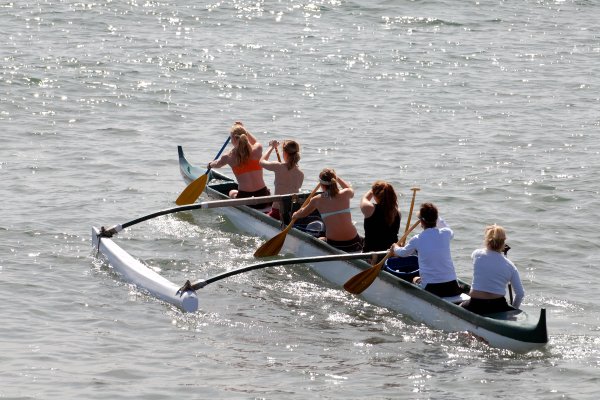
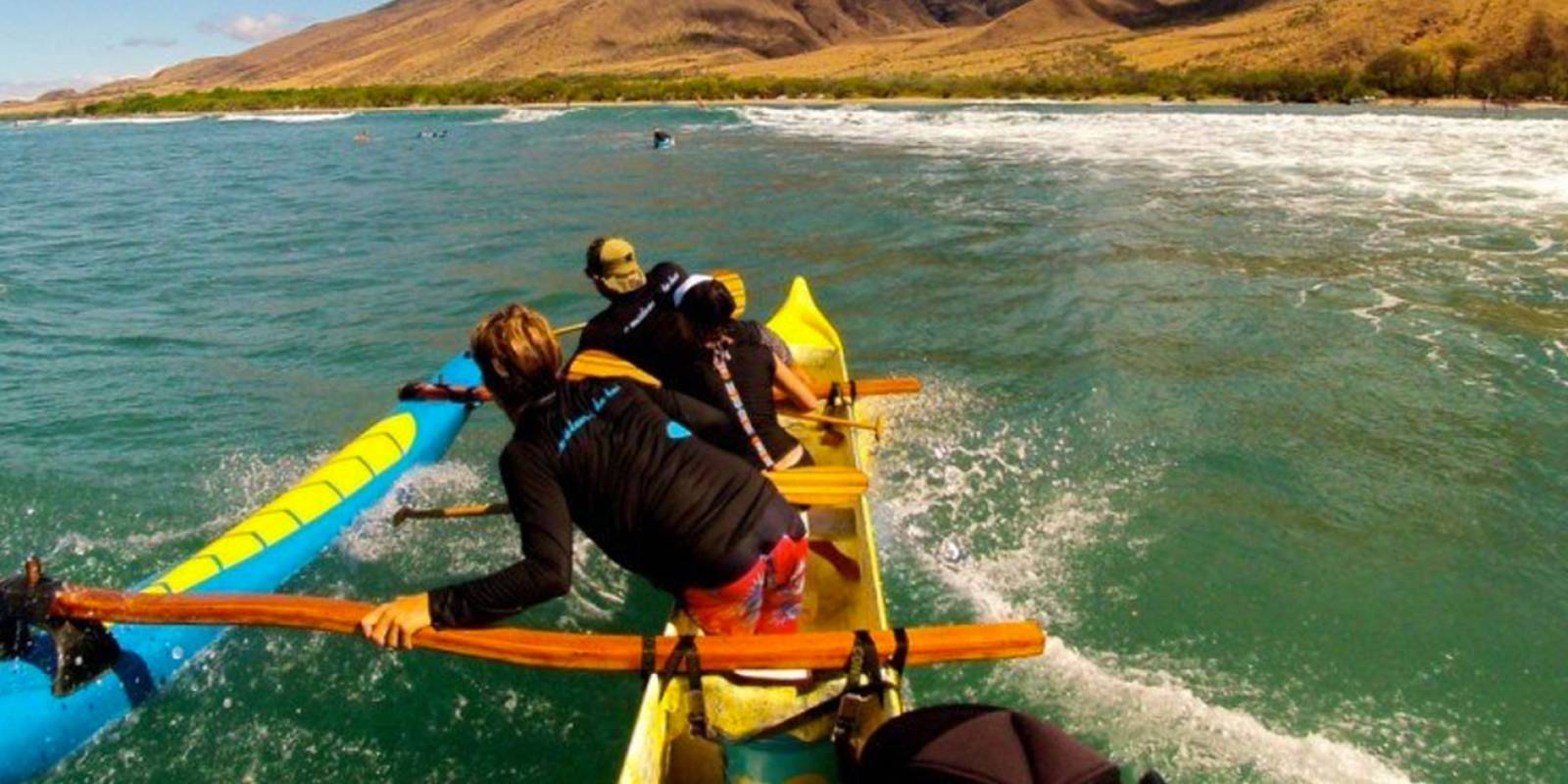
A six-paddler outrigger on a flat-water training run. Race-day boats are the same shape — fiberglass-hulled and built for sprint speed off a starting line.
What you'll see at a host beach
Pick a Saturday and drive to whichever beach park is hosting that weekend. The vibe is closer to a county fair than a sporting event. EZ-up tents go up before dawn along the high water line, one cluster per club. Coolers, plate-lunch setups, kids in matching club shirts everywhere. A long PA system runs heat assignments and lane calls all day. Most short-division sprints run straight from a starting line offshore to the finish in the surf zone, flagged with bright marker buoys you can usually pick out from a beach chair. Longer races round at least one turn buoy and come back in. Heats start at first light and roll on a tight clock through the afternoon. Keiki crews go first. Novice and junior crews fill the morning. Open men’s, open women’s, and the masters divisions race mid-day, with the long-distance open finals usually the last big event before tear-down. There is no admission and no ticket booth — community-run regattas at public beach parks, confirmed year after year on the association schedules. Walk up the beach access path, find a spot on the sand, and watch. A few things to bring. Polarized sunglasses make a real difference for seeing what’s happening on the water — without them every crew looks the same beyond the surf line. A good polarized pair from the dive-shop or sports-glasses category is fine. A canopy or umbrella matters more than people expect; the sun on a host beach in July is brutal by 10 a.m. Hats and water. Sunscreen too, and per Hawaiʻi state law it has to be a non-banned, reef-safe formula.
How to read a regatta
A few cues will pull a regatta into focus. The starting line is the most underrated viewing spot. Crews back their bows up against the line. Steersmen hold position with tiny strokes. The starter calls “hut” through a megaphone and every paddle hits the water on the same beat. The first 30 strokes are an absolute hammer-down — sprint cadence, full extension, water flying. Watch one heat from the start line and you’ll never look at an outrigger canoe the same way again. Listen for the “hut-ho.” Every crew calls a count to switch sides. The stroker calls “hut,” the whole boat answers “ho,” and paddles cross to the opposite gunwale on the next stroke. It keeps the pace synced and the boat tracking straight. On a calm morning you can hear the call from shore across half a mile of water. The buoy turn is where longer races flip. Distance heats include at least one turn around a buoy. Steersmen who can hold a tight inside line — without spinning the boat or burying the ama (the outrigger float on the left side) — pick up boat lengths on the field every time. Watch for which crews come out of a turn already back in stroke rhythm. That’s where I usually focus a camera. Don’t ignore the keiki and novice heats. The fast open crews are dramatic, but the novice and keiki heats are where you see a Hawaiian sport being passed on inside one family or club. Some of the kids paddling are third- and fourth-generation. The whole tradition is in those races, and they’re the ones I’d bring a kid of my own to watch.
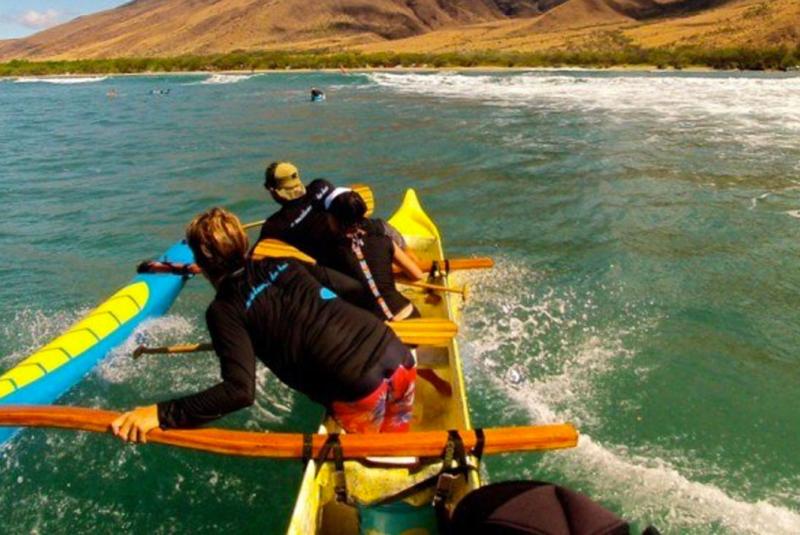
Many regatta paddlers also surf canoes outside the regular season — same boat, riding waves instead of sprinting buoys. A glimpse of the deeper canoe culture this sport sits inside.
Signature regatta beaches by island
Each association rotates its host beach week-to-week, but a few venues come up more often on published schedules and are worth knowing if you want to plan around catching at least one race. Oʻahu (OHCRA): Keehi Lagoon shows up across multiple weekends every season on the OHCRA schedule — sheltered flat water just east of Honolulu Harbor, easy parking, plenty of shoreline. Other regular hosts include Hickam Harbor and Kailua Beach Park on the windward side, with Ala Moana Beach Park in some clubs’ invitational rotations. If I had a single Saturday on Oʻahu, I’d pick Keehi. Maui (MCHCA): Kahului Harbor shows up regularly on the MCHCA schedule. Calmer water inside the harbor, and good visibility from the breakwater shoreline. Big Island (Moku O Hawaiʻi): Hilo Bay is the headline regatta venue on the Hilo side, with Kailua Bay in front of the Kona pier hosting on the Kona side, both confirmed on past Moku O Hawaiʻi schedules. Both viewing areas have flat shoreline walking and visible courses from land. Kauaʻi (GICRA): Hanalei Bay and the Wailua River mouth both turn up on the GICRA schedule. Calm water and a postcard backdrop. If Hanalei lands on the date you’re on island, build the day around it. Each association posts its 2026 schedule and weekly host details on its own site. Confirm the upcoming weekend’s host on HCRA, OHCRA, MCHCA, GICRA, or Moku O Hawaiʻi the week of your trip.
How visitors can paddle an outrigger
A regatta is a closed competition — only registered club paddlers race. You can still get on the water in a six-paddler outrigger as a visitor; you just need an operator that runs canoe tours, not a club. Canoe surfing on Maui is the most accessible “real” Hawaiian outrigger experience on the visitor side. Crews of four to six guests plus a guide steersman ride gentle waves in a traditional six-paddler boat. Hawaiian Paddle Sports runs small-group canoe surfing tours on Maui — book directly through their site for current rates and launch points. On Oʻahu, the resort beach concessions on Waikiki run shorter outrigger rides off the sand. Waikiki Beach Services lists rides at around $50 per person. Not racing, but a flat ride past Diamond Head with a guide doing the steering. It’s the easy intro.
Getting to a regatta
Renting a car is the cleanest way to chase a regatta. Host beaches rotate, and the host on a given Saturday may be 30 minutes from Waikiki or two hours from Kona. I use Discount Hawaii Car Rental to compare across the major brands at HNL, OGG, KOA, and LIH. If a regatta day falls inside a tighter activity schedule, browse Hawaii tours and activities on Viator to fit other plans around the morning racing window.
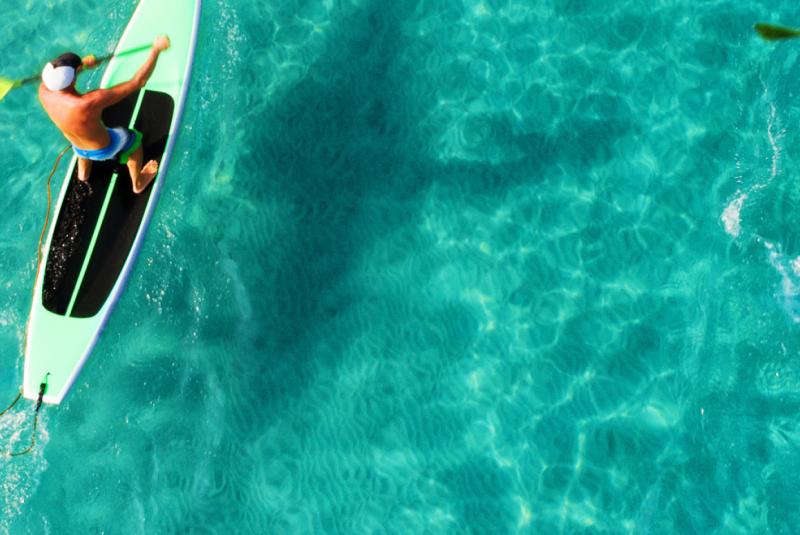
Hawaiian Paddle Sports runs visitor outrigger experiences on Maui — different from regatta racing, but the closest most travelers will get to actually paddling a six-person outrigger.
Why this matters more than it looks
Outrigger canoes brought the first Polynesian voyagers to these islands. The Polynesian Voyaging Society has spent fifty years sailing those routes again on Hōkūleʻa, the double-hulled voyaging canoe most visitors hear about at least once on a trip. The sprint racing on a Saturday morning in Hilo Bay comes from that same voyaging tradition — different hull, same lineage, adapted into sport. What makes a regatta worth a Saturday isn’t the racing. It’s the community on the beach. Every club is multigenerational — kids paddling, parents coaching, grandparents in folding chairs tracking the lane numbers. You’re not paying admission to see Hawaiʻi. You’re walking in on Hawaiʻi already happening. Bring a chair. Stay for the open-men’s final. Take the long way home.