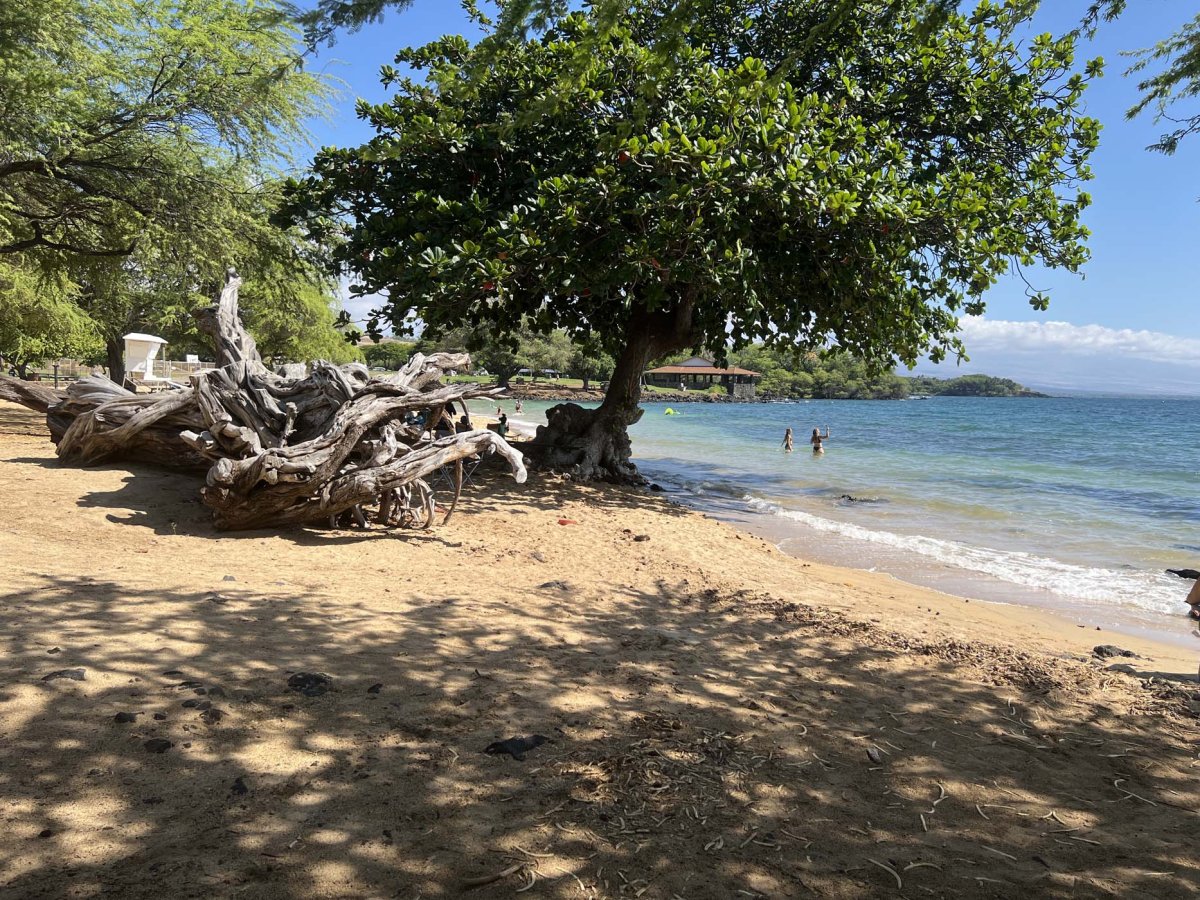
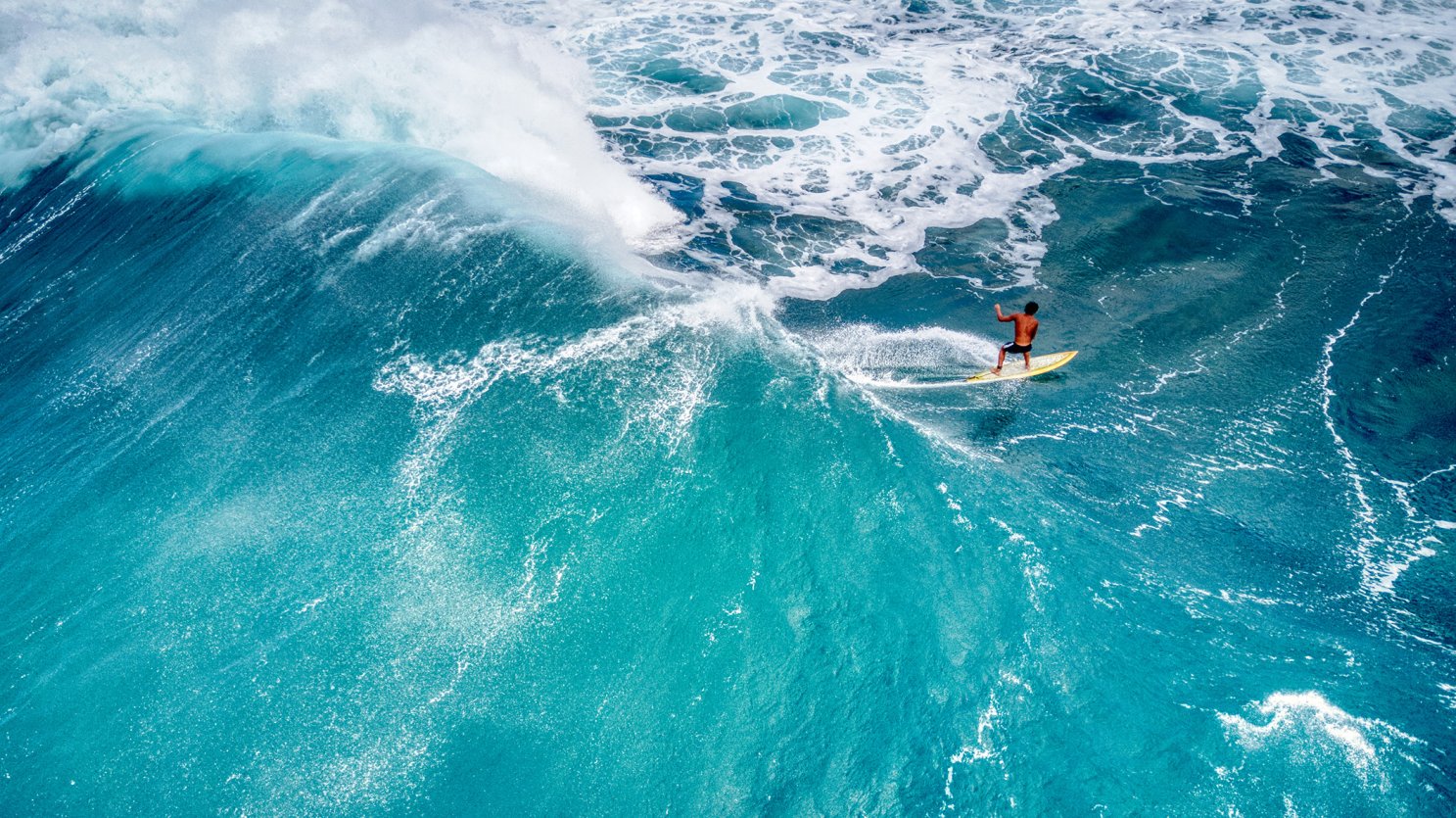

Somewhere between the first mai tai and the last note of a ukulele, the sun in Hawaiʻi does something the rest of the country almost never gets to see. It touches the ocean, flattens, drops, and — if the air is right and you are watching hard — flashes a spot of pure green for a second or two before the last edge disappears. That’s the green flash. It’s not a myth. It’s not a legend passed around luau tables to sell more cocktails. It’s a real optical phenomenon that scientists have been describing since the 1800s (Jules Verne wrote a novel about it in 1882), and Hawaiʻi’s clean ocean horizon gives you a genuine shot at seeing one. I’ve watched Hawaiian sunsets for two decades now. I’ve seen the green flash a dozen or so times. The first time it happened I didn’t quite trust my eyes. It was on the Kohala Coast, no clouds on the horizon, the sun squeezed into a thin line of gold — then a small green wink at the very top of that line, held for less than two seconds, and gone. Everyone around me on the seawall gasped at the same moment. That’s how you know it was real. Nobody performs “green flash” on cue for a crowd of strangers. Here’s how the flash works, why Hawaiʻi’s horizon lines up so well for it, and where I’d position myself if I were trying to catch one this fall.
What the green flash actually is (and isn't)
The green flash is caused by the atmosphere bending sunlight. Air acts like a weak prism: it refracts the sun’s light and separates it into colors, with red bending the least and green and blue bending the most. When the sun’s disc drops below a distant horizon, the last sliver you see is the highest-refracted light — usually green. The blue is scattered out by the atmosphere before it reaches you, so what’s left is a green wink for a second or two right as the top edge of the sun disappears. Astronomer Andrew T. Young at San Diego State University spent decades cataloging the physics. His Green Flash pages identify at least four distinct types — inferior mirage flash, mock mirage flash, subduct flash, and the rare green ray — each caused by a slightly different atmospheric layer. For most of us watching from a beach or resort seawall, the version we’re chasing is the “inferior mirage” flash. It happens when the ocean surface is warmer than the air above it, and the horizon appears as a straight, sharp line. What the green flash is NOT: an afterimage from staring at the sun. Young debunks this idea forcefully. The flash is a real color in the sky, not a trick your retina plays after the fact. If you have to look away and blink to “see” it, that’s not the flash — that’s your own exhausted rods and cones.
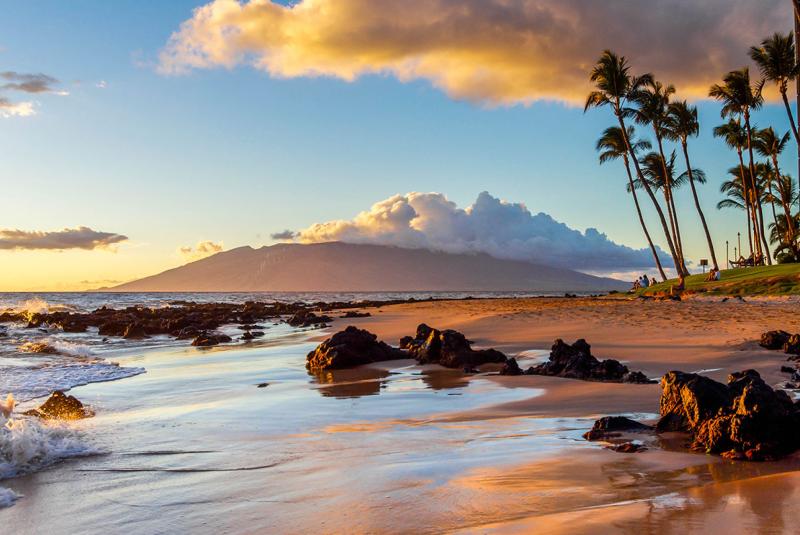
A flat, cloud-free horizon is the single biggest factor. If you can see a knife-edge line where sky meets sea, you have a chance.
Why Hawaiʻi's horizon works so well
Three things stack up in Hawaiʻi’s favor. First, the state sits in the middle of the Pacific — Honolulu is about 2,400 miles from San Francisco — which means the air over the sunset horizon has been traveling over open ocean, not over freeway corridors and industrial basins. Second, the trade winds — even the softer fall version — sweep away the marine boundary layer that would otherwise blur the horizon. Third, most of Hawaiʻi’s west-facing beaches, resorts, and lookouts point directly at that clean western horizon at sunset. Compare that to a sunset on the East Coast (blocked by land), a Gulf Coast beach (often hazy), or a California vantage point (marine layer most nights). Hawaiʻi routinely delivers the two ingredients that are hardest to find together — clean air and an ocean horizon on the sunset side. There’s also the geometry. At Hawaiʻi’s low latitude, the sun drops toward the horizon at a steep angle rather than sliding down at a shallow slant like it does in Seattle. The moment of disappearance is quick and concentrated. When the flash happens, it happens sharply, and it’s gone in a second or two. Don’t blink.
The conditions that matter
Here’s what I look for before I bother staking out a spot: Cloudless horizon. Not just “mostly clear.” If there’s a thin bank of clouds sitting on the ocean line, the sun will disappear behind that bank instead of the water, and no flash happens. Look due west with about 30 minutes to go. If the horizon line is knife-sharp, you’re in business. Trade winds blowing. Trades scour out haze. Kona (leeward) days can still produce a flash, but they’re less reliable because vog and humidity build up without wind to move them. A distant, unobstructed sea horizon. Not a headland, not the outline of Lānaʻi. You want open Pacific. This is why some spots that seem logical — like a west-facing overlook on Oʻahu’s north shore — actually don’t work, because there’s usually another island or a curve of coastline in the way. Nothing between you and the horizon. No boats, no bird flocks, no surfers popping up in your sightline at the wrong second. The green flash is small. It sits at the very top of the sun’s last edge. A catamaran mast in the wrong spot will hide it entirely.
Where to watch on each island
Oʻahu. Ko Olina on the west side is the local favorite because you have four crescent lagoons pointed west and no islands between you and the horizon. Kaʻena Point at the western tip works if you’re willing to hike out and want the widest possible view. Waikīkī can work too — Diamond Head is behind you to the southeast, and the sunset sightline runs west-southwest over open ocean, though downtown haze can dim the show on still nights. Skip Sunset Beach on the North Shore for green-flash purposes; despite the name, the view west is blocked by the curve of the coastline and the mountains behind Kaʻena. Maui. The west side is a strong bet when the weather cooperates. Kāʻanapali Beach gives you a wide horizon with Lānaʻi and Molokaʻi in silhouette (which is fine — they’re low enough that the sun clears them). Kapalua Bay and D.T. Fleming Beach further north offer even cleaner west-southwest looks. Wailea and Mākena face southwest with Kahoʻolawe on the horizon — some of the best flash odds on the island because the ocean fetch is long and the trades stay lively into the evening. Big Island. The Kohala Coast is where I’ve caught the flash most often. The Fairmont Orchid, Mauna Lani, Hapuna Beach, Mauna Kea Beach — every one of them points at an open Pacific horizon with almost nothing to block the view. Down in Kailua-Kona, the Aliʻi Drive seawall is a nightly ritual for locals and visitors alike. Grab a spot near Huliheʻe Palace or on the pier and settle in. Kauaʻi. The south and west shores are your best bets. Poʻipū Beach faces southwest with a long horizon and no islands blocking the view. Further west, Waimea, Kekaha Beach, and Polihale State Park all open onto pure Pacific — Polihale in particular is a favorite of local photographers precisely because there’s nothing at all between you and the horizon for thousands of miles.
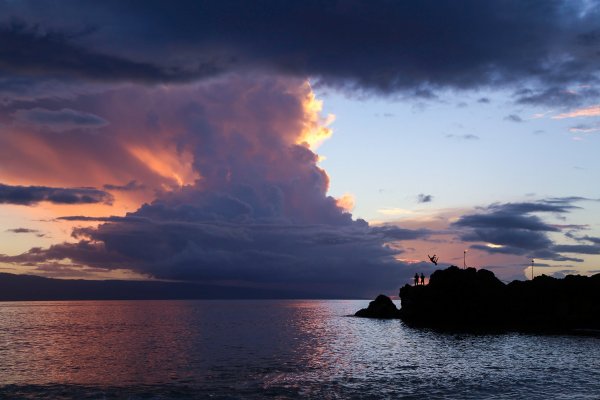
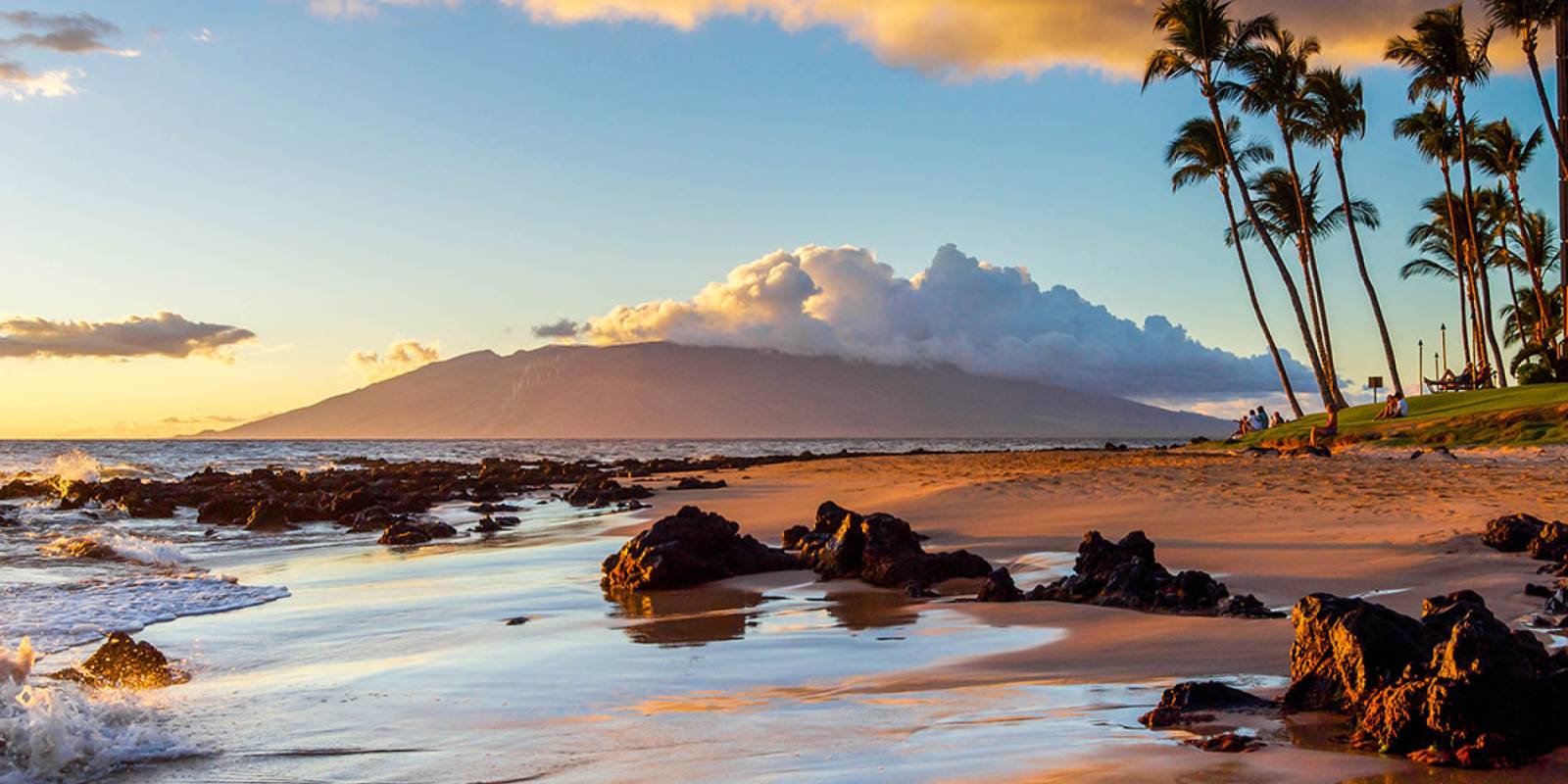
West Maui — Kāʻanapali, Kapalua, and the beaches north of Puʻu Kekaʻa — puts a wide, clean horizon in front of you almost every clear evening.
Why fall is a quietly great time to look
Summer gets the sunset crowds. Winter gets the whale-season crowds. Fall — roughly mid-September through late November — gets whoever shows up, which is usually a much quieter beach. A couple of weather patterns also line up. Trade winds tend to re-establish through October after the calmer patches of late summer, and when they’re blowing steadily at sunset, the horizon line sharpens up like someone drew it with a ruler. Days without trades — Kona-wind periods, muggy stretches — are the ones where haze sits on the water and hides the last edge of the sun. There’s also a practical benefit: sunset moves earlier. Per the Bishop Museum sunrise/sunset tables, Honolulu sunsets in early August land right around 7:00 p.m., and by early November they’ve drifted back to about 5:50 p.m. That lines up beautifully with an early dinner cruise or a beach cocktail before you head out for the night. If you want to eat, watch the sun drop, and still make an 8 o’clock reservation, fall is your window. Our no-daylight-saving guide explains why Hawaiian sunset times march earlier all fall without the “fall back” the mainland gets.
How to actually see one
A few practical rules I’ve collected from twenty years of Hawaiian sunsets: Do NOT stare at the sun until the last minute. This is the important one. Your eyes cannot take direct sun for long, and burning out your rods and cones ruins your chance of seeing the flash when it happens. Keep the sun in your peripheral vision until it flattens against the horizon — the moment it stops looking round and starts looking like a dome or a hat, that’s your cue to look directly. Binoculars help but need care. A good pair of binoculars magnifies the last edge of the sun and makes the flash easier to see. But never point them at the sun until it’s touching the horizon — solar magnification can permanently damage your eyes in seconds. Sunglasses off (they dim the flash out), binoculars up only in the last thirty seconds. Use a telephoto lens and burst mode. Any camera that can rip off a fast burst at a long focal length will catch a flash if one happens. Focus manually on the sun’s edge, expose for the sun (not the sky), and hold the shutter down through the disappearance. You’ll get maybe one usable frame out of a whole sequence. That’s fine — it’s one more than most people ever get. Consider a sunset cruise. Being on the water gets you closer to the horizon line and away from any coastal haze. You can compare Oʻahu sunset cruises on Viator to find one that leaves early enough to be well offshore for the actual moment. Our own sunset dinner cruise guide ranks the best-known operators by island.
One last thing — the Hawaiian word for it
The Hawaiian dictionary defines napoʻo as “to sink, set (as the sun).” Napoʻo ka lā — literally “the sun sinks” or “the sun dives” — is a more accurate description of what happens at this latitude than the English “sunset.” Kūpuna (elders) named the moment before the dive begins because the sun really does drop, not drift. Watching for the green flash is a modern hobby stacked on top of that older habit of paying attention to the sun as it disappears. You don’t need to catch a flash for the sunset to be worth watching. Most nights, you won’t. But most nights the sky will do something — a red belt over the horizon, a Belt of Venus in the east, a green rim you almost saw. That’s the game. Show up early, stay quiet, and don’t spend the whole time on your phone. And if you do catch one, don’t spend the next twenty seconds arguing about whether it was real. It was.
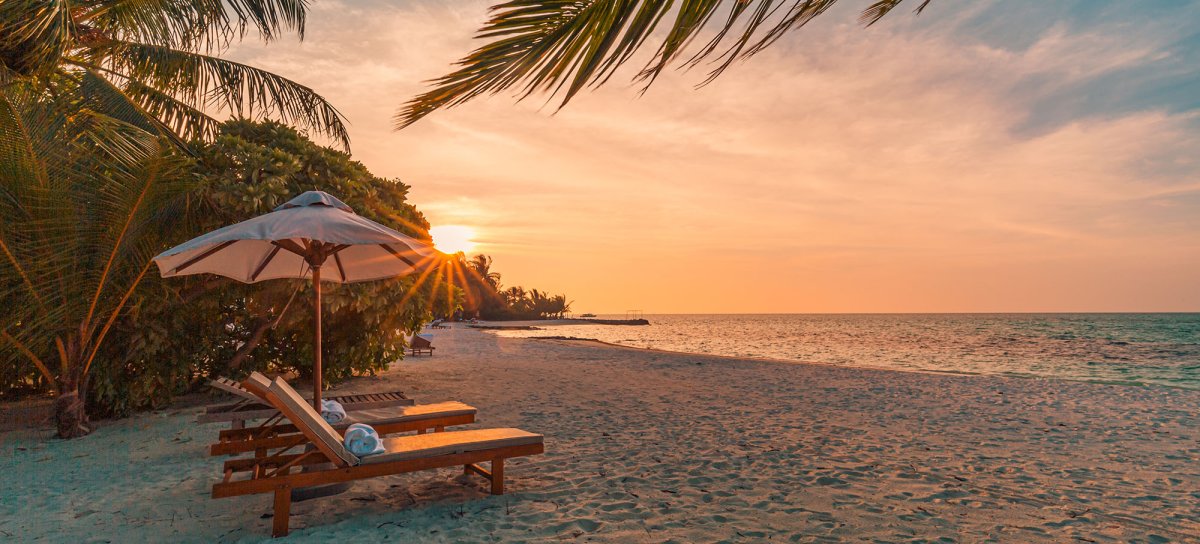
Show up 30 minutes early. Get the chairs. Watch the whole thing. The flash is a bonus — the sunset is the point.