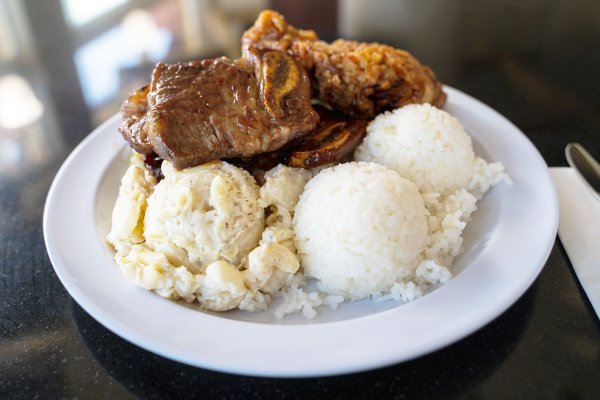
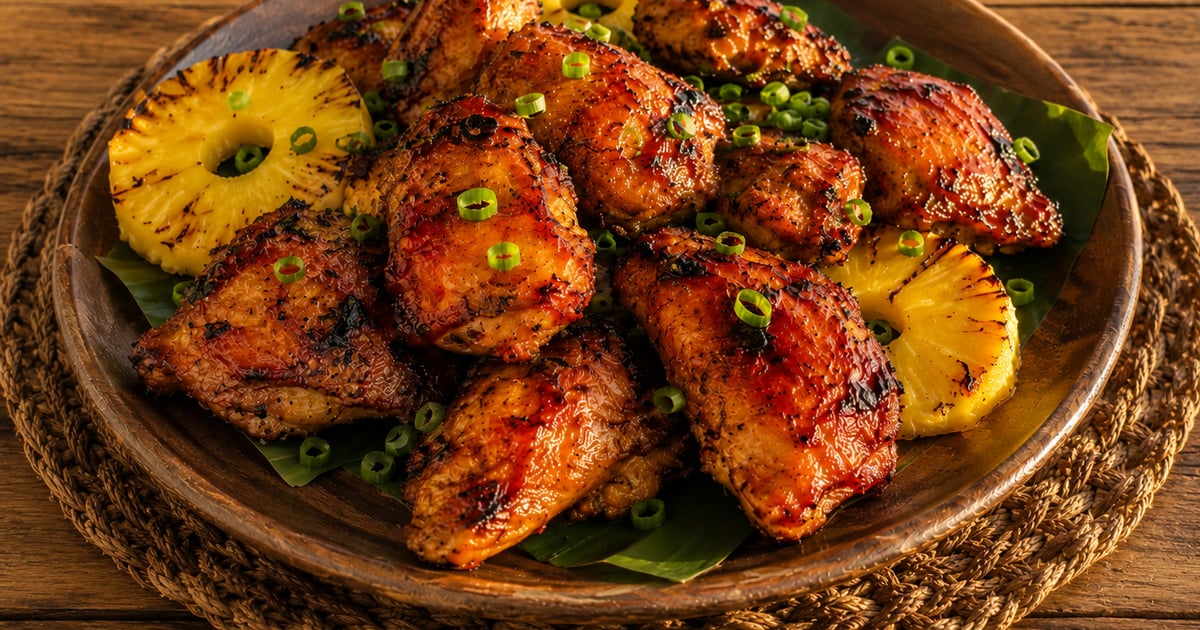

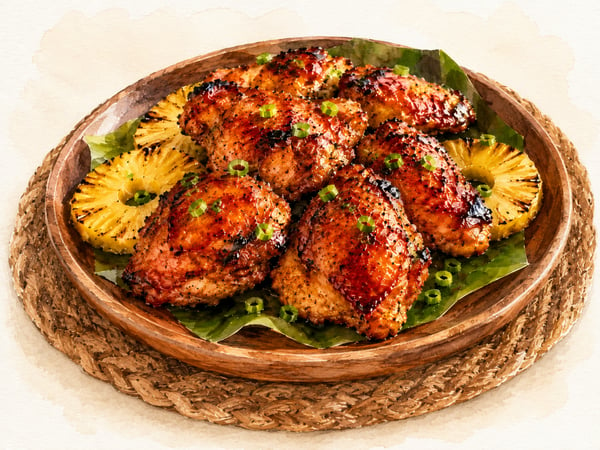
Huli huli chicken is the plate at the fundraiser. You pull off the highway because a hand-painted sign at a church parking lot says CHICKEN PLATE $15, follow the smoke to a row of split half-drum grills, and walk away ten minutes later carrying a foil clamshell: bone-in chicken halves with skin charred mahogany, two scoops of rice, a side of mac salad. It eats like teriyaki's smokier, more confident cousin. It's the plate I miss most when I leave the islands.
The dish traces to 1955 in Honolulu, when local food entrepreneur Ernest Morgado started cooking marinated chicken halves between two iron grills for a Pacific Poultry farmer's group meeting on Oʻahu. The grills were lashed together so the whole sandwich could be turned at once. The cooks called out "huli!" — Hawaiian for "turn" — when it was time to flip the rig. The name stuck, and Morgado's company later registered the "Huli-Huli" trademark. For decades the trademark restricted who could legally sell chicken under that name in Hawaii, which is why most school and church fundraisers carefully called theirs "BBQ chicken plate" instead.
At a glance
4
20 minutes (plus 4–24 hours marinating)
35 to 45 minutes on the grill
Moderate
Ingredients
Marinade and sauce
- 1 cup pineapple juice (unsweetened)
- ½ cup soy sauce (shoyu — Aloha Shoyu if you can find it; Kikkoman works)
- ½ cup brown sugar, packed
- ¼ cup ketchup
- 2 tablespoons fresh ginger, finely grated
- 4 cloves garlic, minced
- 1 tablespoon rice vinegar or sherry
- 1 teaspoon toasted sesame oil
Chicken
- 1 whole chicken (3.5–4 lb), split in half down the breastbone or spatchcocked. Or 4 bone-in skin-on thighs + 4 bone-in legs.
- 1 teaspoon Hawaiian sea salt (or kosher)
- Freshly ground black pepper
Equipment
- Charcoal or gas grill (two-zone setup)
- Saucepan for the marinade
- Tongs or grill spatula
- Basting brush
- Instant-read thermometer
To serve
- 4 cups hot cooked white rice (two scoops per plate)
- Hawaiian-style macaroni salad
- Sliced green onion for garnish
Method
- Make the marinade. In a saucepan, combine the pineapple juice, soy sauce, brown sugar, ketchup, ginger, garlic, vinegar, and sesame oil. Bring to a gentle simmer over medium heat, stirring until the sugar dissolves. Simmer 5 minutes. Cool completely. Reserve ¾ cup of the cooled sauce for basting and serving — the rest is the marinade.
- Marinate. Place the chicken in a large zip-top bag or shallow dish. Season with salt and pepper. Pour in the marinade (not the reserved portion). Refrigerate at least 4 hours, preferably overnight. Flip the bag once if you remember.
- Set up a two-zone grill. Charcoal: build a fire on one side only. Gas: light one or two burners on one side and leave the other off. Hot side around 425°F, cool side around 300°F. Brush the grates clean.
- Sear, skin side down. Pat the chicken dry with paper towels — wet chicken won't sear. Place skin-side down on the hot side for 3–4 minutes, until the skin shows char marks and crisp edges. Move to the cool side.
- Cook over indirect heat. Close the lid. Cook over the cool side for 25–35 minutes, depending on the size of the pieces. Flip every 8–10 minutes and brush with the reserved sauce on each flip. ("Huli, huli.")
- Check temperature. The chicken is done when the thickest part of the thigh registers 175°F on an instant-read thermometer. (USDA's safe minimum for poultry is 165°F, but dark meat eats better at 175°F.) Pull from the grill.
- Rest, then sauce. Let the chicken rest 5 minutes on a cutting board. Brush one more coat of reserved sauce over the skin.
- Plate it. Bone-in pieces over two scoops of rice and a scoop of mac salad. Spoon extra sauce over the top. Green onion if you have it.
Notes from a local cook
The marinade always lies to you about color. Brown sugar and soy char before the chicken is fully cooked, which is why most home cooks burn their first attempt at huli huli. The fix is indirect heat — sear quickly on the hot side, then move to the cool side and let it finish. Basting on each flip builds the lacquered crust without scorching.
Bone-in, skin-on, always. Boneless skinless thighs work in a pinch but the dish needs rendered skin fat to read right. If you can spatchcock a whole bird, do it. Wings, breast, and legs cook in roughly the same time, and you get the full fundraiser silhouette.
Kiawe is the secret if you can find it. Kiawe (Hawaii's mesquite) is what the church grills burn under. A handful of soaked mesquite chunks on a charcoal grill is the closest mainland substitute. Worth doing once to taste the difference.
The sauce keeps. The reserved baste/serve portion lasts a week in the fridge and works as a teriyaki-ish glaze for grilled fish, pork, or tofu later in the week. Most of the labor here is building the sauce. Get extra mileage out of it.
While You're on the Islands
Eat it made by someone else. Two reliable fixed spots: Mike's Huli Chicken, an Oʻahu food truck with regular stops along the windward and North Shore coast, and The Fish and the Hog, a roadside barbecue spot in Waimea on the Big Island with its own rotisserie BBQ chicken (the same owners' Huli Sue's BBQ & Grill is now in Asheville, North Carolina). The best version, though, is still the church or school fundraiser plate. Watch the bulletin boards at Catholic parishes and Buddhist missions, check the booths at the KCC Farmers Market on Saturday morning, and look for weekend "BBQ chicken plate" pop-ups outside Times Supermarkets and Big Save on Kauaʻi, KTA Super Stores on the Big Island. Bring cash, get there early, assume they sell out. See our broader Oahu dining guide for the rest of the picture.
Buy the ingredients fresh. If you can find a bag of kiawe (Hawaii's mesquite) wood at a hardware or grilling-supply store, grab it — it's what the church grills burn under and it's hard to find once you leave the islands.
Bring It Home
What you can substitute, what you can't: a handful of soaked mesquite wood chunks on a charcoal grill is the closest mainland substitute for kiawe — worth doing once to taste the difference. Shoyu, ketchup, and brown sugar (the sauce base) are all easy finds anywhere.
Where to try this in Hawaii