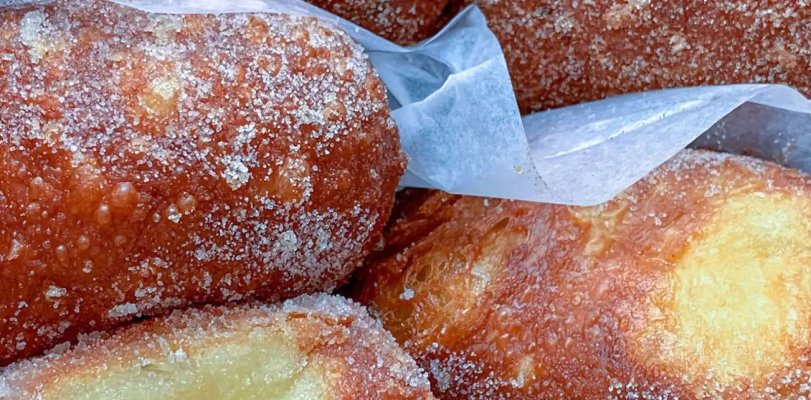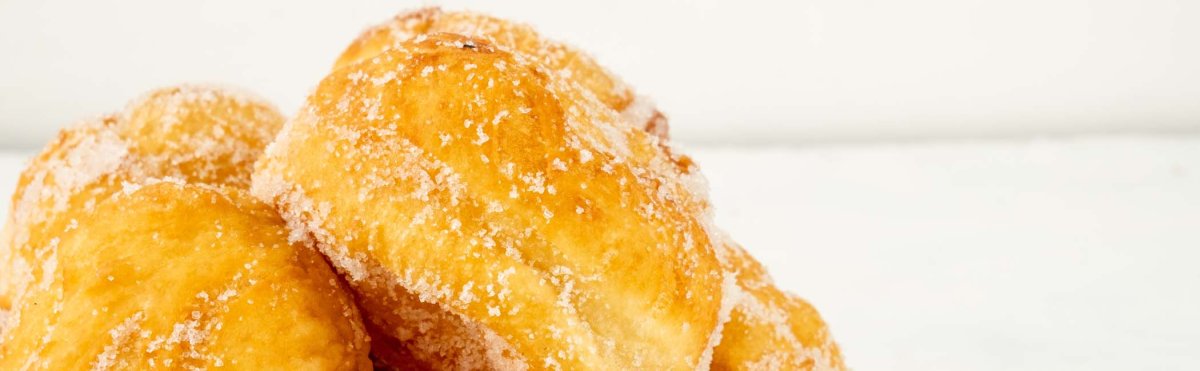
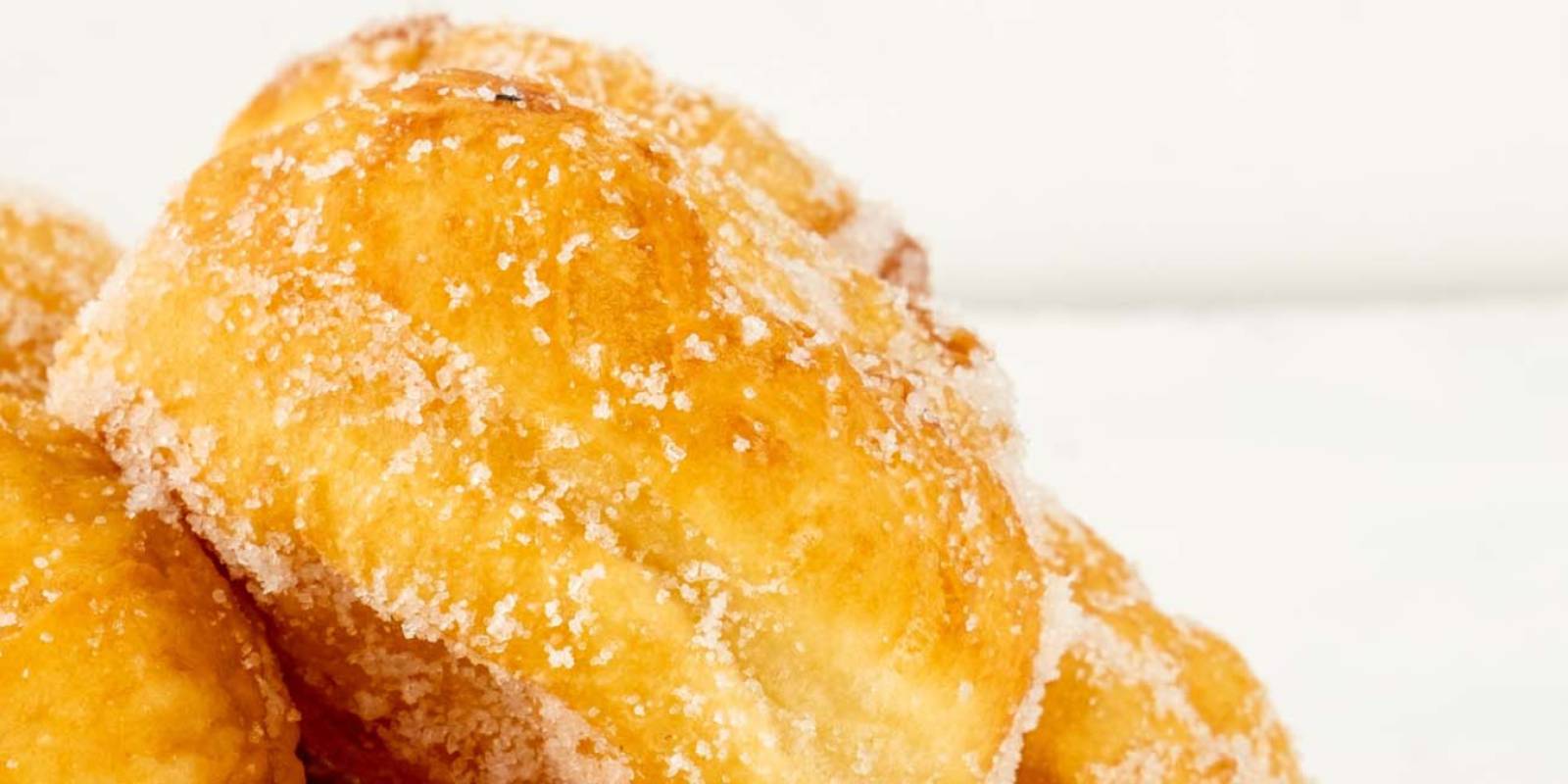

I make malasadas at home when I can't get to Kapahulu. They're yeasted Portuguese doughnuts, fried in oil, rolled hot in granulated sugar. Pillowy, slightly chewy, never crispy. The crumb is open and a little stretchy because the dough is loaded with egg yolks. You eat them five minutes out of the fryer and they're transcendent. You eat them an hour later and they're merely good. That short peak window is the whole reason this is a recipe and not a grocery list.
If you've never had a real one, the short version: think brioche dough, deep-fried, rolled in sugar while it's still warm enough to make the sugar cling. Recipe below. History after.
At a glance
18 to 20 malasadas
30 minutes (plus 2 hours rising)
20 minutes frying
Moderate (yeast dough)
Ingredients
For the dough
- 4½ cups all-purpose flour
- ½ cup granulated sugar
- 1 packet (2¼ teaspoons) active dry yeast
- 1 teaspoon kosher salt
- 6 large eggs, room temperature
- ¾ cup whole milk, warmed to 110°F
- ¼ cup unsalted butter, melted and cooled
- 1 teaspoon vanilla extract
- Zest of 1 lemon (optional but classic)
For frying and finishing
- 6 to 8 cups neutral oil (canola or vegetable) for deep-frying
- 2 cups granulated sugar in a wide bowl for rolling
- Optional: 2 teaspoons cinnamon mixed into the sugar (cinnamon-sugar variant)
Equipment
- Heavy-bottomed pot or deep-fryer
- Candy or deep-fry thermometer
- Slotted spoon or spider
- Cooling rack set over a sheet pan
Method
- Bloom the yeast. Stir the yeast and 1 tablespoon of the sugar into the warm milk. Let stand 5 to 10 minutes until foamy. If it doesn't foam, your yeast is dead or the milk was too hot. Start over with fresh ingredients.
- Build the dough. In a large bowl (or stand mixer with the dough hook), whisk together the flour, remaining sugar, and salt. Add the eggs, melted butter, vanilla, lemon zest, and the bloomed yeast mixture. Mix on low until it comes together, then knead 6 to 8 minutes by mixer or 10 minutes by hand. The dough should be soft, sticky, and silky, closer to brioche than bread dough. Resist adding extra flour. The high egg content makes it look wetter than it is.
- First rise. Lightly grease a clean bowl, transfer the dough, cover with plastic wrap, and let rise in a warm spot until doubled, about 1½ to 2 hours.
- Shape. Turn the risen dough onto a lightly floured surface. Gently press it into a slab about ½ inch thick. Cut into 18 to 20 pieces with a bench scraper or knife. Don't worry about making them uniform; the Leonard's shape is famously irregular. Cover with a clean towel and let rest 20 minutes.
- Heat the oil. Pour 3 to 4 inches of oil into the heavy pot and heat to 350°F. Set the cooling rack and the bowl of sugar near the stove. Hold 350°F throughout frying. Too cool and the malasadas absorb grease; too hot and the outside burns before the inside cooks.
- Fry in small batches. Lower 3 or 4 pieces of dough into the oil at a time. Fry about 90 seconds per side, until deep golden brown and puffed. Use the slotted spoon to transfer to the cooling rack to drain for 30 seconds. While they're still very warm, roll each malasada in the sugar bowl to coat completely.
- Eat immediately. Malasadas peak about 5 minutes out of the fryer. They do not keep. An hour is the outer limit before the texture drops off a cliff.
Notes from a local cook
Oil temperature is the whole game. I check the thermometer between every batch. Cold dough hitting 350°F oil drops the temp 20 to 30 degrees instantly, and you need to let it climb back before the next round. Crowding kills you faster than anything else. Three to four pieces at a time in a six-quart pot, no more. Pack the pot and the temperature crashes and you get greasy malasadas.
The eggs are doing a lot of work. Six is correct, not five. The extra yolks give a Hawaiian malasada its richer, slightly yellow crumb and the chew that distinguishes it from a New Orleans beignet or a Boston Bavarian. Don't swap in egg whites to lighten it. That's a different doughnut.
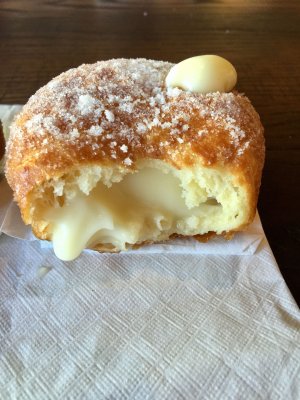
Filled malasadas are a more recent development. The originals were plain. Somewhere along the way, bakeries started piping custard, haupia, lilikoi cream, and chocolate into them, and now you'll find filled versions everywhere on Oahu. To make them at home: fry plain, let cool 5 minutes, then use a piping bag with a long pastry tip to inject the filling from one end. Lilikoi (passion fruit) is the most distinctly Hawaiian. A simple lilikoi pastry cream is just regular pastry cream made with strained passion fruit juice in place of half the milk.
How malasadas got to Hawaii
The short version: sugar planters recruited workers from Madeira and the Azores in 1878 to fill labor gaps on the plantations, and the doughnuts came with them (Leonard's Bakery). The Portuguese tradition was to fry up the last of the household's lard and sugar on Shrove Tuesday before Lent, a use-it-up dish that became known locally as Malasada Day, the island name for Fat Tuesday. They eventually stopped being seasonal and became a year-round staple.
The Rego family founded Leonard's Bakery in 1952 and opened the Kapahulu Avenue storefront on Shrove Tuesday of 1953 (Leonard's Bakery). That shop is the reference point for what most people picture when they hear "malasada" today: egg-yolk-rich yeasted dough, fried to deep golden brown, rolled while still warm in granulated sugar.
Where to try the real thing
If you're heading to Hawaii, Leonard's Bakery on Kapahulu Avenue in Honolulu is the institution. Their menu has the original, cinnamon-sugar, and a rotating cast of filled varieties. The line moves fast. Cards work, but bring cash if you want to speed up your order. On the Big Island, Punaluu Bake Shop in Naalehu is a worthwhile stop on the drive between the volcano and Kona. See our island-by-island guides for the rest of the local lineup: Oahu, Maui, Big Island, and Kauai.
Where to Eat It on Your Trip
Our picks for Malasadas across the islands — tap a spot for hours, photos, and directions.
 Photo: r3xOʻahu
Waiahole Poi Factory
 Photo: Liliha Bakery WaikikiOʻahu
Liliha Bakery
 Photo: Tami PriceBig Island
Tex Drive In
 Photo: Mark's PlaceKauaʻi