
Most people ask the question like they are weighing a destination against other vacations. Cost. Flight time. Crowds. Whether the resort is worth what the resort costs. They are treating it like a math problem with an answer. The honest version of the question is different. People are not really asking whether the islands are worth the airfare. They are asking whether something will happen to them. Whether the place will stick. Whether a week off work will turn into something else they can’t quite name yet. I can only answer that one way. By telling you what happened to me. May 2002. Maui. A bench in a rainforest I almost didn’t reach.
The kid who almost didn't get on the plane
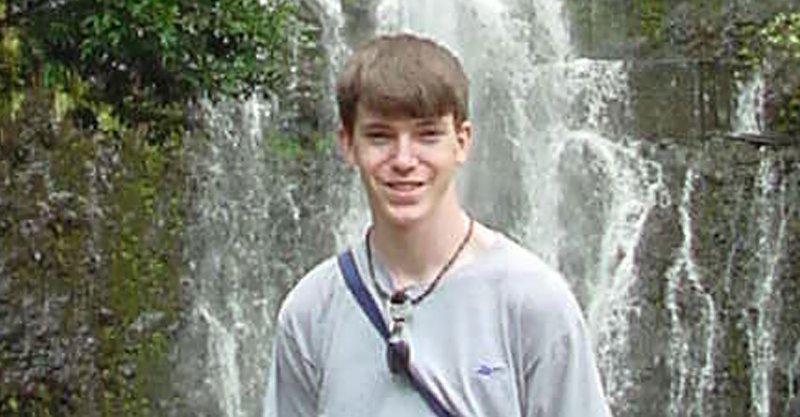
Me, May 2002, age 21. First trip to Hawaii. I had a brand new digital camera that wrote photos to a floppy disk.
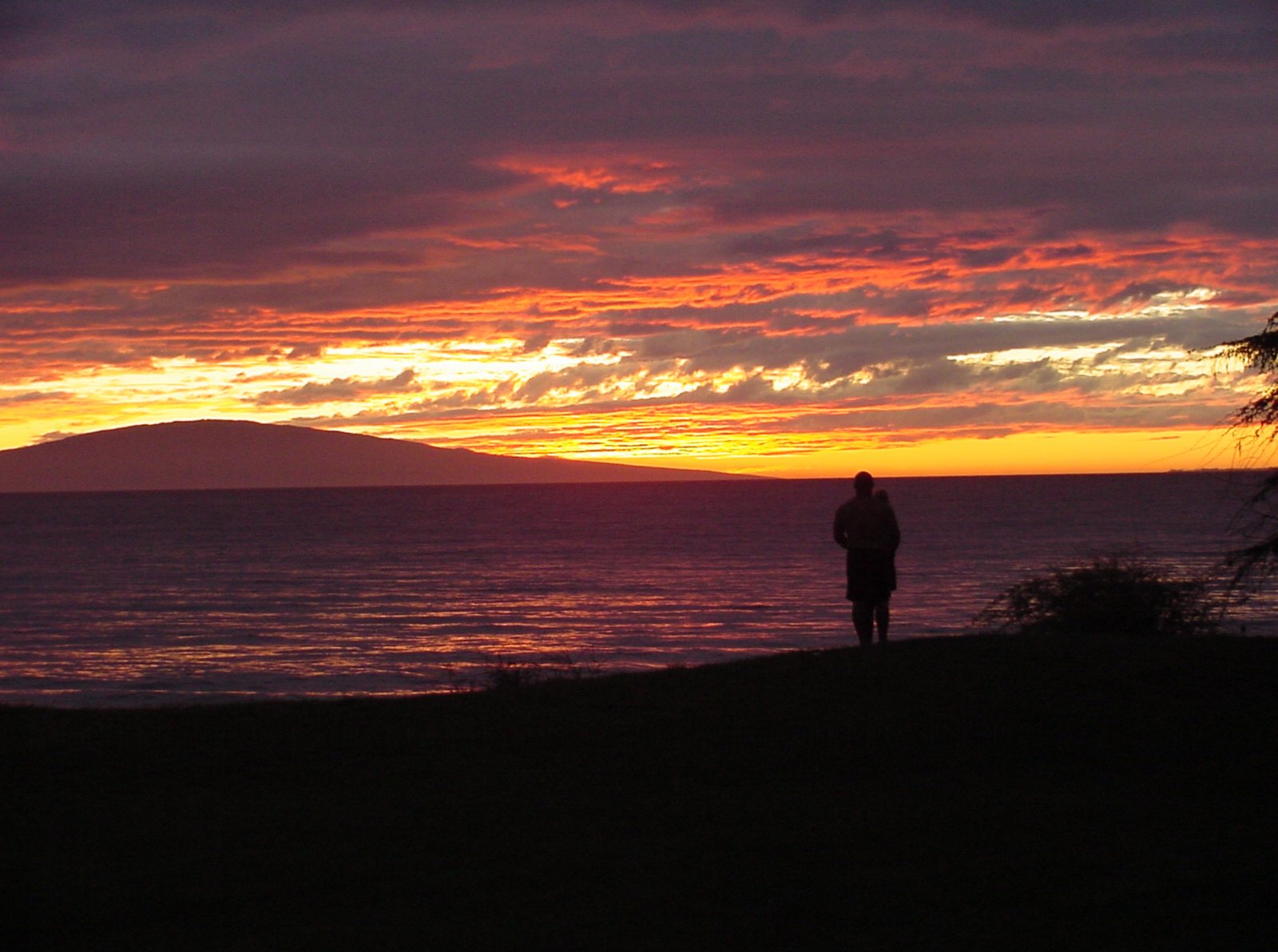
I grew up in central South Carolina. The kind of kid who had been to 49 states with his family by the time he turned 20, mostly in an Expedition. Alaska in 2000 was the second-to-last. Hawaii was the only piece left. My mom is afraid to fly, so for the first time in my life I would have to do the missing piece without my regular travel companions. I was 21. An engineering student at the University of South Carolina with a brand-new digital camera that wrote photos to a floppy disk. The morning of the trip, the sky over Columbia was hailing. Severe thunderstorms had set up a wall east of the airport and we drove through the back end of it to get to the gate. The first flight I’d ever been on bounced from Columbia to Atlanta through the worst turbulence I would ever experience in my life. My friend, sitting next to me, watched me grip the seat and asked if I was going to do that the whole way. I let go of the seat. I did not let go of the underlying problem. Eight hours of flying later I stepped off the plane in Kahului into an open-air terminal with myna birds flying through the rafters. The drive into Kihei in our rental car looked nothing like the pictures I had been studying for two months. Sugar cane fields. A smokestack pumping steam from the old Puʻunene mill. I remember thinking, very plainly, “this is Hawaii?” Then we got to Kamaʻole III in the late evening. The sun had already set, leaving the sky banded in colors only the open Pacific gets. The west side of Maui rose dark on my right. Lanaʻi and Kahoʻolawe sat in silhouette beyond the channel. I stood on the sand and felt something I had no word for at the time. The closest I can come to it now is that I felt like I had walked into a room I had been homesick for without knowing.
The earth is raw and new
The next morning we drove the Hana Highway. I had researched it stop by stop with a list, the way an engineering student does. Twin Falls. Garden of Eden (which we missed entirely, and which I would come to regret on more than one trip). A three-point turn on the highway itself when I realized I had passed the trailhead at Waikamoi Ridge. I am still surprised I am alive. We made Hana by mid-afternoon. I talked story for the first time at the general store with a man behind the counter who was in absolutely no hurry. I had not realized I was carrying a clock in my chest until then. Two days later we drove up Haleakalā. The summit was socked in on the first attempt and we saw nothing but the inside of a cloud. A few days after that we tried again and got the view that made me understand “raw and new” as something you feel in your knees instead of read in a textbook. You are standing on the lip of a mountain whose base is four miles below you under the Pacific. Geologists call this one dormant, not extinct. None of it is finished. We hiked the Pīpīwai Trail through a bamboo forest that hummed in the wind and stood under the 400-foot ribbon of Waimoku Falls. We drove the back road around Haleakalā that every rental car company tells you not to drive. (It’s fine. Drive it slow.) The whole island felt half-made. Geological youth as a thing you can feel in your body, not a sentence in a guidebook.
The bench at Waikamoi
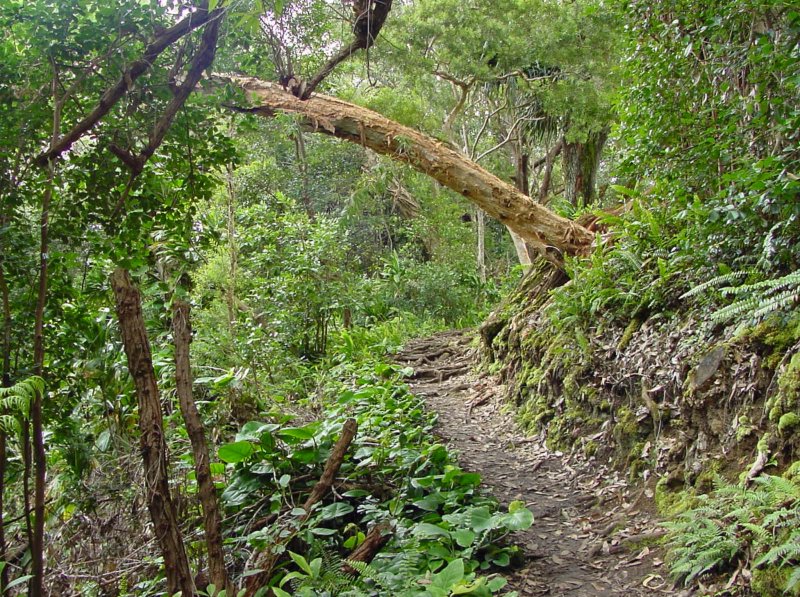
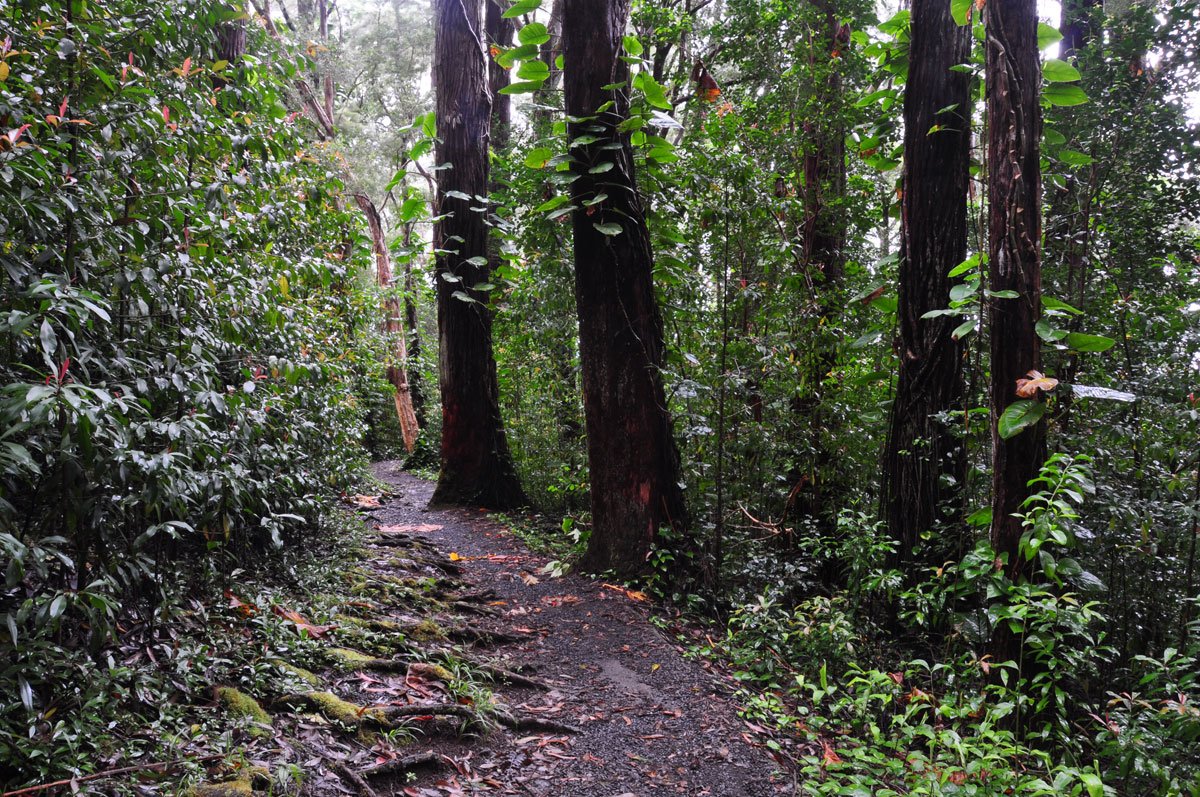
The Waikamoi Ridge Trail along the Hana Highway. I took this photo on my last day in Hawaii in 2002, on the trip back. I went out there alone.
On the last day of the trip my friend wanted to lay on the beach. I wanted to go back to Waikamoi alone. I drove the Hana Highway one more time, two hours each way from Kihei, with the gas needle drifting toward the line. I almost turned around twice. I thought about not going. I am not a person who gets feelings about places. I am a person who got into engineering school because feelings could be reduced to equations. But something about that trail had grabbed me on the first pass and I needed to go back. It was late afternoon by the time I parked. I had the trail to myself. A few minutes in there is a small wooden bench. I sat down. I stood up on it to see over the railing. And then something I am still not entirely able to explain happened to me. The Hawaiians have a word for it. Mana. Life force. Something ancient running underneath the soil here that you can feel if you are quiet enough and the conditions are right. I am the wrong person to be telling you this story because I do not have language for it. The closest I can do is say that for a few seconds my chest stopped being mine and belonged to the rainforest, and when it came back something had been swapped in it. I sat back down. I sat there for a while. On the walk out I passed a couple. I greeted them with “aloha” without thinking about it first. I had never said it out loud before. I did not worry about the gas all the way back to Pāʻia. I did not worry about anything. My brain had, without asking, switched into a different gear. That happened on a Friday in May of 2002. I have not been the same since.
Aloha is a worldview, not a greeting
The thing about that moment I have spent the last 24 years trying to articulate is that it did not feel like a tourist’s epiphany. It felt like an instruction. Aloha in the islands is not a word the locals fling at strangers as a polite hello. It is a way of being in the world. Reciprocity, patience, looking the person in front of you in the eye like they matter, treating the land like a relative instead of a backdrop. You cannot buy any of it. You cannot extract any of it. You can only be it back. In over two decades of returning, I have watched a lot of visitors treat aloha like a souvenir they can take home with the macadamia nuts. It does not work that way. It is a posture, not a thing. The locals will be unfailingly kind to you, and they will also clock instantly whether you are bringing your own posture or expecting them to provide one for you. Talking story at the Hana general store on day three of my first trip taught me more about that than anything I have read since. The man behind the counter was not trying to sell me anything. He was not in a hurry. He had a worldview, and for ten minutes he let me sit inside it. I came home and changed my college major. I changed jobs. I changed the kind of people I wanted to spend time around. A first marriage didn’t survive what the islands had put in me, and that was nobody’s fault. Just the wrong fit. Years later I met someone who got it on her first trip the same way I had got it on mine. Tori and I were married on Kauaʻi in April 2011, under the peaks above Hanalei Bay, where the mana feels ten times what it does on Maui.
The food took me ten years
Here is the most embarrassing sentence I will write today. It took me ten years of visiting Hawaiʻi before I really ate the food. I had eaten plenty of resort food in those ten years. Mediocre buffet teriyaki. Macadamia-encrusted mahi at $42 a plate. The kind of meals designed not to upset a Midwestern palate. And then, on a trip in 2012, somebody put a real plate of laulau in front of me. Pork and butterfish wrapped in lūʻau leaves and ti leaves, steamed for hours until the leaves go silky and the pork falls apart at the touch. I remember setting the fork down after the first bite. I texted Tori something I am not going to print word-for-word here, but the gist was: how did I miss this for ten years? Locals call good food ono grindz. They are right. Laulau, kālua pig pulled out of a backyard imu, fresh ʻahi poke with shoyu and limu and ʻinamona, malasada hot enough to burn your fingers, saimin at a counter with eight seats and one cook. The food in Hawaiʻi is not a side note to the trip. It is the worldview on a plate. Generations of immigrants from Japan, China, Portugal, the Philippines, Korea, and Puerto Rico, layered over the original Polynesian foodways, all of it cooked by people who actually live on the islands. None of it is at the resort buffet. The lesson I took from the laulau, ten years late, was the same lesson the bench at Waikamoi tried to teach me on day six of my first trip. You can be in a place without being in it. Authenticity is a choice, not a location. Pono, which is one of those Hawaiian words that does not translate cleanly into English, means something like balance, rightness, doing right by. The state motto is built on it. Be pono in how you show up here and the islands will give you back more than the airfare. Show up extractive, the way too many visitors do, and you will get a vacation. Show up pono and you get something that lasts.
We were going to move. We never did.
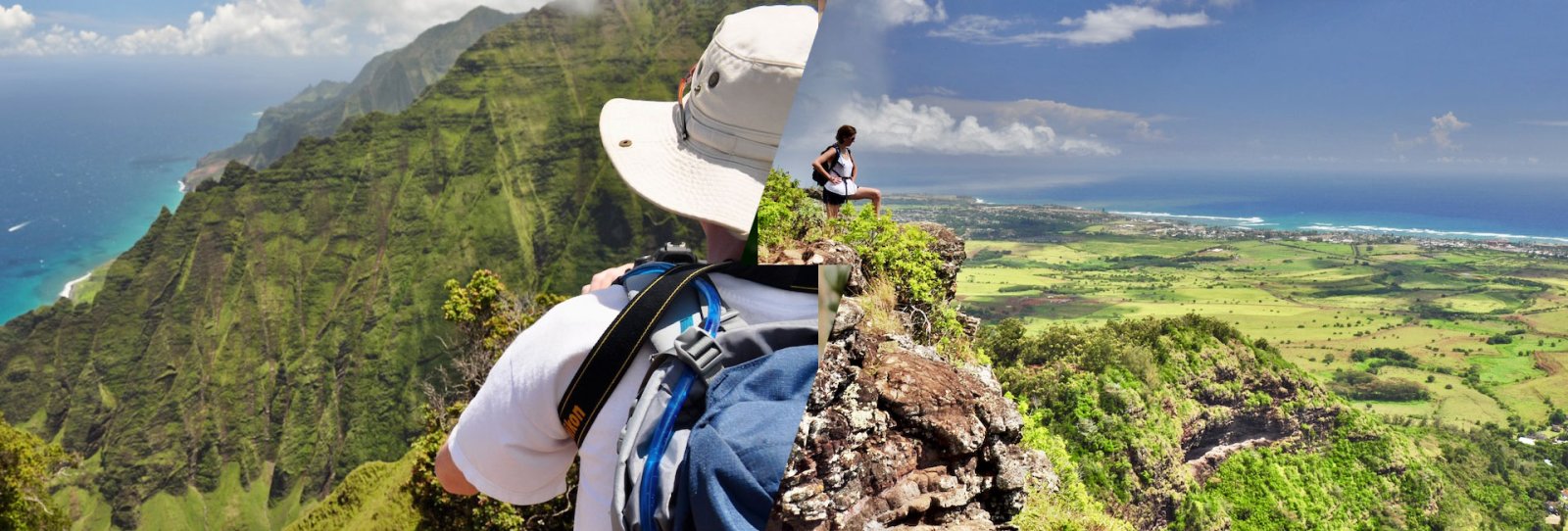
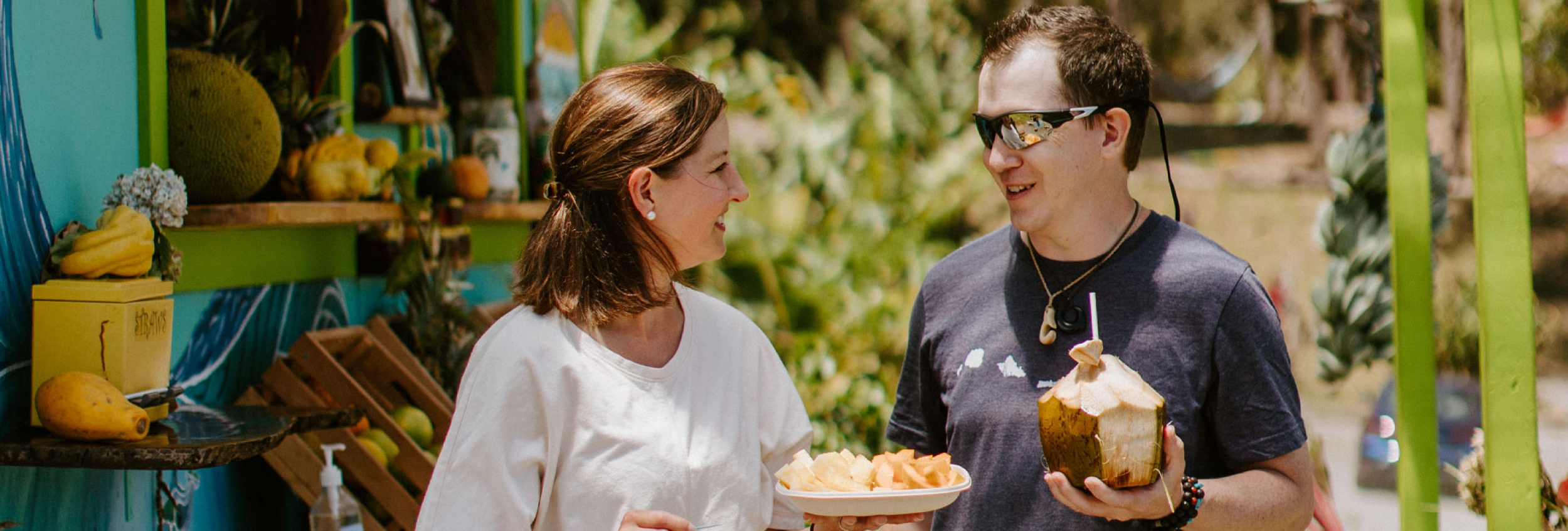
Tori and me on Kauaʻi, on one of the many trips back. We were married on this island in April 2011 under the peaks above Hanalei.
Tori and I were going to move to Hawaiʻi. We talked about it through 2012 the way people talk about a thing that is going to happen. We made lists. I wrote a long blog post about it that exists in an old folder on a hard drive. February 24, 2012. I read it now and the kid who wrote it sounds completely certain. We never moved. Life sent us in a different direction. We built the business from central South Carolina, which made no logistical sense and worked anyway. We have come back to the islands every chance we have gotten for 24 years. The garden behind our house is full of ti plants and gingers and heliconias I have brought back over the years, every one of them a tiny piece of that rainforest in my yard. We did not live in Hawaiʻi. Hawaiʻi lived in us. That, I have come to believe, is the actual answer to the question people ask me about whether they should visit. The trip is not the answer. The trip is the question. What you take home is the answer. Some people take home a tan and three thousand photos and the same person they were when they got on the plane. Some people take home a bench at Waikamoi.
So. Should you visit Hawaii?
You already know what I am going to say. Get on the plane. Show up pono. Do not eat at the resort the whole week. Talk to somebody at a general store. Drive a road that scares you a little. Rent the cheapest car that fits your stuff and put the miles on it. Sit on a bench when nobody else is around. The honest answer to whether something will happen to you is that I do not know. I know what happened to me. I know it has happened to a lot of other people who have written to me over the years. I know it does not happen if you stay inside the resort and refuse to let the place in. Get on the plane. — John