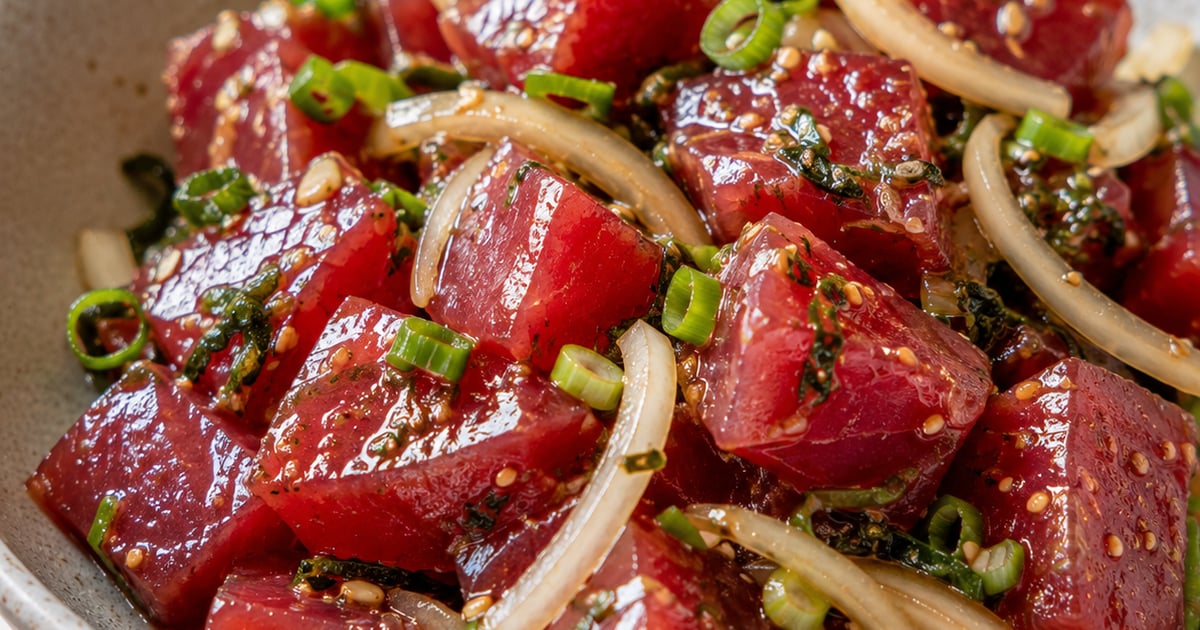

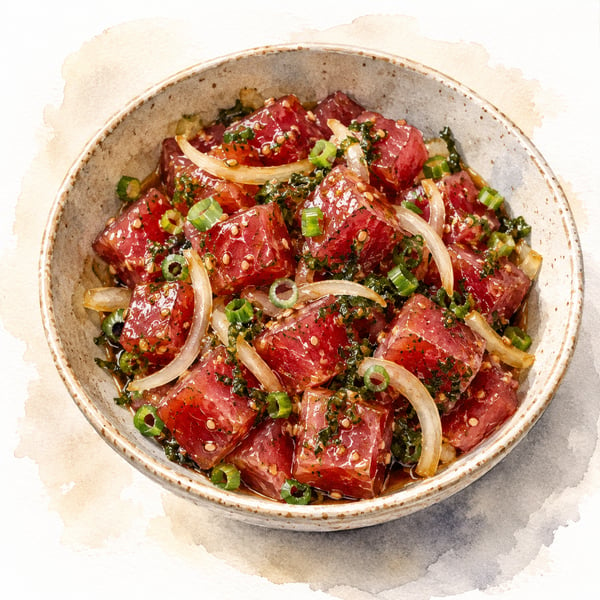
Classic shoyu poke is fresh ahi, shoyu, sesame oil, sweet onion, and Hawaiian salt. Five minutes of mixing. The whole dish lives or dies on the fish you start with.
Poke is pronounced POH-keh, not POH-kee, and the word means "to slice, cut crosswise into pieces" in Hawaiian. The earliest version was fishermen cubing reef fish straight off the boat and seasoning it with limu, sea salt, and crushed roasted kukui nut. The shoyu-and-sesame version most people know today is a 20th-century evolution, shaped by Japanese and other Asian immigrants on the sugar plantations who brought soy sauce, sesame oil, and green onion into the local pantry.
At a glance
4 as appetizer, 2 as main
10 minutes
None (raw)
Easy (fish quality matters)
Ingredients
For the poke
- 1 lb sushi-grade ahi (yellowfin tuna), cut into ½-inch cubes
- 3 tablespoons shoyu (soy sauce). Aloha Shoyu; Kikkoman works fine
- 1 tablespoon toasted sesame oil
- ¼ cup thinly sliced sweet onion (Maui onion if you can find it; Vidalia or Walla Walla otherwise)
- 2 stalks green onion, thinly sliced (both white and green parts)
- ½ teaspoon Hawaiian sea salt (alaea or paʻakai), or flaky sea salt as a substitute
- 1 teaspoon toasted sesame seeds
- ¼ cup chopped limu kohu or wakame seaweed (optional but traditional)
- Pinch of red chili flakes or a small amount of chopped Hawaiian chili pepper (optional, for heat)
To serve
- Hot white rice (Calrose or other medium-grain)
Equipment
- Sharp knife and cutting board
- Medium mixing bowl
- Paper towels to pat the fish dry
Steps
- Buy good fish. Fish quality matters more than anything else in this recipe. Ask your fishmonger for sushi-grade or sashimi-grade ahi. The flesh should be deep ruby-red, firm to the touch, and smell like clean ocean, not "fishy." If it does not look right, do not buy it. Frozen sushi-grade ahi (sold as a "saku block" in many Asian markets) is a fine substitute; thaw it overnight in the refrigerator.
- Cube the fish. Pat the ahi dry with paper towels. With a sharp knife, slice the fish into ½-inch cubes. Keep them uniform: bite-sized but substantial.
- Mix the seasonings. In a medium bowl, combine the shoyu, sesame oil, sliced sweet onion, green onion, Hawaiian sea salt, sesame seeds, and limu if using. Stir.
- Add the fish and toss. Add the cubed ahi to the bowl. Toss gently with a spoon or your hands until every piece is coated. Be careful: you want the fish to stay intact, not get mashed.
- Rest, then serve. Let the poke sit at room temperature for 5 to 10 minutes so the flavors come together, or refrigerate for up to 30 minutes. Do not let it sit longer; the shoyu will start to cure the fish and the texture turns rubbery.
- Plate it. Serve over a mound of warm white rice, or in a small bowl on its own with rice on the side, then scatter a handful of chopped green onion over the top.
Notes from making this at home
Quality of fish is everything. If you cannot get sushi-grade ahi, do not use a regular tuna steak from the grocery store. Make a different dish. A good fallback for poke style is cooked: lightly seared ahi or smoked salmon will both take the same dressing and give you something honest.
Hawaiian sea salt (also called alaea when blended with iron-rich red volcanic clay) makes a real difference here. Maui-made brands are easy to find online if your local market does not stock it. Plain kosher salt works, but the mineral edge of Hawaiian salt is what gives the dish its anchor.
Skip the mayo, skip the sriracha, skip the avocado. Those are good in their own context, but they are not classic poke. Get the original right first.
While You're on the Islands
Eat it made by someone else.
- Tamura's Fine Wine & Liquors, Oʻahu — multiple locations across Oʻahu, and the poke counter is the one I keep going back to. Order by the pound at the case.
- Foodland, statewide — yes, the supermarket. Most stores have a real poke counter with the daily catch listed on a chalkboard, and the rotation is fast enough that locals shop there for it.
- Ono Seafood, Honolulu — a tiny Kapahulu shop with a board full of ahi variations (shoyu, spicy, wasabi, Hawaiian-style, and more). Order by the cup, expect a wait, eat it on the curb.
- Da Poke Shack, Kailua-Kona (Big Island) — beachside takeout with generous portions. The "Pele's Kiss" (spicy ahi) and the limu poke are the two to compare.
Full island roundups: Oʻahu poke, Maui poke, Big Island poke, and Kauaʻi poke.
Buy the fish fresh. If you're making this in a vacation rental, the same Foodland poke counters listed above sell raw sushi-grade ahi by the pound for cutting your own — ask for "poke-grade" or "sashimi-grade" specifically, not the standard fish-case cuts.
Bring It Home
What to stock up on before you fly home: a bag of Hawaiian alaea sea salt travels fine and is the one ingredient here that actually changes the flavor at home.
What you can substitute, what you can't: kosher salt works in a pinch, but skip it on the fish itself — sushi-grade ahi doesn't travel home in a suitcase, so plan to buy it fresh from a trusted fishmonger wherever you live. That's the one ingredient this recipe genuinely depends on getting right, on-island or off.
Where to Eat It on Your Trip
Our picks for Ahi Shoyu Poke across the islands — tap a spot for hours, photos, and directions.
 Photo: 守井嘉朗Oʻahu
Ono Seafood
 Photo: KANGHAN LEEOʻahu
Fresh Catch
 Photo: D DalbyMaui
Honokowai Okazuya & Deli
 Photo: Umekes Fish Market Bar & GrillBig Island
Umekes Fish Market Bar & Grill
 Photo: Jason ScofieldKauaʻi
Koloa Fish Market
 Photo: The Fish ExpressKauaʻi