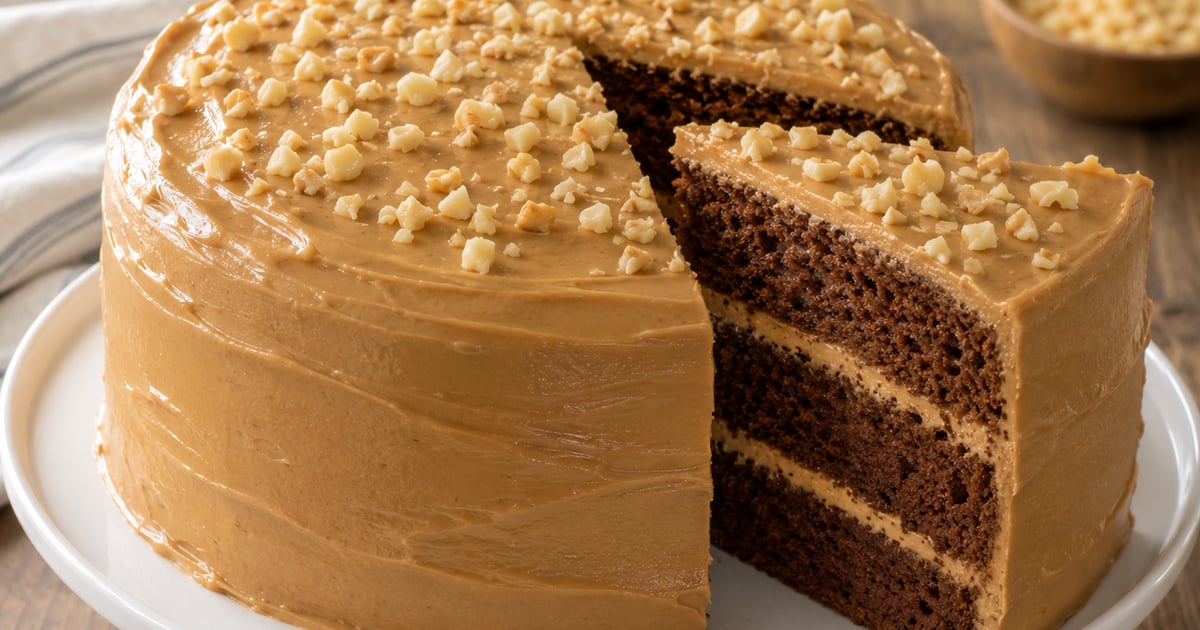

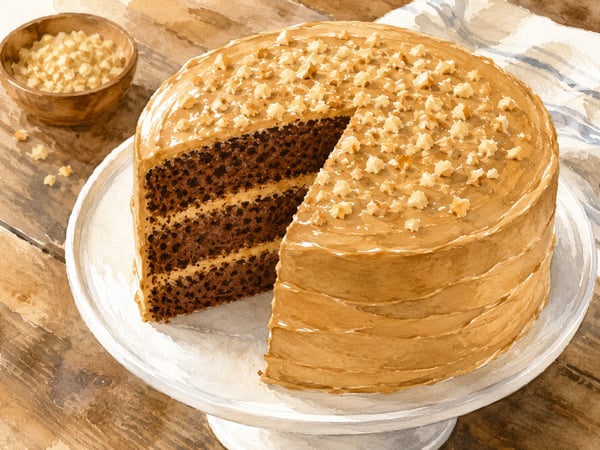
"Chantilly" in most of the world means lightly sweetened whipped cream. In Hawaii it means something else entirely. Here, chantilly is a thick, cooked, custardy frosting built from butter, evaporated milk, sugar, egg yolks, vanilla, shredded coconut, and chopped pecans. Closer kin to a German chocolate cake topping than to whipped cream. It's not whipped. Not fluffy. Not light. It's dense, caramel-leaning, and stick-to-your-fork rich. Slathered between layers of chocolate cake and spread thick over the top and sides. You'll see it in Honolulu bakery cases from Liliha to Kaimukī, on plenty of birthday-party trays, and sliced thick on a saucer next to coffee after dinner.
The cake is a Hawaii invention. The origin story everyone cites belongs to Liliha Bakery on Kūʻākini Street in Honolulu, founded in 1950 and still running today. The chocolate chantilly is one of the bakery's two signature items, alongside the Coco Puffs. Other Honolulu bakeries put out their own versions, and the recipe lives in dog-eared community cookbooks across the islands. This is the home version, scaled to a 9-inch round and built on the bakery template: tender chocolate layer cake, that cooked chantilly frosting on every surface, sliced thick.
At a glance
One 9-inch double-layer cake (12 slices)
45 minutes
30 min cake + 25 min frosting
Moderate
Ingredients
For the chocolate cake
- 2 cups all-purpose flour
- 3/4 cup unsweetened cocoa powder (natural, not Dutch-process)
- 2 cups granulated sugar
- 2 teaspoons baking soda
- 1 teaspoon baking powder
- 1 teaspoon salt
- 2 large eggs
- 1 cup buttermilk
- 1 cup hot brewed coffee
- 1/2 cup neutral oil (canola or vegetable)
- 2 teaspoons vanilla extract
For the chantilly frosting
- 1 can (12 oz) evaporated milk
- 1.5 cups granulated sugar
- 1 cup (2 sticks) unsalted butter, cut into tablespoon pieces
- 4 large egg yolks, lightly beaten
- 1 teaspoon vanilla extract
- 1/4 teaspoon salt
- 1 cup sweetened shredded coconut
- 1 cup pecans, chopped (or walnuts for a more old-school version)
Equipment
- Two 9-inch round cake pans
- Parchment paper rounds for the pan bottoms
- Large mixing bowl + whisk
- Heavy 3-quart saucepan (for the frosting)
- Wooden spoon or silicone spatula
- Wire cooling racks
- Offset spatula for frosting
- Cake plate or stand
Pantry notes
- Natural cocoa (Hershey's regular, not Special Dark or Dutch) is the right cocoa here. It reacts with the baking soda and gives the cake its tender, fine crumb.
- Hot brewed coffee deepens the chocolate without making the cake taste like coffee. Drip is fine. Instant works too (1 tablespoon in 1 cup boiling water).
- Sweetened (not unsweetened) shredded coconut is correct here. Baker's Angel Flake or any standard supermarket bag.
Method
- Prep the pans and oven. Preheat to 350°F. Grease two 9-inch round pans, line the bottoms with parchment rounds, then grease the parchment and dust with flour. Tap out the excess.
- Mix the cake. In a large bowl, whisk together flour, cocoa, sugar, baking soda, baking powder, and salt. Add the eggs, buttermilk, hot coffee, oil, and vanilla. Whisk until smooth. The batter will be thin, almost like a loose pancake batter. That is correct. Do not add flour to thicken it.
- Bake. Divide the batter evenly between the two pans. Bake on the middle rack for 28 to 32 minutes, until a toothpick inserted in the center comes out with just a few moist crumbs. Cool in the pans for 10 minutes, then run a knife around the edges, invert onto cooling racks, peel off the parchment, and let cool completely. Do not even think about frosting warm cake.
- Start the chantilly. In a heavy 3-quart saucepan, combine the evaporated milk, sugar, and butter. Cook over medium-low heat, stirring frequently, until the butter melts and the sugar dissolves. Bring to a gentle simmer.
- Temper the yolks. Whisk the egg yolks in a small bowl. While whisking constantly, slowly ladle about 1 cup of the hot milk mixture into the yolks to warm them. Then slowly pour the warmed yolk mixture back into the saucepan, whisking the whole time. This step prevents scrambled-egg flecks in your frosting.
- Cook the frosting. Reduce heat to low. Stir constantly with a wooden spoon, scraping the bottom and corners of the pan. Cook for 12 to 18 minutes, until the mixture thickens enough to coat the back of the spoon. Drag a finger across the spoon and the line should hold. The frosting will turn a deep caramel color. Pull off the heat and stir in the vanilla, salt, coconut, and chopped pecans.
- Cool the frosting until spreadable. Transfer to a wide bowl and let cool at room temperature, stirring occasionally, for 30 to 45 minutes. It'll thicken further as it cools. Spreadable consistency is when it holds soft peaks but moves under an offset spatula. Too hot and it runs off the cake. Too cold and it tears the crumb.
- Frost. Place the first cake layer on the plate. Spread a thick layer of chantilly (about 1.5 cups) across the top, all the way to the edges. Set the second layer on top, gently. Spread the remaining chantilly over the top and down the sides, swirling the top with the back of the spoon. The Hawaii bakery style is rough swirls, not pristine smooth sides. Don't fight it.
- Rest, then slice. Let the assembled cake stand at room temperature for at least 1 hour before slicing so the frosting can set up. Slice with a clean knife wiped between cuts. Keep leftovers covered at room temperature for 24 hours, then refrigerate after that and bring to room temperature before serving. Cold chantilly is dense and waxy. This cake is meant to eat warm-ish to room temperature.
Notes from a local cook
Constant stirring on the frosting. The single most important step is stage 6, cooking the chantilly. Egg yolks scramble and milk scorches the second you stop moving. Stir continuously with a wooden spoon, scraping every corner of the pan, low heat the whole time. If you see lumps, immediately pull off the heat and whisk hard for 30 seconds. That usually catches it. If the frosting breaks (looks oily and split), see the troubleshooting note below.
If the frosting breaks. Sometimes the butter splits out from the rest. Don't panic. Off the heat, add 2 tablespoons of cold evaporated milk and whisk vigorously for 30 seconds. That usually pulls it back together. If it still won't emulsify, pour the broken frosting into a blender and pulse a few times. Not pretty, but it has saved more than one Saturday afternoon cake.
The coffee in the cake is doing real work. Hot coffee in chocolate cake batter doesn't taste like coffee. It deepens the cocoa and pulls out a bittersweet, almost truffle-like edge that supermarket chocolate cake mixes miss. Use whatever drip coffee is in your pot. If you genuinely don't have any, hot water works. Instant espresso powder dissolved in hot water is even better.
The chantilly is the variable to play with. Some families like the frosting with walnuts instead of pecans, the older Hawaii version. Some skip the nuts and double the coconut. Some skip the coconut entirely. Some add a tablespoon of dark rum at the end. The framework is evaporated milk, sugar, butter, egg yolks, cooked low and slow. That's what makes it chantilly. Everything else is a family setting.
While You're on the Islands
Eat it made by someone else. The reference cake in Honolulu is at Liliha Bakery. The original location on Kūʻākini Street has been open since 1950, with additional locations at Ala Moana, Nimitz, and Waikīkī. They sell whole chantilly cakes, individual slices, and a chantilly chiffon variation. Ask for the chocolate chantilly. Other long-running Honolulu bakeries serve their own takes, and you'll often find slices in supermarket bakery cases across the islands. For more on Hawaii's bakery and dessert tradition, see our Oahu dining guide and the wider Hawaii Eats coverage.
Bring It Home
What you can substitute, what you can't: evaporated milk and butter, the two ingredients that make the fudge-style chocolate frosting, are stocked at any mainland grocery store — nothing here needs special sourcing. This is a technique cake, not an ingredient one; the payoff is in getting the frosting's cook time right, not in tracking down a rare product.
Where to try this in Hawaii