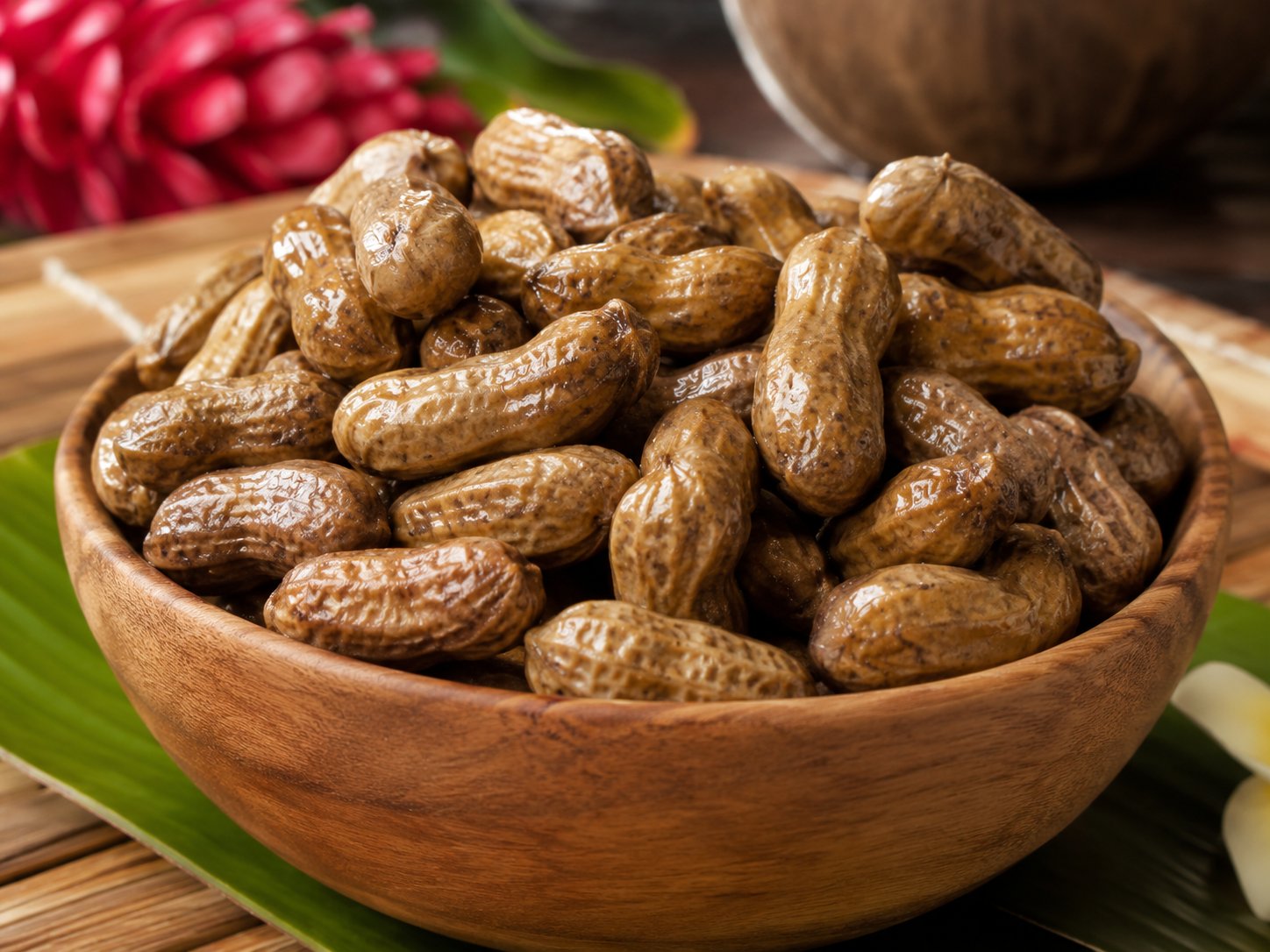

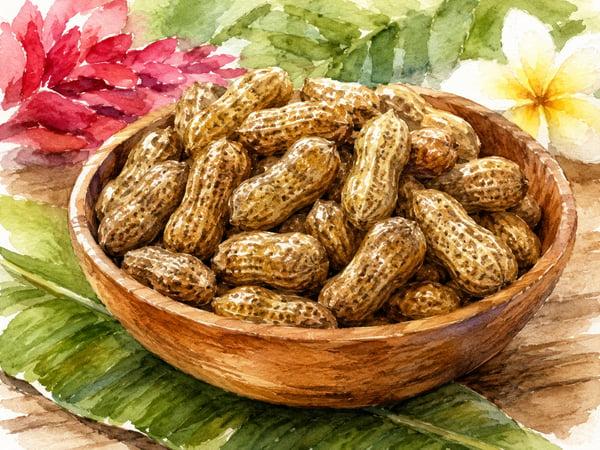
Hawaiian boiled peanuts are a different animal from the soft Southern peanut you'll find at a roadside stand in Georgia. The Hawaii version is spiced with star anise, ginger, sometimes Chinese five-spice and a hit of garlic. The brine is aggressively salty. The shell comes out the color of dark tea, glossy, yielding to fingernail pressure. The kernel inside is tender, almost beanlike, with the salinity of an olive and the warm-spice perfume of an apothecary cabinet. You pop the shell at the seam, suck out the peanut, drop the spent hull onto a paper plate. Repeat for an hour. That's a Hawaii afternoon.
Local food histories trace this back to the plantation era, when Chinese, Filipino, and Japanese contract workers were boiling raw peanuts with whatever aromatics they had on hand, and the recipes blended over generations. The result is a peanut that tastes nothing like the snack bowl on a mainland coffee table. They show up at high school football tailgates, beach cookouts, and on the counter at neighborhood mom-and-pops across all four islands. They're also one of the easiest things you can cook in a Hawaii kitchen: one pot, one slow simmer, no fussing.
At a glance
2 lb (about 6 servings as pupu)
10 minutes
2 to 2½ hours
Easy
Ingredients
For the peanuts
- 2 lb raw peanuts, in the shell (NOT roasted; raw is non-negotiable)
- 3 quarts (12 cups) water
For the brine
- ½ cup Hawaiian sea salt (paʻakai), or kosher salt as a substitute
- 4 whole star anise pods
- 1 thumb-sized piece fresh ginger, sliced into coins (no need to peel)
- 4 cloves garlic, smashed
- 1 teaspoon black peppercorns
- 1 teaspoon Chinese five-spice powder (optional but recommended)
Equipment
- Large stockpot with a lid (6-quart minimum)
- A plate or pot lid one size smaller, to keep the peanuts submerged
- Slotted spoon or strainer
To serve
- A bowl for boiled peanuts
- An empty bowl or paper plate for the shells
- Cold beer or iced tea
- Napkins (your fingers will end up sticky-salty)
Method
- Rinse the peanuts. Raw peanuts come dusted with field soil. Dump the bag into a colander and rinse under cold water, rubbing them gently against each other to scrub the shells. Drain. Look them over and pick out any obviously bad ones. Split, moldy, or fully black shells go in the trash.
- Build the brine. Combine the water, Hawaiian salt, star anise, ginger, garlic, peppercorns, and five-spice in the stockpot. Stir over medium heat until the salt fully dissolves. Bring to a boil.
- Add the peanuts. Tip the rinsed peanuts into the boiling brine. They'll float. That's normal; raw peanuts are full of air. Lay a slightly-smaller plate or pot lid directly on top of the peanuts to push them under. Add more water if they're still poking out (an extra cup is fine; the brine is concentrated enough to absorb it).
- Simmer low and slow. Drop the heat to a gentle simmer with small lazy bubbles, not a hard boil. Cover with the pot lid (resting on top of the weight plate, which is fine). Simmer for 2 hours, checking the water level every 30 minutes. Top up with hot water if it drops more than an inch below the peanuts. A hard boil will toughen the shells. A slow simmer is what gets you the tender, brine-soaked peanut.
- Taste-test at 2 hours. Fish one out and crack the shell. The kernel should be soft and yielding, closer to a cooked bean than a roasted peanut, and unmistakably salty all the way through. If the shell is still rubbery or the kernel feels chalky, simmer another 30 to 45 minutes. Older crop peanuts (which is most of what you'll find on the mainland; green peanuts are rare) need the longer simmer to fully soften. Don't rush this.
- Rest in the brine. Pull the pot off the heat. Let the peanuts cool in the brine for at least 30 minutes. They keep absorbing salt and spice during the rest, and this is where most of the flavor lands. The longer they sit, the saltier and more deeply flavored they get. An overnight rest in the fridge in their brine is even better; some local cooks insist on a full 24 hours.
- Serve. Drain (save the brine if you want to re-use it for a second batch) and pile in a bowl. Eat warm, room temperature, or cold straight from the fridge. They'll last 4 to 5 days in a sealed container in the refrigerator. They actually get better by day three.
Notes from a local cook
Raw peanuts, raw peanuts, raw peanuts. Roasted peanuts do not work for this recipe. The roasting denatures the shell and the kernel, so the brine never penetrates and the texture stays brittle and dry. Raw in-shell peanuts turn up at Asian grocers around the islands — Marukai, Don Quijote, and Costco (rotational; don't count on it) are the usual stops, plus some farmers markets. If you can find green peanuts (still moist from the field, usually only in late summer), they're the ideal. They cook in half the time and come out creamier. Dry raw peanuts are far more available and work fine.
Don't undersalt. The brine is meant to taste aggressively salty before you add the peanuts, like saltier-than-the-sea. Most of that salt stays in the brine; only a fraction makes it through the shell. If the cooking liquid tastes "about right," the peanuts will end up bland.
The Instant Pot shortcut. A pressure cooker pulls 2½ hours of stovetop simmer down to about 45 minutes on high pressure with a natural release. The flavor is nearly identical. The texture suffers slightly (they can come out a touch mushier) but if time is short, it's a fair trade. Same brine, same peanut quantity, just close the lid and walk away.
Variations. Add 2 to 3 dried Hawaiian chili peppers (or red pepper flakes) for spicy. Add a 2-inch piece of dried orange peel for a more aromatic version. Some Chinese-Hawaiian families swap the star anise for cinnamon and cloves, which leans the flavor toward five-spice.
While You're on the Islands
Eat it made by someone else. Hawaii boiled peanuts turn up at neighborhood markets, fish counters, and pupu cases across the islands. On Oʻahu, Young's Fish Market at 1286 Kalani Street in Kalihi has long been a go-to spot, better known for their laulau and Hawaiian-food plates but also reliable for boiled peanuts. Alicia's Market in Kalihi is another reliable stop for a quart to grab before a beach day. On the Big Island, Hilo's Suisan Fish Market tends to keep them in rotation, though stock varies day to day. Call ahead if you're making a special trip. See our Oahu dining guide for more grab-and-go pupu spots.
Buy the ingredients fresh. Raw green peanuts (the kind needed for this recipe, not the roasted ones) are sold at the same markets above and at some farmers markets — they're genuinely different from dried roasted peanuts, so ask specifically for "raw" or "green" peanuts.
Bring It Home
What you can substitute, what you can't: raw (green) peanuts are the one thing that doesn't substitute well — dried roasted peanuts won't get you the same soft, briny texture. Some Asian and Southern grocery stores on the mainland carry raw peanuts seasonally (look near boudin and Cajun boiled-peanut supplies in the South), so it's worth checking before assuming you can't make this at home.
Where to try this in Hawaii