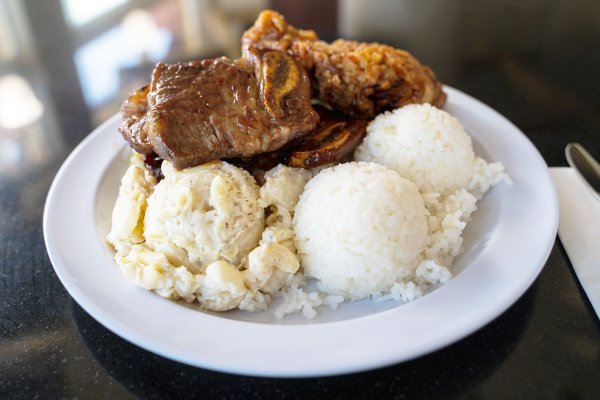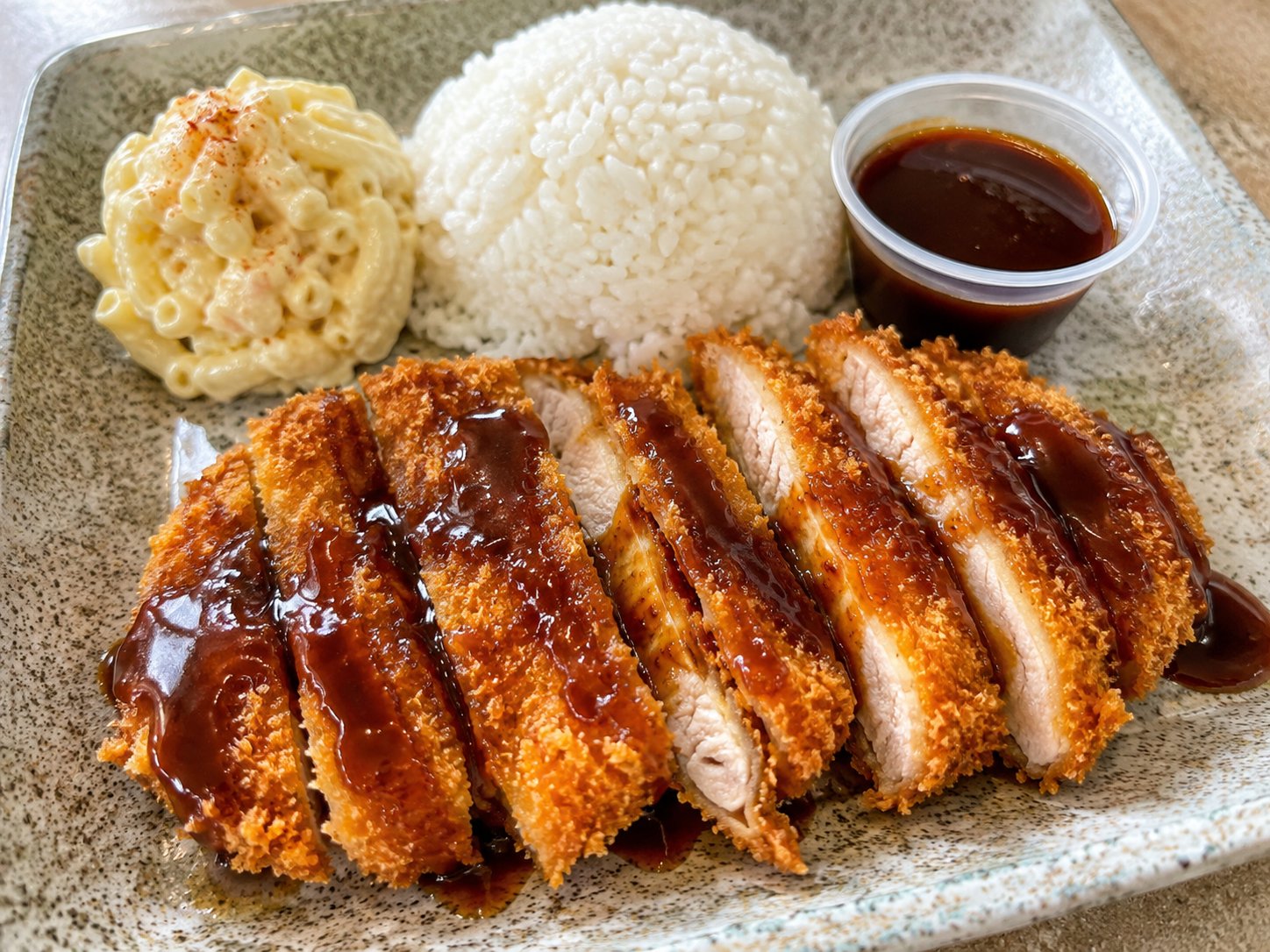
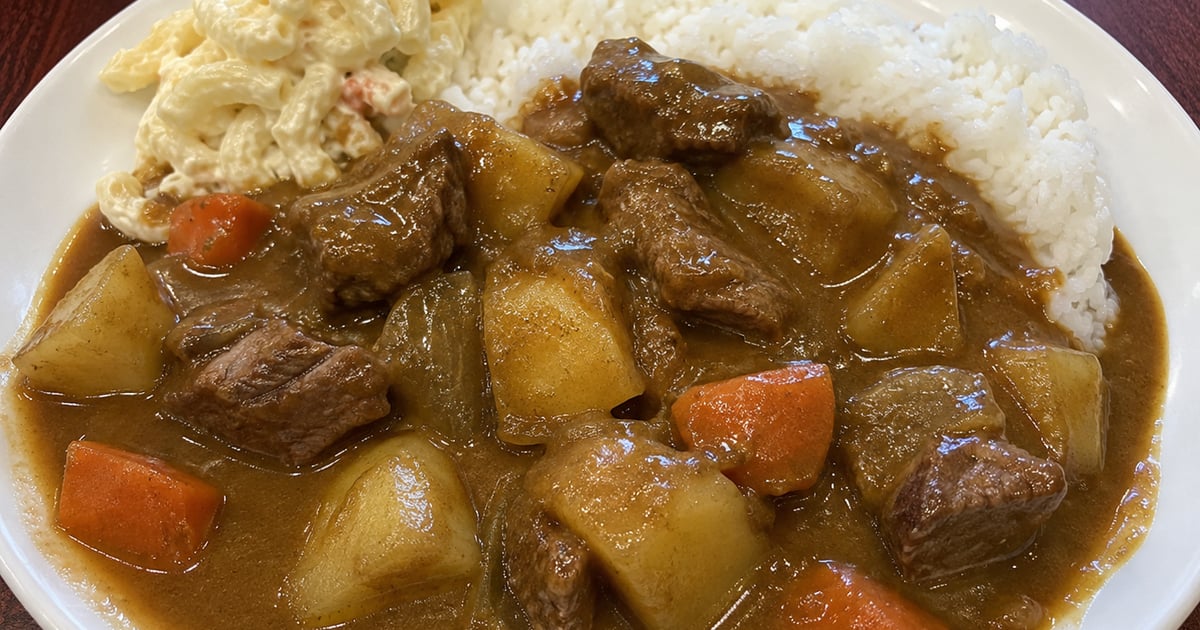

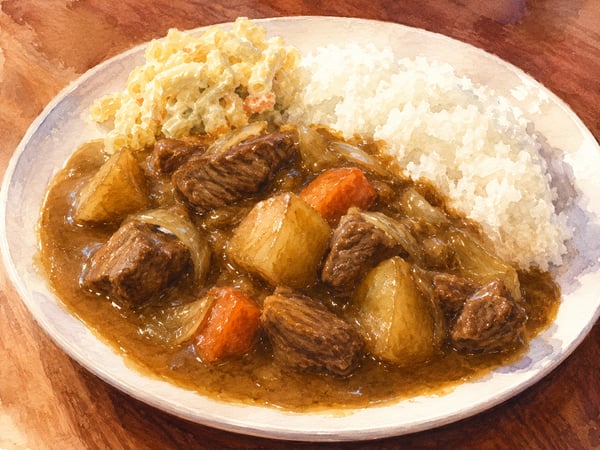
Hawaii-style curry rice descends straight from Japanese kare raisu. Same family-favorite stew, built around an S&B Golden Curry or Vermont Curry roux block, simmered with carrots, potatoes, onions, and a protein, ladled over white rice. The Hawaii version runs thicker, a little sweeter, and almost always shares the plate with something else. A chicken katsu cutlet. A hamburger patty. A scoop of macaroni salad. It's a plate-lunch fixture at counters like Zippy's, where the house menu still lists a Chili and Curry mixed plate decades on.
The dish came over with the Japanese laborers recruited to the sugar plantations in the late 1800s and early 1900s. It landed at a moment when Japanese curry itself was still relatively young — Japan had picked up curry from British naval cooks during the Meiji era, and the boxed roux home cooks lean on today became widely available in the mid-20th century. The Hawaii version that grew out of all that is its own animal: thicker sauce, flat plate instead of a bowl, mac salad on the side in true plate-lunch fashion.
At a glance
4 to 6
15 minutes
45 minutes
Easy
Ingredients
For the curry
- 1.5 lb beef chuck or boneless chicken thighs, cut into 1-inch cubes
- 2 tablespoons neutral oil
- 1 large yellow onion, sliced thick
- 3 cloves garlic, minced
- 1 tablespoon fresh ginger, grated
- 3 medium yukon gold potatoes, cut into 1-inch chunks
- 2 large carrots, cut into thick rounds
- 5 cups water or unsalted chicken broth
- 1 box (8.4 oz) Japanese curry roux, S&B Golden Curry or Vermont Curry, medium-hot
- 1 tablespoon shoyu (soy sauce)
- 1 teaspoon brown sugar
- 1 small apple, grated (the Hawaii sweetness trick)
Equipment
- Large heavy-bottomed Dutch oven or deep pot
- Wooden spoon
- Box grater (for the apple and ginger)
- Rice cooker (or pot with a tight-fitting lid)
To serve
- Two scoops of hot white rice (Calrose, the standard Hawaii table rice)
- Optional: a piece of chicken katsu alongside
- Optional: a scoop of local-style macaroni salad
- Optional: a few slices of red pickled fukujinzuke or yellow takuan on the side
Method
- Brown the protein. Heat the oil in the Dutch oven over medium-high heat until it shimmers. Pat the beef or chicken dry, salt lightly, and add to the pot in a single layer. Do not crowd. Sear undisturbed for 2 to 3 minutes per side until deeply browned. Work in batches if needed. Move the browned protein to a plate. The fond at the bottom of the pot is where the flavor lives. Don't clean the pot.
- Soften the aromatics. Reduce heat to medium. Add the sliced onion to the same pot and cook 8 to 10 minutes, stirring occasionally, until translucent and the edges are golden. Add the garlic and grated ginger and cook another minute until fragrant.
- Simmer with the vegetables. Return the browned protein to the pot. Add the potatoes, carrots, and water (or broth). Bring to a boil, reduce to a simmer, cover loosely, and cook for 25 minutes. Skim any foam that rises to the surface. That brown scum is concentrated impurities, and skimming it is what keeps the final curry clean-looking.
- Add the roux. Turn off the heat. Break the curry roux block into squares and drop them in. Stir gently until each square dissolves completely. This takes a few minutes. Add the shoyu, brown sugar, and grated apple. Turn the heat back on to low and simmer 5 to 8 minutes, stirring occasionally, until the curry thickens to the consistency of brown gravy. It should coat the back of a spoon.
- Serve plate-lunch style. Two scoops of hot white rice on a flat plate. Ladle the curry over half the rice, leaving the other half exposed. If you're going full Hawaii diner: a chicken katsu cutlet leaning on one side, a scoop of mac salad next to it, a few slices of red pickle. Eat with a fork. The yellow takuan or red fukujinzuke is the palate-reset between bites. Small portion, sharp pickle, then back to the curry.
Notes from a local cook
Boxed roux is not a shortcut, it's the canon. Hawaii curry rice is built on Japanese boxed curry roux. S&B Golden Curry and Vermont Curry are both the right call. The medium-hot box is the standard heat level. Mild for kids, hot if you want real bite. Trying to make this dish from scratch with curry powder and butter gets you a Western curry. Fine, but not this. The roux block is the dish.
The grated apple is the local move. Hawaii home cooks often add a grated apple to round out the sweetness and body of the sauce. Honeycrisp or fuji works well. It dissolves into the simmer and you won't see chunks, but you'll taste the depth. Skip the apple and the curry leans flat. Adding it after the roux dissolves keeps the apple flavor from cooking out.
Chunky vegetables. Cut the potatoes and carrots big, 1-inch chunks at minimum. They should be visible in the finished curry, not dissolved into the sauce. A long simmer at low heat keeps them soft but intact. If they're cracking apart at the end, your simmer was too hard, or they were cut too small.
Leftover curry is better the next day. The roux thickens further overnight and the flavors deepen. Reheat with a splash of water to loosen, and you have a second-day dinner that beats the first. Hawaii kids grow up eating curry leftovers. It's a respected second life.
While You're on the Islands
Eat it made by someone else. Plenty of plate-lunch counters around the islands carry curry rice. The most recognizable place to find it is Zippy's, the Hawaii diner chain whose menu lists curry on its own and as part of a chili-curry mixed plate. Rainbow Drive-In serves a chicken katsu curry that's the classic plate-lunch pairing, with two scoops of rice and a scoop of mac. Many small neighborhood Japanese-Hawaiian counters keep their own house version on the board too. See our Oahu dining guide and best plate lunch in Hawaii for more.
Buy the ingredients fresh. Japanese curry roux blocks (S&B or Vermont brand) are stocked in the Asian-foods aisle at any island grocery store — no special sourcing trip needed if you want to cook this in a vacation rental.
Bring It Home
What you can substitute, what you can't: Japanese curry roux blocks (S&B Golden Curry, Vermont Curry) are sold at most mainland Asian grocery stores and even some regular supermarkets now, so there's no special Hawaii sourcing required — just look for the same brand names once you're home.
Where to try this in Hawaii