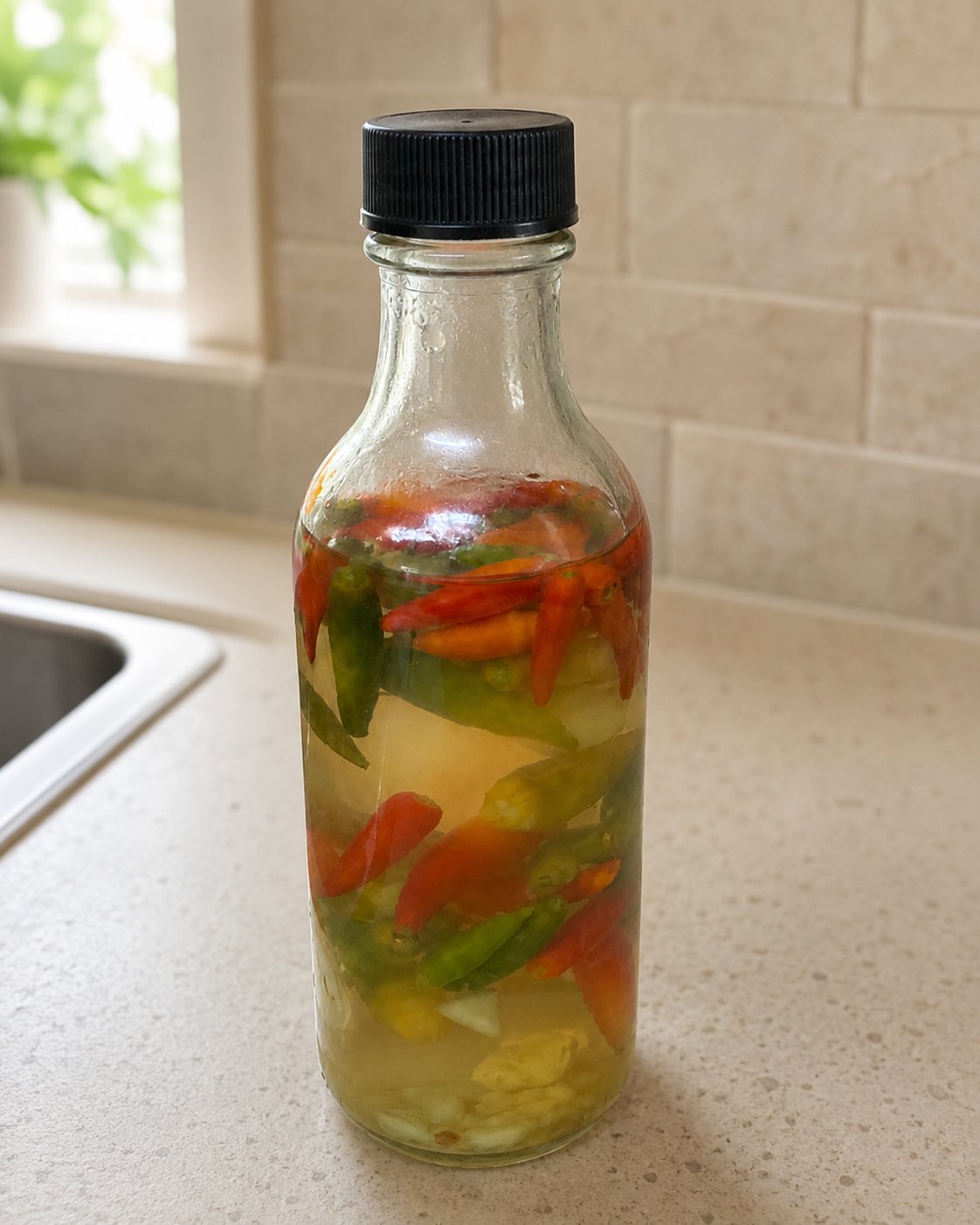

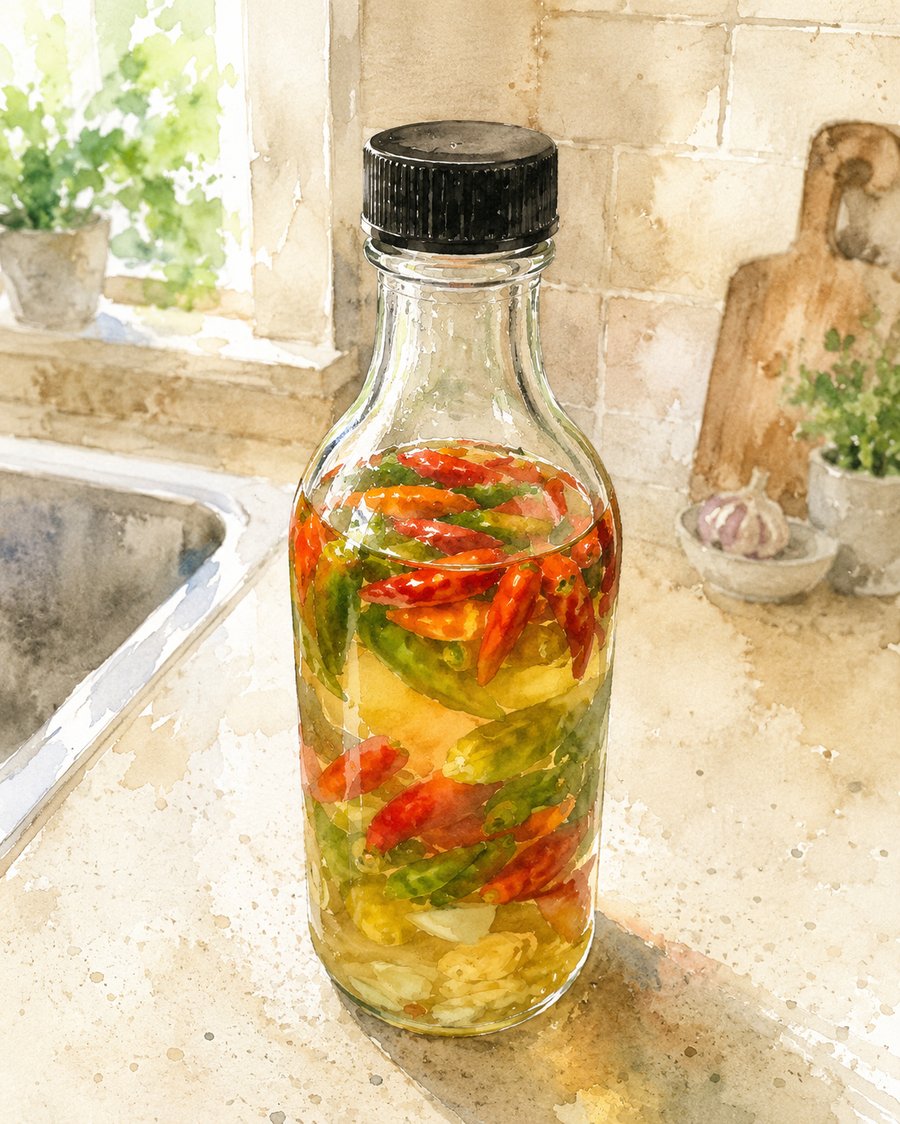
Chili pepper water sits next to the shoyu at the plate-lunch counter in a small clear bottle, looking like nothing — white vinegar and water steeped with a fistful of tiny Hawaiian chilies and a few smashed garlic cloves. A couple of drops over a bowl of stew, a fried egg, a piece of fish, a scoop of rice. Bright sharp heat that lifts the plate instead of smothering it. That is the whole point. A thick chili paste sits on top of food. This goes through it.
The pepper is the Hawaiian chili — nioi, also written nīʻoi in the Hawaiian dictionary — a small bird-pepper that grows wild and in backyards across the islands. The vinegar-and-water bottle is the local-kitchen version most island families keep on the table — usually described as a plantation-era adaptation, a way to stretch a handful of fresh chilies into something shelf-stable. Every family's bottle tastes a little different. The frame is fixed. The seasoning is yours.
At a glance
About 2 cups
10 minutes
3 days minimum
Easy
Ingredients
For the chili pepper water
- 20 to 30 small Hawaiian chilies (nioi), or 10 to 15 Thai bird chilies if you are on the mainland
- 4 to 6 cloves garlic, lightly smashed
- 1 cup distilled white vinegar
- 1 cup water
- 1 teaspoon Hawaiian sea salt (or kosher salt)
- 1 teaspoon sugar (optional, takes the edge off the vinegar)
- 1 small slice of fresh ginger (optional)
Equipment
- Small saucepan
- 16 oz glass bottle or jar with a tight lid — a cleaned-out hot-sauce bottle is perfect
- Small funnel
- Disposable gloves. Bird chilies are no joke on the fingers.
To serve over
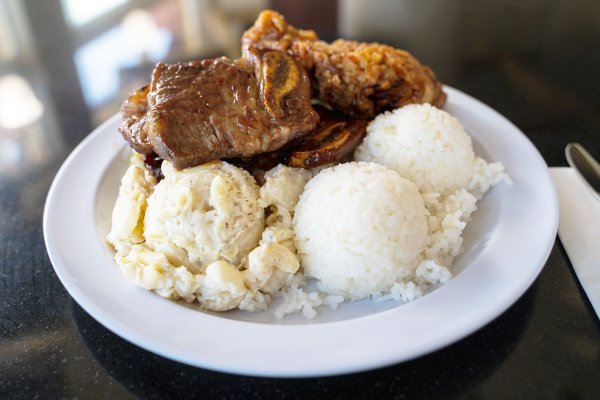
- Plate lunches, fried rice, kalua pig, eggs over rice
- Saimin, oxtail soup, beef stew, Portuguese bean soup
- Anything you would normally hit with Tabasco
Method
- Prep the chilies. Gloves on. Rinse the chilies and trim the stems. Leave them whole — seeds and ribs stay sealed inside the pepper so the heat releases slowly. Want it hotter? Slit 5 or 6 lengthwise.
- Sterilize the bottle. Wash the bottle and lid in hot soapy water, then pour boiling water over both and air-dry on a clean towel. Any film of old soap or food residue will cloud the infusion.
- Build the bottle. Drop the chilies and smashed garlic into the bottle. Add the salt, the optional sugar, and the optional ginger.
- Heat the brine. In a small saucepan, bring the vinegar and water just to a simmer. Do not boil hard. Pull off the heat the moment small bubbles ring the edge.
- Fill and seal. Pour the hot brine through a funnel into the bottle, covering the chilies completely. Leave 1/2 inch of headspace. Cap tight, cool on the counter, then move to a cool dark cupboard.
- Wait. Three days minimum. A week is better. The water should turn pale gold, and the bottle should smell sharp, garlicky, and warm-not-screaming when you crack the lid.
- Use and refill. Shake gently before each pour. As the level drops, top the bottle back up with fresh vinegar and water once or twice — the existing chilies keep giving. After the second refill, start a fresh batch.
Notes from a local cook
Whole chilies, not crushed. Crushed peppers turn the bottle muddy and over-extract the seeds, which gives the water a bitter back-end. Whole peppers steep slowly and the bottle stays clear. That is the look you want.
Vinegar matters less than you think. Distilled white is standard because it has no flavor of its own. Apple cider works (slightly fruitier). Unseasoned rice vinegar works too (slightly softer). Balsamic and red wine vinegar do not — both bury the chili under their own flavor.
How hot. Twenty whole Hawaiian chilies make a pleasant medium heat that builds over a few seconds and clears. On the mainland, Thai bird chilies (also called bird's-eye) are the closest substitute — same size, same shape, same Scoville range of roughly 50,000 to 100,000 SHU. Skip jalapeños and serranos — both are too vegetal and not hot enough to register here.
Storage and shelf life. My own rule of thumb, after years of keeping a bottle going on the counter: a capped bottle holds well in a cool cupboard for a few months. The flavor seems to peak somewhere between weeks two and six, then fades. If the chilies turn dull brown and the brine looks cloudy or smells off, dump it and start over.
While You're on the Islands
Eat it made by someone else. Plenty of old-school plate-lunch counters around the islands keep a bottle of chili pepper water on the table. Two I have eaten at and seen it on: Helena's Hawaiian Food on North School Street, where I shake it over the laulau and pipikaula, and Highway Inn at Kakaako and Waipahu, where it goes on the kalua pig and the beef stew. Worth asking your server if you do not see one — some places keep it tucked behind the counter. For where else to eat real Hawaii local food, see Oahu dining and the broader Hawaii Eats hub.
Buy the ingredients fresh. Hawaiian chili peppers grow in plenty of home gardens and turn up at farmers markets — ask any vendor selling produce if they have "Hawaiian chili pepper" specifically; it's a small, fiery variety distinct from a jalapeño or serrano.
Bring It Home
What you can substitute, what you can't: Thai bird's eye chilies are the closest mainland substitute for Hawaiian chili peppers — similar size and heat level. Garlic, vinegar, and water are the rest of the bottle, and none of those need special sourcing.