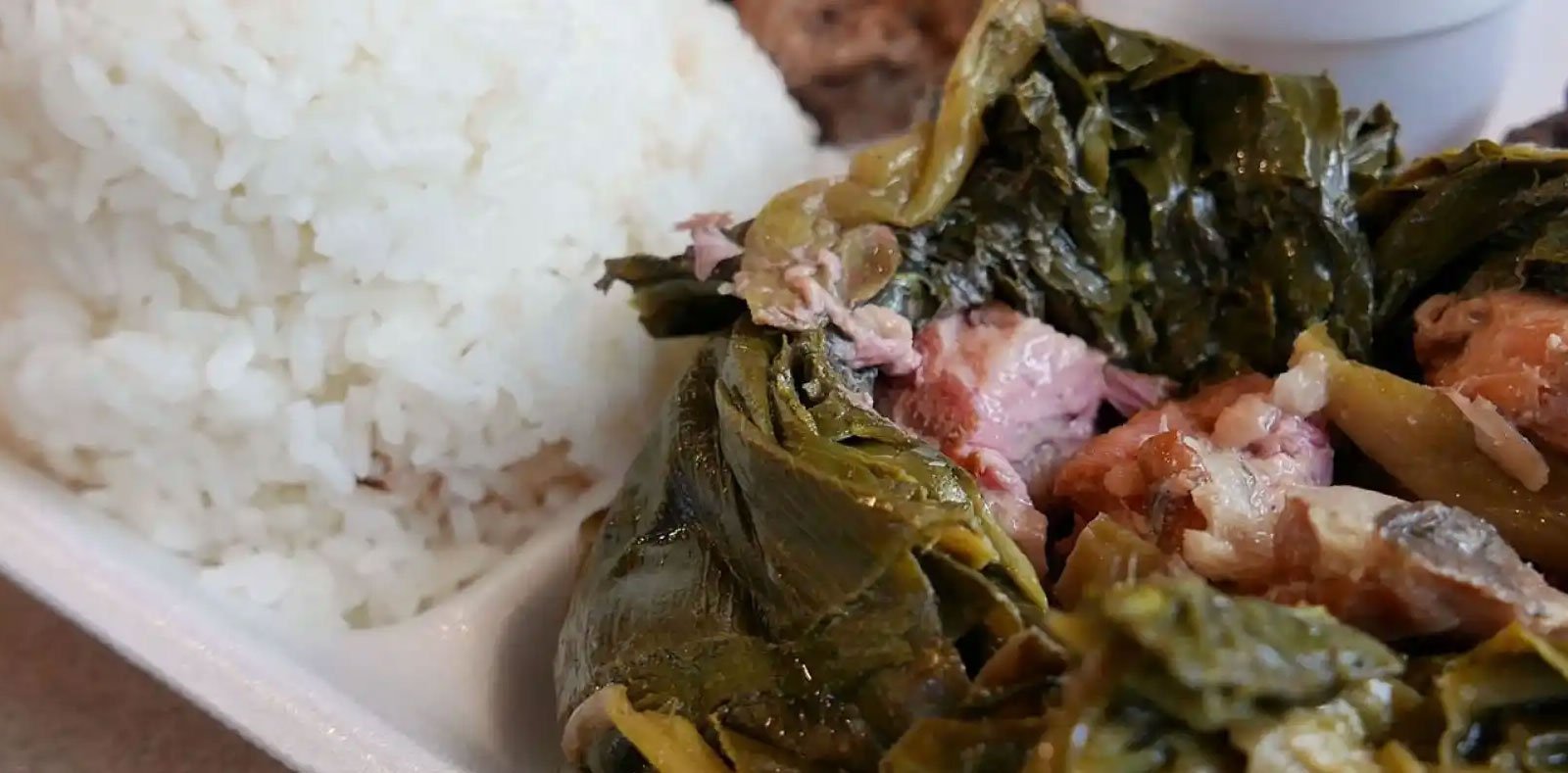


Laulau is one of the foundational dishes of Native Hawaiian cooking. The word means "to wrap" — lau is leaf, and laulau is the wrapped bundle (Hawaiian Dictionary, wehewehe.org). Pork and a piece of salted butterfish are bundled inside layers of young taro leaves (luau) — themselves a vegetable — then wrapped again in fibrous ti leaves to hold the package together, and steamed for hours until everything inside has cooked down into a silky, savory mass. Traditionally laulau was cooked alongside kalua pig in the same imu, the underground oven. Today most home and restaurant versions are steamed in a large pot over the stove for four or five hours.
You eat the wrapper. That is the first surprise for first-timers. The cooked luau leaves taste a bit like creamed spinach with a deeper, almost mineral note, and they have absorbed all the fat and salt from the pork and fish inside them. On a Native Hawaiian plate at Helena's Hawaiian Food or Highway Inn, the laulau is usually the thing people unwrap first.
At a glance
6 (one bundle per person)
40 minutes
4 to 5 hours steaming
Moderate
Ingredients
For the filling
- 2 lb pork shoulder, cut into 6 chunks (about 5 oz each)
- 6 oz salted butterfish (black cod), rinsed and cut into 6 pieces
- 1 tablespoon Hawaiian alaea sea salt
- 1 teaspoon black pepper
For the wrapper
- 30 to 36 young taro (luau) leaves — fresh from a Hawaiian grocer if you can find them, otherwise frozen
- 12 to 18 ti leaves (or substitute heavy-duty foil for the outer wrap)
Equipment
- Large stockpot with a steamer insert (or pasta pot with strainer)
- Kitchen twine
- Sharp knife and cutting board
To serve
- Steamed white rice or poi
- Lomi lomi salmon on a traditional Hawaiian plate lunch
Method
- Prep the luau leaves. Wash each leaf thoroughly under cold water. Cut out the thick central stem and the stalk — they take much longer to cook than the leaves, and raw taro contains calcium oxalate crystals that need long cooking to break down. If you cannot remove the stems entirely, score them with a knife to help them soften.
- Salt the pork. Season each pork chunk all over with the alaea salt and black pepper. The salt does double duty here — it seasons the pork and it draws moisture from the leaves so the package steams properly.
- Build the bundles. Lay 5 or 6 luau leaves in a stack with the largest on the bottom and the stems pointing in different directions. Place one chunk of pork and one piece of butterfish in the center. Fold the leaves up and over to enclose the filling completely, like wrapping a small gift. Wrap that bundle in 2 or 3 ti leaves (or foil if you must) and tie with kitchen twine. Repeat to make 6 bundles.
- Steam. Bring water to a rolling boil in the stockpot. Set the steamer insert above the water level (the bundles should not touch the water). Arrange the bundles in the steamer, cover, and steam for 4 to 5 hours. Check the water level every 45 minutes and refill with boiling water as needed. Do not let it run dry. The leaves are done when they are deep army green and tender enough to fall apart with a fork.
- Serve. Cut the twine, peel back the ti-leaf outer wrap (discard it), and eat the entire luau-leaf bundle including the wrapper. Plate with rice or poi on the side. The pork and butterfish should be silky-tender and have flavored the leaves throughout.
Notes from a local cook
The non-negotiable rule with laulau is the cook time. Raw and undercooked taro leaves contain calcium oxalate crystals — that is the cause of the scratchy throat sensation people get from a shortcut laulau. The fix is long, thorough cooking. A full 4 to 5 hours of steaming is what traditional recipes call for, and what I'd recommend. If the leaves still look firm or feel grassy at 4 hours, keep going. Do not shortcut this to 2 hours and hope for the best.
Frozen luau leaves are widely available in Hawaiian and Asian grocery stores on the mainland, and they work just as well as fresh once cooked. Salted butterfish (also called black cod) brings a salt-cured, almost ham-like quality that carries the dish — do not substitute fresh cod. Hawaiian grocers and many Asian markets sell it. Mainland substitute: a small piece of salted salmon belly will get you most of the way there.
Some Maui families add a chunk of taro to the bundle for extra body. Some replace the pork with chicken or beef. The frame is forgiving once you understand it: salt, fat, fish, and many layers of luau leaves, steamed long enough that the leaves themselves become the dish.
Where to try the real thing
If you're heading to Hawaii, the sit-down laulau worth planning around is at Helena's Hawaiian Food on North School Street in Kalihi (Oahu), a James Beard America's Classic honoree in 2000. Several of their combination plates pair the laulau with pipikaula short ribs. Highway Inn in Kakaako and Waipahu has been run by the Toguchi family since 1947 and now into its third and fourth generations. On Maui, small lunch counters along the Hana Highway often have laulau on the daily plate-lunch board — availability is hit or miss, so check the day you're driving rather than planning a special trip for it. See our full guides to Oahu dining and Hawaiian luaus.
Where to Eat It on Your Trip
Our picks for Laulau across the islands — tap a spot for hours, photos, and directions.
 Photo: Eddie KimOʻahu
Helena's Hawaiian Food
 Photo: r3xOʻahu
Waiahole Poi Factory
 Photo: Al HarrisonMaui
Da Kitchen
 Photo: Mama's Fish HouseMaui
Mama's Fish House
 Photo: Minn TunBig Island
Ippy’s Hawaiian BBQ
 Photo: Hanalei TaroKauaʻi
Hanalei Taro & Juice Co.
 Photo: Mark's PlaceKauaʻi