
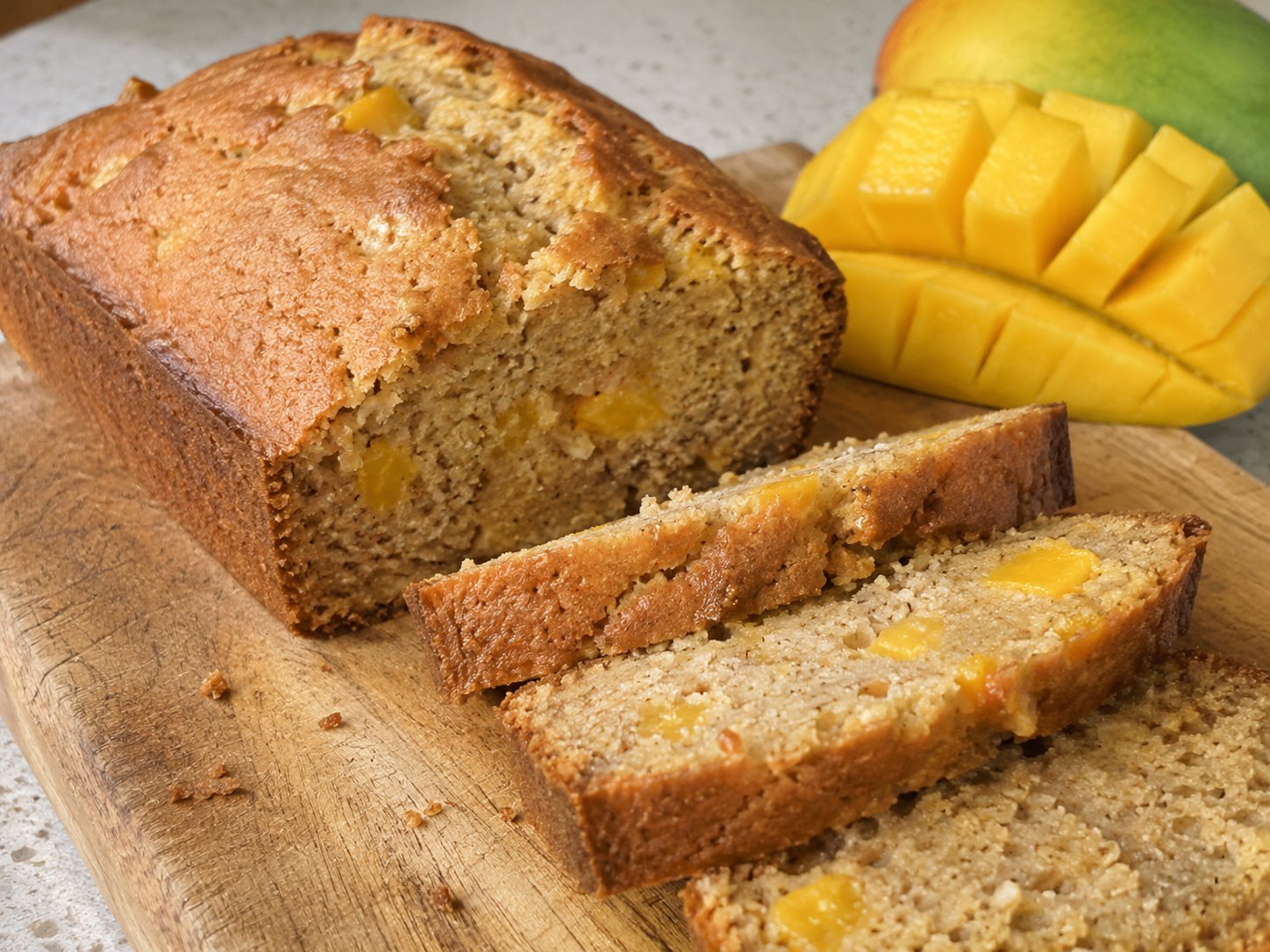

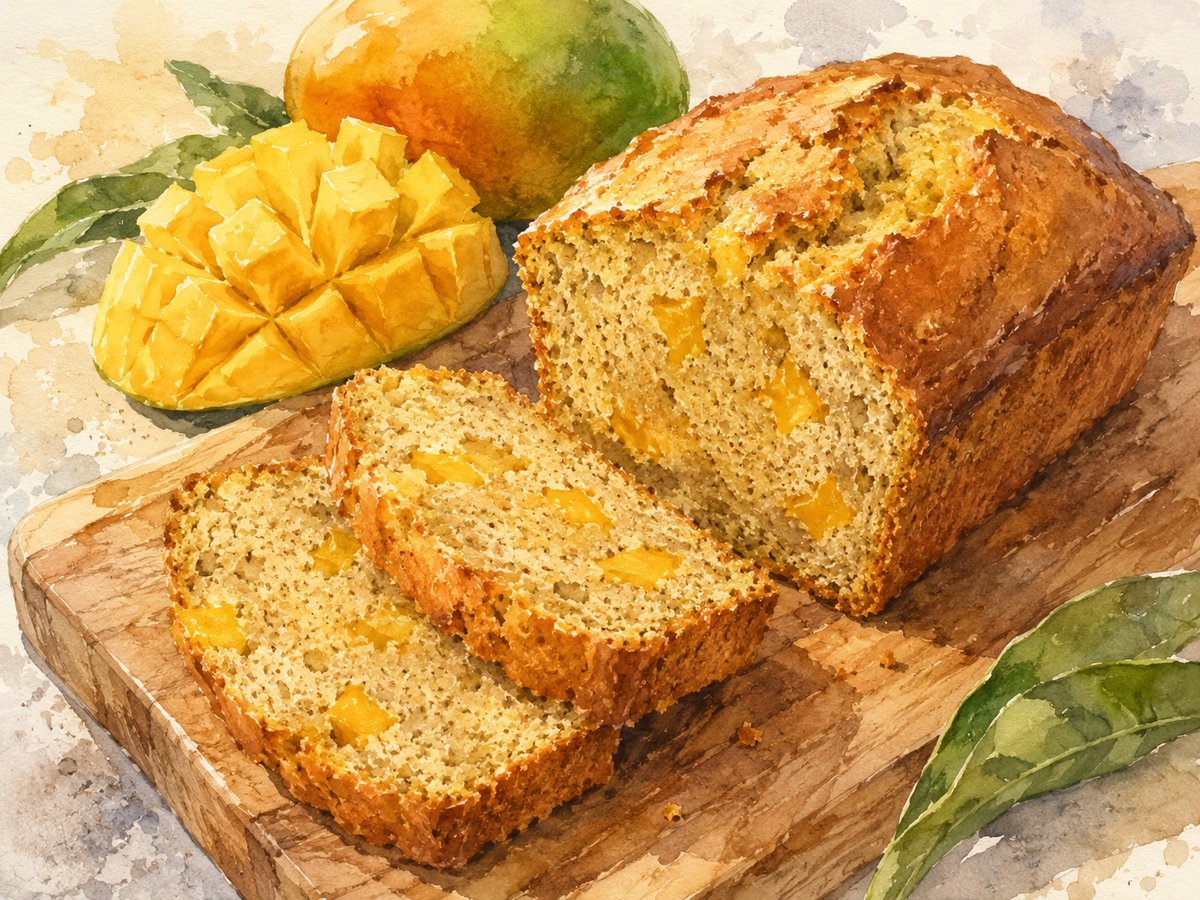
Mango bread is what Hawaii bakes when the trees come in. From about June through September, neighborhood mango trees drop more fruit than any one family can eat, and bags of ripe Haden, Pirie, and Rapoza mangoes start showing up on doorsteps and in office break rooms. The good ones get sliced and eaten over the sink. The half-ripe and the bruised get peeled, diced, and folded into batter for mango bread — a cinnamon-and-nutmeg quick bread that turns up at every summer potluck, school bake sale, and beach picnic on the islands.
Think of it as the local answer to banana bread. Oil, one bowl, low and slow. The mango pushes acid and a kind of perfume into the loaf that banana never does, so this version leans harder on the spice and throws in shredded coconut. Some families add macadamia nuts. Others add crystallized ginger. The version below is spiced, coconut-flecked, not too sweet, and forgiving when the mangoes are a little fibrous.
At a glance
1 large loaf (10 to 12 slices)
20 minutes
55 to 65 minutes
Easy
Ingredients
For the batter
- 2 cups all-purpose flour
- 1 cup granulated sugar (reduce to 3/4 cup if your mangoes are very sweet)
- 1 teaspoon baking soda
- 1/2 teaspoon baking powder
- 1/2 teaspoon salt
- 1 teaspoon ground cinnamon
- 1/2 teaspoon ground nutmeg
- 2 large eggs, at room temperature
- 1/2 cup neutral oil (canola, grapeseed, or vegetable)
- 1 teaspoon vanilla extract
For the fold-ins
- 1 1/2 cups peeled, diced ripe mango (about 2 medium Haden or Pirie mangoes)
- 1/2 cup sweetened shredded coconut
- 1/2 cup chopped macadamia nuts, optional
Equipment
- 9 x 5 inch loaf pan, greased and floured
- Two mixing bowls (one large, one medium)
- Whisk and rubber spatula
- Sharp paring knife for mango prep
To serve
- Salted butter for spreading on warm slices
- Coffee or strong black tea
Method
- Heat the oven, prep the pan. Set a rack in the middle of the oven and preheat to 350°F. Grease a 9 x 5 inch loaf pan with butter or non-stick spray and dust lightly with flour, tapping out the excess. A parchment sling cut to fit the long sides makes lifting the loaf out painless.
- Dice the mango. Peel the mangoes with a paring knife, slice the flesh off the seed in flat cheeks, and cut into 1/2-inch dice. You want chunks that hold their shape in the batter, not a puree. Drain on a paper towel briefly if they are very juicy.
- Whisk the dry. In a large bowl, whisk together the flour, sugar, baking soda, baking powder, salt, cinnamon, and nutmeg until evenly combined.
- Whisk the wet. In a medium bowl, whisk the eggs until smooth, then whisk in the oil and vanilla until emulsified.
- Combine, gently. Pour the wet into the dry and fold with a rubber spatula just until no dry flour streaks remain. The batter will be very thick and look dry — the mango brings the moisture. Fold in the diced mango, shredded coconut, and macadamia nuts. Stop folding the moment everything is distributed.
- Bake. Scrape into the prepared loaf pan and smooth the top. Bake at 350°F for 55 to 65 minutes, until the top is deep golden, the loaf has pulled slightly away from the pan, and a toothpick inserted into the center comes out with moist crumbs but no wet batter. If the top is browning too fast, tent loosely with foil after the 40-minute mark.
- Cool, then slice. Cool the loaf in the pan on a rack for 15 minutes, then lift out using the parchment sling and cool fully on the rack before slicing — about another hour. Slicing too early shreds the crumb because the mango is still steaming.
Notes from a local cook
Pick the right mango. Haden is the workhorse backyard mango across the islands, and Pirie is the old-time favorite a lot of families plant alongside it. Rapoza was developed on the Big Island and ripens later in the summer, usually July into August (see the CTAHR mango variety bulletin). Any sweet variety works. Avoid green or rock-hard mangoes — this is a recipe for ripe-but-not-mushy fruit. If your mangoes are very fibrous (common with seedling trees), pulse them briefly in a food processor instead of dicing.
Frozen mango works. When the trees are out of season, frozen diced mango from the grocer is a fair substitute. Thaw and drain it well first — a wet batter bakes up dense and gummy. Mango pulp from a can or pouch is too smooth for this recipe; you lose the fruit chunks that make mango bread mango bread.
Sweetness is a knob. Mangoes range wildly in sugar content. A bag of late-season Rapozas can be candy-sweet; an early Haden can be tart and brisk. Taste a piece before you mix. If it is on the sweet end, drop the sugar in the recipe to 3/4 cup. The bread should taste like fruit, not like cake.
Storage and freezing. Wrapped tight, the loaf keeps 3 days at room temperature and a week in the fridge. It freezes beautifully — slice first, wrap individual slices in foil, freeze in a zip-top bag, and thaw a slice at a time. The texture survives the freeze without much loss.
While You're on the Islands
Eat it made by someone else. Mango bread is mostly a home dish, not a bakery counter dish. In my experience, the easiest place to buy a decent loaf in summer is a Saturday farmers market — the Honolulu and Maui markets I shop usually have at least one baker working with that week's mango haul. Bigger grocers like Foodland run it as a seasonal bakery item at many stores when fruit is coming in. For more home-baking and Hawaii pantry guides, see Hawaii Eats.
Buy the fruit fresh. If you want to bake this yourself, the same farmers markets and Foodland stores sell ripe mangoes in season (roughly May through September) — squeeze gently for a little give, the way you would a ripe peach.
Bring It Home
What you can substitute, what you can't: ripe mangoes are sold seasonally at most mainland grocery stores too, just not always the same varieties grown in Hawaii. Any ripe, sweet mango works fine here — the bread isn't picky about cultivar, just ripeness.
Where to try this in Hawaii