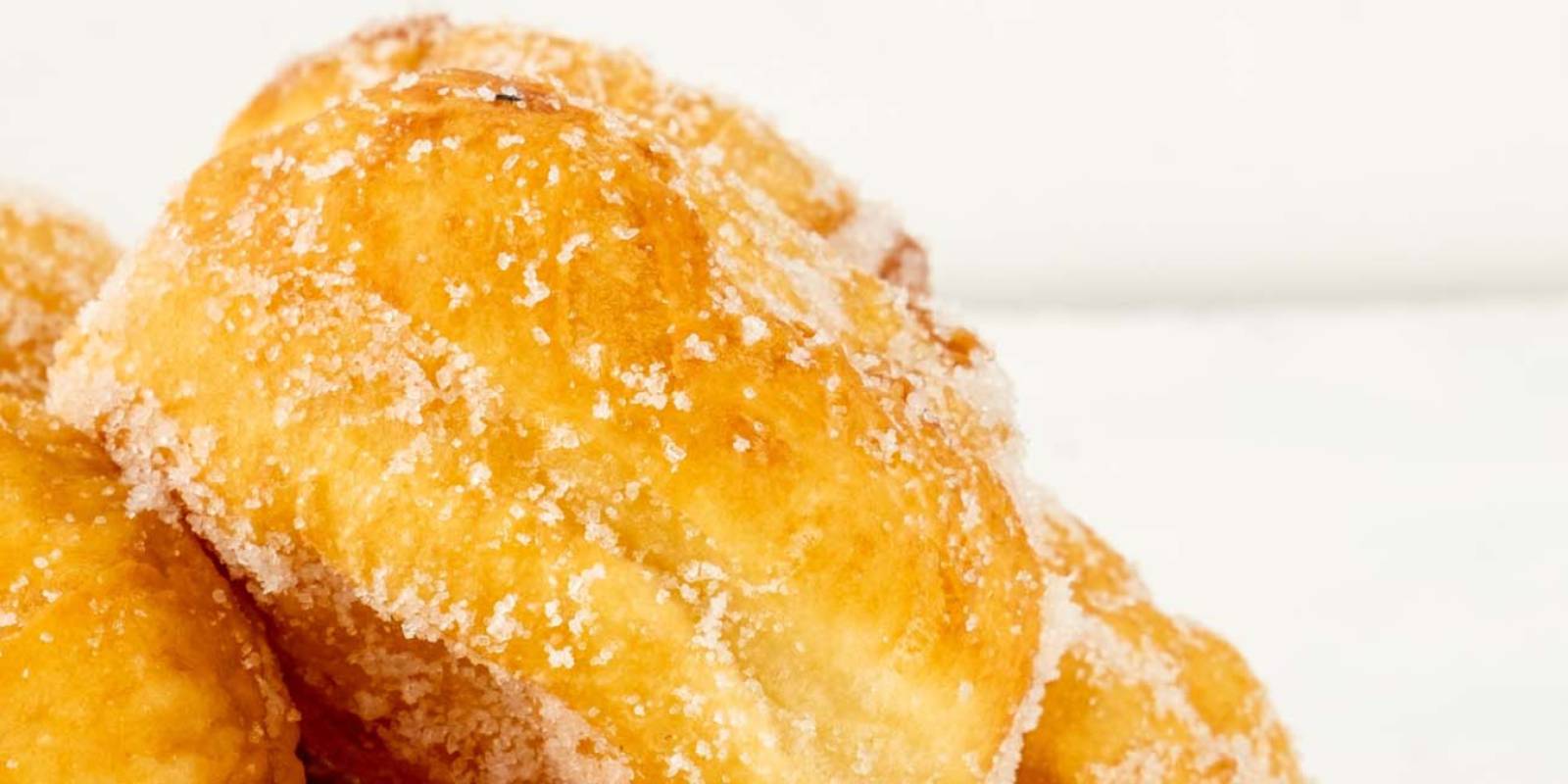
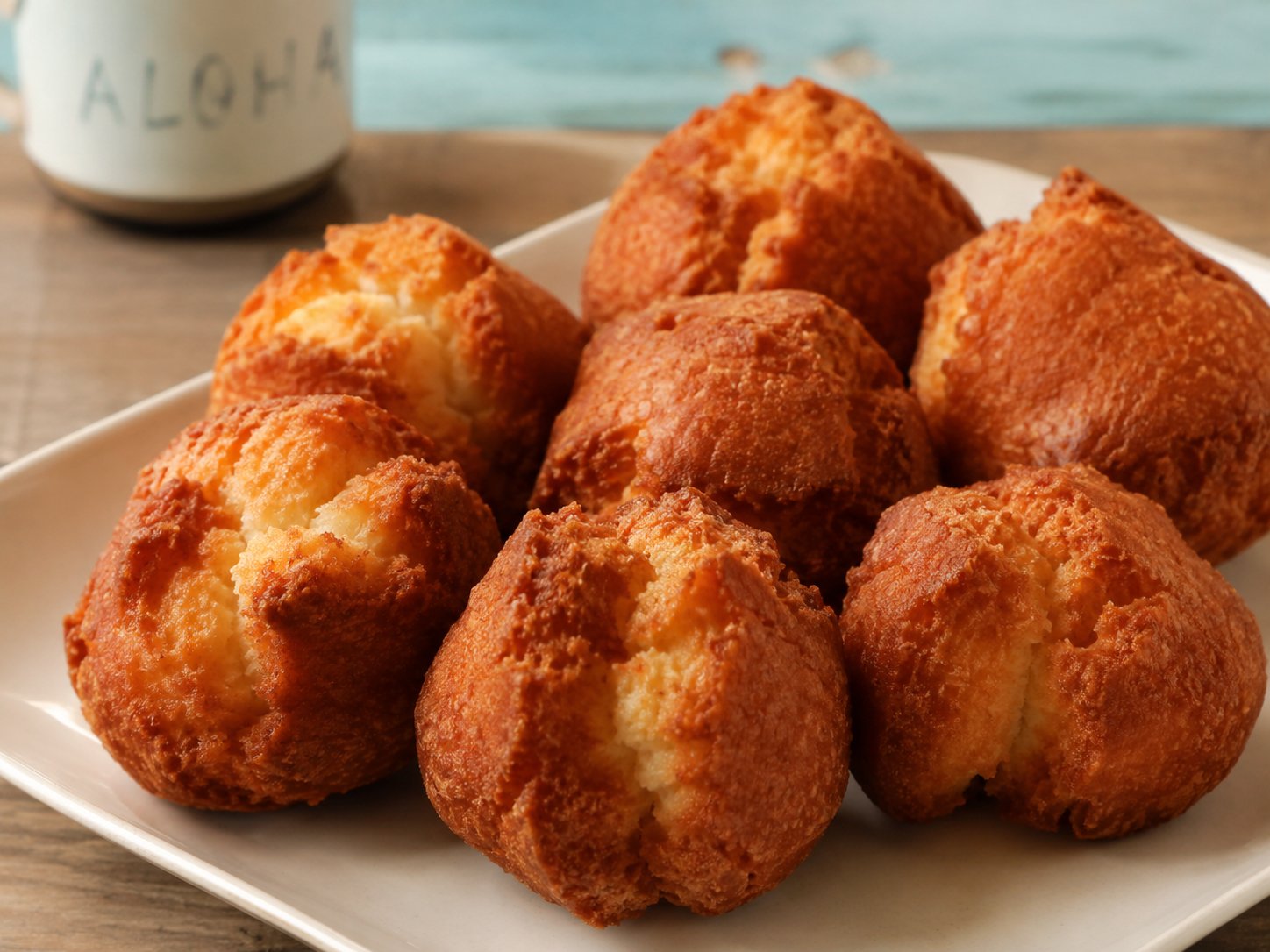

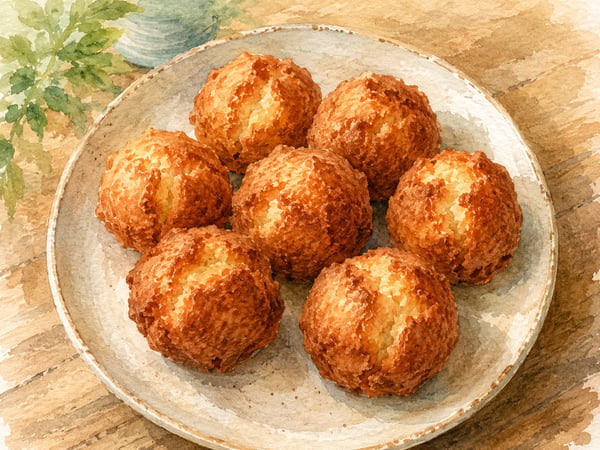
Andagi is a round, golf-ball-sized Okinawan doughnut with a crisp golden shell and a tender, cake-like crumb inside. The dough is barely sweet, dense with whole eggs, and shaped by hand into rough spheres that crackle open as they fry. The name comes from the Okinawan words aanda (oil) and agi (fried) — literally "fried in oil." On Hawaiʻi these are inseparable from the Okinawan community: the Okinawan Festival at the Hawaiʻi Convention Center frames its whole weekend around them, with volunteer crews frying in shifts for two straight days. Bon dance season brings them back out at temple lots all summer.
The plantation backstory: Okinawan workers began arriving in Hawaiʻi in 1900 to work the sugar and pineapple fields, and they brought andagi with them. The dough holds up: eggy and forgiving, no yeast, easy to fry a hundred at a time in a wok of hot oil. That made it the temple-fundraiser doughnut for most of a century, and that's mostly how it still gets made today.
At a glance
About 24 doughnuts
15 minutes
25 minutes
Easy
Ingredients
For the dough
- 2 cups all-purpose flour
- ¾ cup granulated sugar
- 2 teaspoons baking powder
- ¼ teaspoon salt
- 3 large eggs
- ¼ cup whole milk
- 1 teaspoon vanilla extract
For frying
- 4 to 6 cups neutral oil (canola, vegetable, or peanut), enough for 2 inches in your pot
Equipment
- Heavy 4- or 5-quart pot, or a wok
- Deep-fry or candy thermometer
- Two spoons or a small cookie scoop
- Wire rack set over a sheet pan
To serve
- Optional: a light dusting of granulated sugar while warm
- Hot coffee or cold milk
Method
- Whisk the dry. In a large bowl, whisk the flour, sugar, baking powder, and salt until evenly distributed.
- Mix the wet. In a separate bowl, beat the eggs lightly, then add the milk and vanilla. Whisk to combine.
- Bring it together. Pour the wet into the dry. Stir with a wooden spoon or spatula until just combined. The dough should be thick and sticky, somewhere between a drop biscuit dough and a stiff batter. Resist the urge to add flour. A stickier dough fries up rounder and lighter; a stiffer one comes out denser and oblong.
- Heat the oil. Pour 2 inches of oil into the pot and bring it to 325°F. This is lower than typical doughnut-frying temperature, and the reason matters: andagi are dense enough that the inside needs time to cook, and a hotter oil browns the shell before the center is set. If you don't have a thermometer, drop a small test ball. It should sink, then rise, and brown in about 3 minutes per side. Too fast means hot, too slow means cold.
- Shape and drop. Use two spoons (or a small cookie scoop) to scoop a generous tablespoon of dough, then push it off the spoon into the hot oil. Work in batches of 6 to 8 so the temperature doesn't drop. The doughnuts will sink, then float to the surface within 30 seconds. That's normal. They'll also crack open as they fry, exposing a paler interior. That irregular cracked-open look is the andagi signature.
- Fry through. Fry for 5 to 6 minutes total, turning gently so all sides brown evenly. The exterior should be a deep golden brown, darker than a yeast doughnut. To test for doneness, lift one out and split it: the center should be cooked through, not gummy. If the outside is browning before the center cooks, your oil is too hot. Drop it 10 degrees and try again.
- Drain and serve. Lift the andagi out with a slotted spoon and rest on the wire rack. Eat warm. They keep about a day on the counter in a paper bag (not plastic, which softens the shell and turns them rubbery).
Notes from a local cook
Don't over-mix the dough. Like pancake batter, andagi dough toughens fast. Stir just until the flour disappears. Lumps are fine. An over-mixed batch comes out dense and chewy instead of cakey.
Drop, don't roll. Festival cooks don't shape these. They push spoonfuls off a spoon directly into the oil. The dough is too soft to roll into clean balls without flouring your hands aggressively, and the more flour you add to your hands, the heavier each doughnut gets. The lumpy cracked-open look is correct.
Oil temperature is the whole game. 325°F is the andagi sweet spot. Hotter than 350°F and you get a dark shell over raw dough. Cooler than 310°F and they absorb oil and turn greasy. A clip-on thermometer is the single biggest upgrade for the recipe.
Variations. Some families add a tablespoon of melted butter to the wet for extra tenderness. Others fold in shredded coconut or a little brown sugar. Sata andagi (the cousin from southern Okinawa) uses brown sugar in the dough and skips the milk; it tastes more caramel-forward. Both are right.
While You're on the Islands
Eat it made by someone else. The largest open-to-the-public source is the Okinawan Festival at the Hawaiʻi Convention Center on Labor Day weekend, where the andagi line stretches across both days. Year-round, Teruya's Andagi at 1104 Pensacola Street in Honolulu has been frying them family-style for decades — takeout only, check their site for current hours before driving over. Pop-up vendors like Aloha Andagi have rotated through Marukai and the Pagoda Restaurant; Instagram is the most reliable way to catch a location. Through the summer, bon dance nights at Buddhist temples across Oʻahu, Maui, and the Big Island often have an andagi booth — see our Hawaiʻi Bon Dance Season guide for the schedule. For more on the Okinawan community's food legacy, our Oahu dining guide has the broader picture.
Bring It Home
What you can substitute, what you can't: there's no special Hawaii-only ingredient here — flour, sugar, and baking powder are the same everywhere. The thing that doesn't travel is the fry itself; andagi are best eaten the day they're made, while the crust is still crackly, so this is a make-it-fresh-at-home recipe rather than a stock-up-and-ship one.
Where to try this in Hawaii