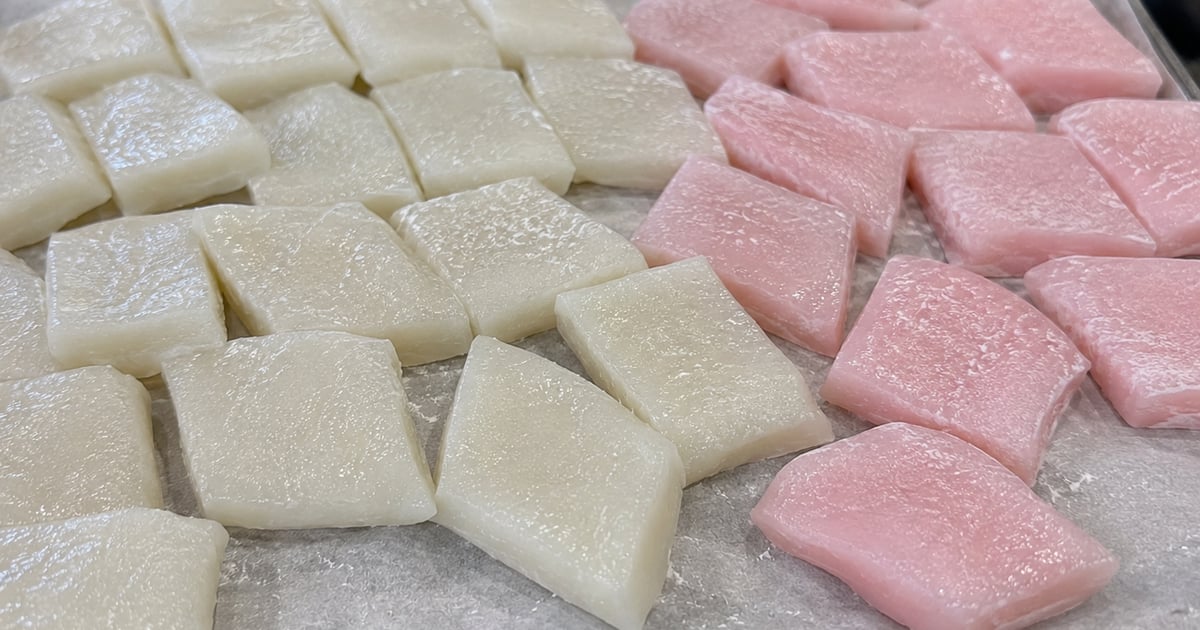


Chi chi dango is a soft, pastel-pink-and-white mochi cube that shows up on a lot of Japanese-Hawaiian family tables in early May. The name is a little misleading — in Japan, dango usually means firm, skewered rice balls. Hawaii's chi chi dango is something else: a baked sheet of sweet mochiko-rice batter, cut into pillowy squares and dusted with potato starch so they do not stick. The texture lands somewhere between Turkish delight and a marshmallow. It became a fixture of Boys' Day (Tango no Sekku, May 5) and Girls' Day (Hina Matsuri, March 3), with the pink-and-white color palette tied to both holidays.
If you walk into a long-running Honolulu Japanese candy maker like Nisshodo Candy Store in Kalihi any time in April, you will usually see trays of chi chi dango in pink, white, and pale green. The tradition of making mochi in Hawaii traces back to Japanese plantation-era families, and chi chi dango is one of the recipes that adapted to local ingredients — coconut milk in place of dairy or water, sugar dialed up, food coloring once it was cheap and available. The home version is forgivingly simple. One can of coconut milk, one box of mochiko, a lot of sugar, and an oven.
At a glance
About 64 small cubes
15 minutes
1 hour bake, 3 to 4 hours cool
Easy
Ingredients
For the batter
- 1 box (1 lb / 454 g) Koda Farms mochiko sweet rice flour — do not substitute regular rice flour
- 2 cups granulated sugar
- 1 teaspoon baking powder
- 1 can (13.5 oz) full-fat coconut milk
- 1 cup water
- 1 teaspoon pure vanilla extract
- 3 to 4 drops red food coloring (for the traditional pink)
For dusting
- 1/2 cup potato starch or cornstarch
Equipment
- 9 x 13 inch metal baking pan
- Parchment paper or aluminum foil
- Mixing bowl + whisk
- Plastic knife or sharp metal knife wiped between cuts
- Sieve for dusting
To serve
- Tea (genmaicha or hojicha works beautifully)
- A platter lined with parchment, dusted with starch
Method
- Prep the pan. Heat the oven to 350°F. Line the 9 x 13 inch pan with parchment paper, leaving an overhang on the long sides so you can lift the slab out later. Lightly grease the parchment.
- Whisk the dry, then the wet. In a large mixing bowl, whisk the mochiko, sugar, and baking powder together until uniform. Add the coconut milk, water, and vanilla. Whisk until the batter is smooth and pourable with no lumps — about a minute of steady whisking. Stir in the food coloring until you have an even pale pink. (For a multicolor batch, see the note below.)
- Pour and bake. Pour the batter into the prepared pan. Tap the pan on the counter twice to release any large air bubbles. Bake on the middle rack for 60 minutes. The top will set into a slightly tacky surface and the edges will pull just a hair away from the pan. A skewer inserted in the center should come out with sticky-but-clean traces of batter clinging to it — not wet, not dry.
- Cool fully before cutting. Lift the slab out onto a wire rack using the parchment overhang. Let it cool completely at room temperature, at least 3 hours and ideally 4. Cutting warm chi chi dango will compress and tear the cubes; cool ones cut clean.
- Cut and dust. Sprinkle the top of the cooled slab generously with potato starch. Flip onto a starch-dusted cutting board. Using a plastic knife (or a metal knife wiped clean between every few cuts), slice into 1-inch cubes. Toss each cube in starch as you go so they do not stick to each other. Layer on a starch-dusted plate.
Notes from a local cook
Mochiko, not regular rice flour. This is non-negotiable. Mochiko is short-grain sweet rice ground fine, and it is what gives chi chi dango its springy, chewy texture. Standard rice flour (the kind sold in the gluten-free aisle for baking) is the wrong starch and will produce a sandy, crumbly result. Koda Farms is a common brand in Hawaii pantries and the one most local recipes call for; Asian-grocery house brands work fine too — just check the label says “sweet rice flour” or mochiko.
Plan on the slow cool. A common rookie move is cutting at the 90-minute mark while the slab is still warm. The cubes will smush together within a few hours. Cool the whole slab on the counter for 3 to 4 hours minimum — longer is better. The chi chi dango will keep its shape and the dusting starch will actually adhere to the surface.
For a multicolor batch, split the batter. Divide the batter into 2 or 3 bowls before adding coloring. Add 3 drops red to one bowl for pink, leave one bowl plain for white, and add 1 drop green to a third for pale green if you want the full color palette. Pour the colored batters into separate small pans (or alongside each other in the same pan, separated by a foil divider). They bake in the same 60 minutes.
Storage. Chi chi dango is best the day it is made. It will keep at room temperature, covered with a clean towel (not airtight — the trapped moisture will go funky), for 2 days. Do not refrigerate — cold turns the mochiko hard and rubbery. If you must store longer, freeze in a single layer between sheets of parchment and thaw at room temperature.
While You're on the Islands
Eat it made by someone else. One reliable place to taste chi chi dango from a longtime Japanese-Hawaiian candy maker is Nisshodo Candy Store in Kalihi (Oʻahu), a family-run mochi shop with deep roots in the neighborhood. On Hawaiʻi Island, Two Ladies Kitchen on Kilauea Avenue in Hilo is the long-running counterpart — a counter-service mochi shop that has been a Hilo fixture for years. Around early May and early March, many local Japanese-Hawaiian markets and bakeries put pink-and-white chi chi dango trays out for the holidays; call ahead before a special-trip detour. See our guide to Oahu dining for more long-running Honolulu sit-downs.
Buy the ingredients fresh. Mochiko (sweet rice flour) and food coloring are both stocked at any Japanese grocery on the islands, like Don Quijote — easy to grab if you want to make this in a vacation rental.
Bring It Home
What you can substitute, what you can't: mochiko is sold at most mainland Asian grocery stores under the same name (the Koda Farms brand is the most common), so there's nothing here that needs special sourcing from Hawaii — just know the name to ask for.