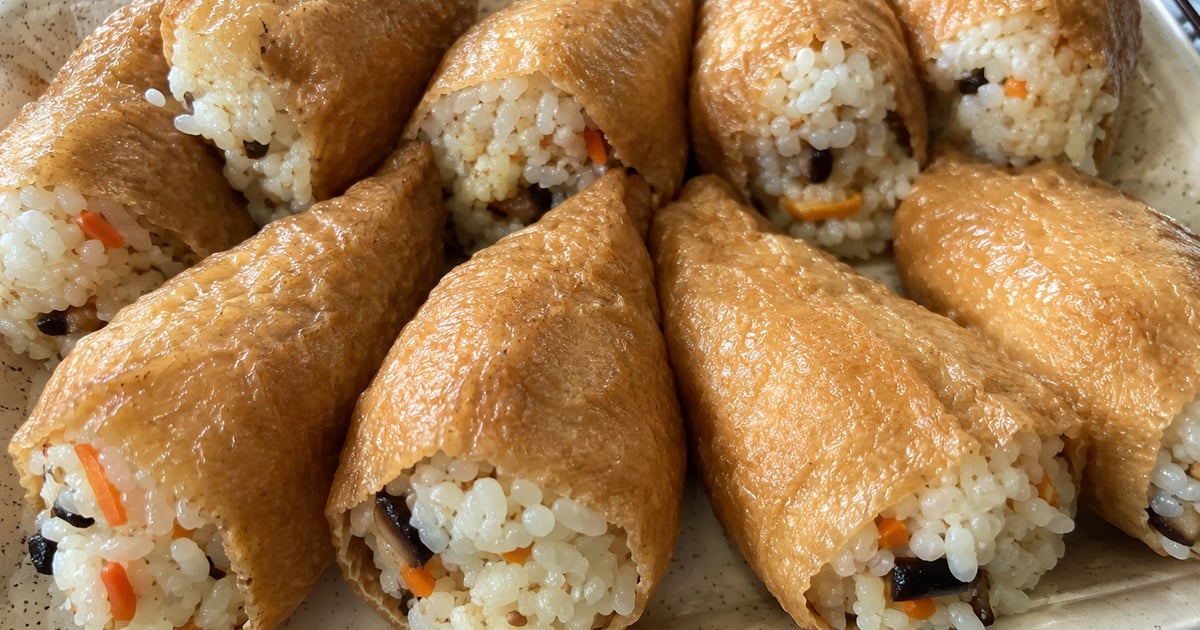

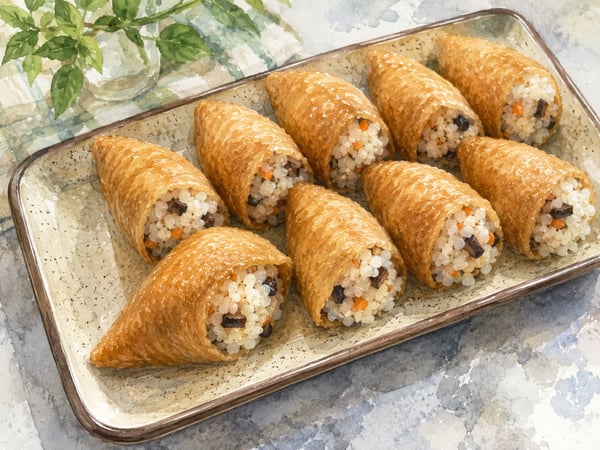
Cone sushi is the most Hawaii-bento thing on a Hawaii bento. A wedge-shaped pouch of sweet, soy-simmered fried tofu — aburaage — stuffed plump with vinegared sushi rice. You eat it with your fingers like an open-faced taco. The pouch is silky and sweet, the rice is cool and a little tart from rice vinegar, and the combination is somehow both substantial and refreshing. It travels well, eats well at room temperature, and is the first thing to disappear off a potluck table.
Mainland sushi menus call it inari sushi or inari-zushi. In Hawaii it's almost always "cone sushi" — a reference to the triangular pouch shape. Japanese immigrants brought the dish to the islands during the plantation era, beginning with the first arrivals in 1868 and the larger labor waves after 1885, and it threaded its way into the local bento and potluck repertoire. You'll find it today at most Don Quijote takeout counters, in the deli case at Foodland, and on bento trays at Times Supermarket. The home version is a Saturday afternoon project. Plan to make a lot — they will not last.
At a glance
16 pieces (one pack of aburaage)
30 minutes (plus rice cooking)
25 minutes
Moderate
Ingredients
For the pouches
- 1 pack (8 sheets) aburaage (fried tofu pouches), found refrigerated or frozen at Asian grocery stores — yields 16 cones when cut diagonally
- 1 cup dashi (Japanese soup stock — instant dashi powder dissolved in water works perfectly)
- 1/3 cup shoyu (soy sauce)
- 1/3 cup granulated sugar
- 2 tablespoons mirin
- 1 tablespoon sake (optional)
For the sushi rice
- 2 cups Calrose or other short-grain rice (raw, before cooking) — yields about 5 cups cooked
- 2.25 cups water (or per your rice cooker's directions for sushi rice — slightly less than usual)
- 1/3 cup rice vinegar
- 3 tablespoons sugar
- 1 teaspoon Hawaiian salt or kosher salt
- 2 tablespoons toasted sesame seeds (mixed into the rice)
- Optional add-ins: finely diced carrot blanched soft, finely diced reconstituted shiitake, finely chopped takuan (pickled daikon)
Equipment
- Rice cooker (or pot for stovetop rice)
- Wide saucepan (10-inch) for simmering the pouches
- Drop lid (otoshibuta) OR a circle of parchment paper
- Small bowl of water for wetting your hands
- Wooden rice paddle or large spoon
- Wide platter or shallow tray for serving
Pantry notes
- Aburaage comes in flat rectangular sheets; the standard Japanese pack has 8 sheets and yields 16 cones when each is cut on the diagonal
- Some Asian markets sell pre-seasoned, ready-to-stuff inari pouches in a can or vacuum pouch — a real shortcut and not a cheat
- Dashi powder (Ajinomoto Hondashi or similar) keeps for months in the pantry
Method
- Start the rice. Rinse the rice under cold water until the water runs mostly clear. Cook with 2.25 cups water in your rice cooker on the white-rice setting. While the rice cooks, get everything else ready.
- De-grease the aburaage. The fried tofu pouches come coated in their frying oil. Bring a small pot of water to a boil, lower the aburaage in, and boil for 2 minutes. Drain, rinse under cold water, and gently press between your palms to squeeze out the water and the residual oil. Don't tear them. Now cut each rectangular sheet in half on the diagonal — you'll have 16 triangular pouches with the cut side as the opening.
- Open the pouches. Working one at a time, slide a chopstick or your finger into the cut edge and gently rub the inside walls of each pouch to separate them and create a hollow cavity. Some pouches will tear; that's normal. Patched pouches still work for eating, they just stuff a little messy.
- Simmer the pouches. In the wide saucepan, combine the dashi, shoyu, sugar, mirin, and sake. Bring to a boil over medium-high heat, stirring once to dissolve the sugar. Add the prepared aburaage pouches, opening side up, in a single layer if possible (two layers is fine — they'll all braise). Reduce to medium-low and place a drop lid (or a circle of parchment with a small slit cut in the middle) directly on the surface. Simmer for 15 to 20 minutes, until most of the liquid has been absorbed and the pouches are deep amber and glossy. Turn off the heat and let them sit in the residual liquid while you finish the rice.
- Dress the rice. Stir together rice vinegar, sugar, and salt in a small bowl until dissolved. When the rice is done cooking, immediately tip it into a wide bowl (a Japanese sushi-rice bowl, hangiri, is traditional but any wide nonreactive bowl works). Drizzle the vinegar mixture over the rice. Using a wooden paddle or spoon, fold the rice with a cutting-and-scooping motion to mix in the dressing without mashing the grains. Fan the rice while you do this if you have a helper or a small fan — it cools faster and the grains stay glossy instead of going gummy. Stir in the sesame seeds and any optional add-ins.
- Stuff and shape. With wet hands (to keep the rice from sticking), pinch off a portion of rice — about 2.5 tablespoons or roughly the size of a golf ball — and lightly squeeze it into a slightly tapered cylinder. Pick up a simmered pouch, gently press to open the cavity, and tuck the rice cylinder inside. Press the top edges of the pouch slightly closed so the rice peeks out the top but doesn't fall out. Don't overfill — the pouches stretch and split. Set on the serving platter as you go.
- Rest and serve. Cone sushi tastes best at room temperature, about 30 minutes after stuffing — the rice has a chance to absorb a little of the sweet pouch juice and the flavors marry. Eat with your hands. If you must refrigerate them, cover tightly and bring back to room temperature before serving; never serve straight from the fridge.
Notes from a local cook
The pouch braise is everything. The aburaage absorbs the dashi-shoyu-sugar liquid like a sponge — and that absorbed liquid is what makes cone sushi cone sushi. If the simmer is too short, the pouch tastes bland and oily. If it's too long, the pouch falls apart on the stuffing step. Fifteen to twenty minutes on a low simmer, with a drop lid keeping everything submerged and steamy, is the sweet spot. The pouches should be glossy and visibly stained mahogany when you pick one up.
About the rice add-ins. Plain rice with sesame seeds is the most common version, especially at Hawaii bento counters. Some families fold in finely diced cooked carrot, reconstituted-and-diced shiitake, or chopped takuan for crunch and color. A small handful of any of those, added at the rice-mixing stage, is traditional too. Don't overdo it — the pouch is doing most of the flavor work.
The pre-seasoned pouch shortcut. Many Asian markets carry pre-seasoned ready-to-stuff aburaage in cans or vacuum pouches — sold as "seasoned fried bean curd" or "ajitsuke inari age," usually from a Japanese food brand. They're not a cheat — they cut a real corner with no quality loss. If you make cone sushi a few times a year for potluck duty, keep two cans in the pantry. The rice is still on you.
Storage. Cone sushi is best the day it's made. Refrigeration toughens the rice and the pouch loses its silky give. If you must store, wrap in plastic and refrigerate up to 24 hours, then bring to room temperature for at least 45 minutes before eating. Never microwave — the rice goes mushy and the pouch turns rubbery.
While You're on the Islands
Eat it made by someone else. Hawaii's reliable everyday cone sushi lives at supermarket prepared-foods counters across the islands — the deli case at Foodland and the bento section at Times Supermarket are both worth checking. The Don Quijote stores in Kaheka (Honolulu), Pearl City, and Kapolei carry a wider rotating bento selection, and small standalone bento counters around Honolulu and the neighbor islands often have it on the daily menu. For more on the Japanese-Hawaiian bento and plate-lunch tradition see our Oahu dining guide and our broader Hawaii Eats coverage.
Buy the ingredients fresh. Seasoned fried tofu pouches (the cones themselves) are sold pre-made in the same Asian-foods aisle at any island grocer — much easier than making them from scratch if you want to assemble these in a vacation rental.
Bring It Home
What you can substitute, what you can't: pre-seasoned inari (fried tofu pouches) are sold at most mainland Japanese grocery stores under the same name, so there's no special Hawaii sourcing needed — just look for "inari age" or "seasoned tofu pouches" once you're home.
Where to try this in Hawaii