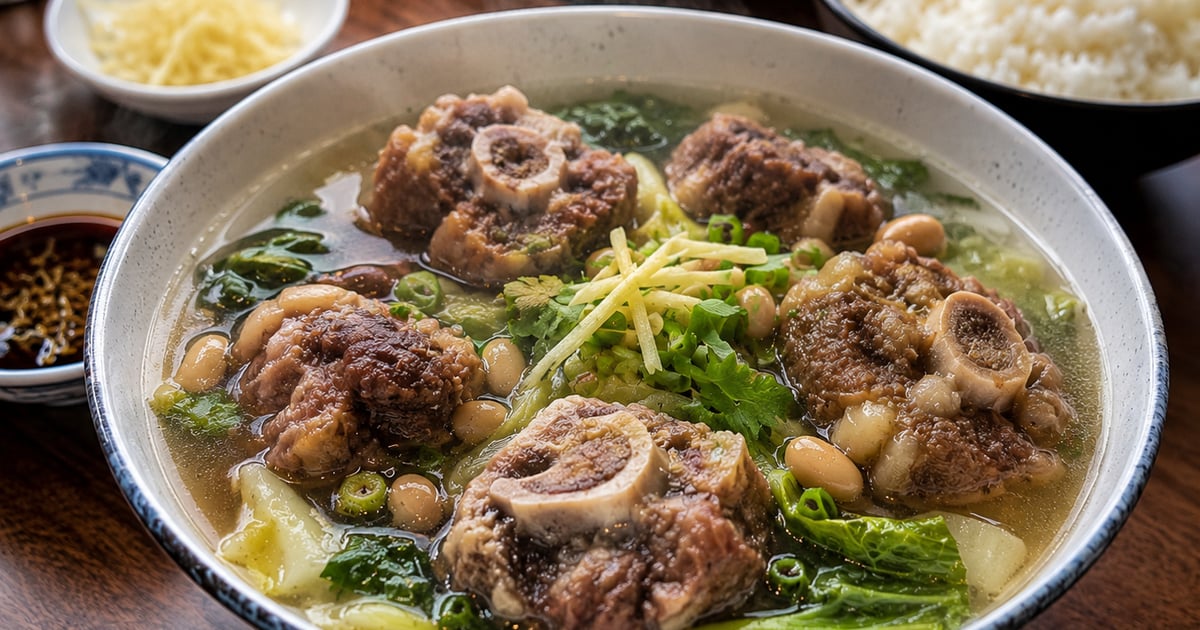

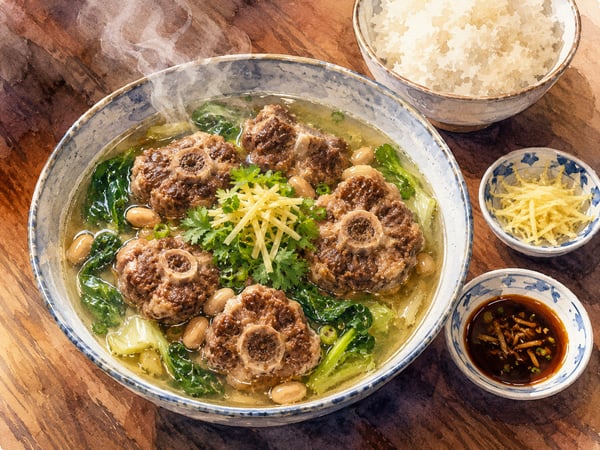
Hawaii oxtail soup takes all day and tastes like nothing else. A clean, clear, almost amber broth. Oxtails simmered until the meat slips off the bone. Raw peanuts cooked soft into the broth. Dried tangerine peel and star anise perfuming the whole pot. Mustard cabbage cooked just to the point of tender. You eat it with a bowl of hot white rice and a saucer of grated ginger and shoyu on the side. People are protective of how it should taste. They are correct to be.
The dish is Cantonese in lineage, brought to Hawaii by Chinese immigrants during the plantation era of the 1800s, then settled into the islands' Chinese-counter and saimin-stand repertoire — where it's been served for breakfast, lunch, and dinner ever since. The Hawaii version sets itself apart with raw peanuts simmered in the broth, dried tangerine peel (chenpi), star anise, ginger, and mustard cabbage as the green. My favorite bowl in Honolulu is at Asahi Grill on Ward Avenue. Every neighborhood has its own version. This is mine.
At a glance
6 generous bowls
25 minutes
4 hours simmering
Easy (low and slow)
Ingredients
For the soup
- 4 lb meaty beef oxtails, cut crosswise into 2-inch pieces by your butcher
- 1 cup raw peanuts (skin-on, not roasted, not salted)
- 1 large knob of fresh ginger (about 3 inches), smashed but left whole, plus more for the table
- 6 cloves garlic, smashed but left whole
- 2 whole star anise pods
- 2 strips dried tangerine peel (chenpi) — about the size of a quarter each
- 1 tablespoon Hawaiian salt or kosher salt, plus more to taste
- 1 small head mustard cabbage (gai choy), cut into 2-inch pieces, washed thoroughly
- 3 stalks green onion, cut into 1-inch lengths (plus more for serving)
- Cilantro for serving
For the table
- Fresh grated ginger
- Aloha Shoyu or your shoyu of choice
- Hot steamed white rice
Equipment
- Large heavy stockpot (8 quarts or larger)
- Strainer or skimmer for skimming foam
- Sharp knife
- Small bowls for the ginger-shoyu dip
Pantry notes
- Dried tangerine peel keeps a long time when sealed and stored dry — a single bag will last you many batches
- Mustard cabbage (gai choy) is the right green; bok choy works in a pinch but is sweeter and softer
- Raw peanuts are sold in the snack aisle of most Asian grocery stores. Don't substitute roasted peanuts — the broth will turn muddy
Method
- Blanch the oxtails. Put the oxtails in your stockpot, cover with cold water, and bring to a hard boil for 5 minutes. Lots of brown foam will rise. Drain the oxtails, discard the blanching water, and rinse the oxtails under cold running water until clean. This step is the difference between a clear broth and a cloudy one. Don't skip it.
- Start the broth. Return the rinsed oxtails to the pot and cover with 4 quarts (16 cups) of fresh cold water. Add the raw peanuts, smashed ginger, smashed garlic, star anise, dried tangerine peel, and the salt. Bring to a boil, then immediately reduce to a bare simmer.
- Simmer slowly. Cover partially and simmer for 3.5 to 4 hours. The broth should barely move. Skim any foam that rises in the first 30 minutes. The oxtails are done when the meat slumps off the bone at the touch of chopsticks. Test one. If it resists, give it another 20 minutes.
- Add the greens. When the oxtails are tender, add the mustard cabbage and the green onion lengths. Cook for 5 to 7 minutes. You want the mustard cabbage tender but still bright green, not olive. Taste the broth and add more salt only at this point. Salt too early and you'll over-salt as the broth reduces.
- Serve. Ladle into deep bowls. Get a few peanuts and a piece of mustard cabbage into each bowl alongside the oxtails. Top with a small handful of green onion and cilantro. Serve with hot white rice, and a small dipping saucer of grated fresh ginger with a few drops of shoyu, which is what you'll dunk each bite of oxtail meat into.
Notes from a local cook
Clean broth is the whole point. The blanching step in stage 1 is non-negotiable. Skip it and you produce a brown, scummy, beefy stew — fine for a different dish, wrong for this one. Hawaii oxtail soup is supposed to be amber-clear, almost delicate. The blanch pulls surface blood and impurities out before they have a chance to disperse into the cooking liquid.
The peanuts cook into the broth. Raw peanuts soften over 3 to 4 hours of simmering and turn from crunchy to creamy. They're eaten alongside the oxtails. Scoop a spoonful into each bowl. Some families like the peanuts cooked very soft (closer to 4 hours); some prefer them still with a little bite (closer to 3). Either is correct.
The dipping sauce is part of the dish. Don't skip the grated-ginger-and-shoyu side dish. Each piece of oxtail meat gets dragged through it before going in your mouth. The bright fresh ginger in raw, cold form is the counterpoint to the deeply slow-cooked ginger in the broth. Two different flavors of the same root, layered.
Make it the day before. This soup is better on day two. Cool overnight, lift off and discard the layer of fat that solidifies on top, and reheat gently. The flavors round out and the broth clarifies further. If you're cooking for company, do it the day before.
While You're on the Islands
Eat it made by someone else. The bowl I'd send you to in Honolulu is at Asahi Grill at 515 Ward Avenue — a Chinese-Hawaiian counter whose oxtail soup is one of the most reliable in town. Hours shift seasonally, so check the current listing on their site before a special-trip detour. If you're hunting oxtail elsewhere, Chinese-counter and saimin-stand menus across Oahu are where to look. For more on the Chinese-Hawaiian counter tradition, see our Oahu dining and Hawaii Eats guides.
Buy the ingredients fresh. Fresh oxtail and star anise are both sold at any island grocery store's meat and spice counters — no special on-island sourcing needed for this one.
Bring It Home
What you can substitute, what you can't: oxtail, star anise, and dried tangerine peel are all standard items at a mainland Asian grocery store, so there's nothing here that needs packing home. The long, slow braise is what makes the dish, not any single rare ingredient.
Where to try this in Hawaii