

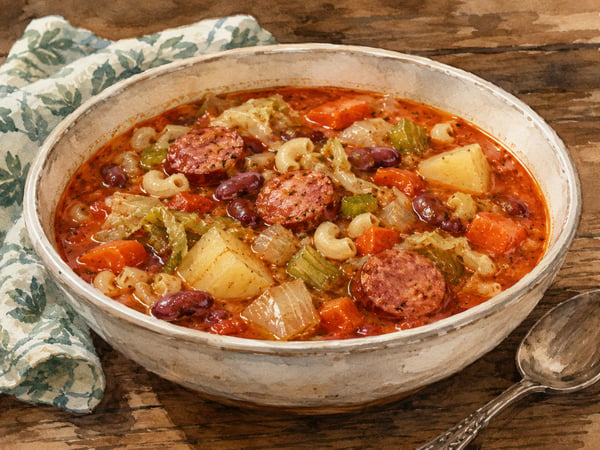
Portuguese bean soup is one of Hawaii's great cold-weather comforts, even in a place where "cold weather" tops out at 65°F. It is a thick, slow-simmered stew of red kidney beans, smoky ham hock, Portuguese sausage, potatoes, cabbage, and carrots, all bound together by a tomato-rich broth that turns brick-red after a long simmer. Plenty of saimin shops and old-school local cafes keep it on the regular menu, usually paired with rice on the side or a slice of Hawaiian sweet bread for sopping.
It arrived in the islands with the Portuguese laborers from Madeira and the Azores who were recruited to the sugar plantations starting in 1878. Sopa de feijão is a staple of Azorean and Madeiran home cooking, and the immigrants kept making it in plantation camp kitchens with whatever protein and vegetables they could grow or trade for. The Hawaiian version grew its own personality over time. More tomato than the European original. Hawaii-made Portuguese sausage (not chouriço) instead of linguiça. A cooked-down cabbage texture that the original Azorean cooks would probably side-eye. Done right, it tastes like a plantation Sunday, a pot left simmering all afternoon while the family was at church.
At a glance
8 to 10 (it scales, so make a big pot)
20 minutes
2.5 to 3 hours
Easy
Ingredients
For the broth
- 1 smoked ham hock (1.5 to 2 lb)
- 10 cups water
- 1 medium yellow onion, diced
- 4 cloves garlic, smashed
- 2 bay leaves
For the soup
- 1 lb Portuguese sausage (Redondo's preferred), sliced into 1/4-inch coins — or linguiça or mild chorizo
- 2 cans (15 oz each) red kidney beans, drained and rinsed (or 1 lb dried, soaked overnight)
- 2 medium russet potatoes, peeled and cut into 3/4-inch dice
- 2 medium carrots, peeled and cut into 1/2-inch coins
- 1 can (15 oz) tomato sauce
- 1 can (6 oz) tomato paste
- 1/2 small head green cabbage, cored and chopped into rough 1-inch pieces (about 4 cups)
- 1 tsp dried oregano
- 1 tsp smoked paprika (optional but recommended)
- Salt and freshly ground black pepper to taste
Equipment
- Large stockpot or Dutch oven (8-quart or bigger)
- Tongs and a slotted spoon
- Cutting board and a chef's knife
To serve
- Steamed white rice on the side (the local way)
- Thick slices of Hawaiian sweet bread for sopping
- A few drops of red pepper water or your favorite hot sauce
Method
- Start the stock. Put the ham hock, water, diced onion, smashed garlic, and bay leaves in your stockpot. Bring to a boil, then drop to a steady simmer with the lid slightly cracked. Cook 90 minutes. You want the meat falling off the hock and the broth lightly smoky and gelatinous.
- Pull the hock. Lift the ham hock out with tongs and set it on a cutting board to cool. Skim any heavy foam off the surface of the broth. Once the hock is cool enough to handle, pull the meat off the bones in strips, discard the bone, skin, and any pure fat, and chop the meat into bite-size pieces. Reserve.
- Build the soup. Add the Portuguese sausage coins, kidney beans, potatoes, carrots, tomato sauce, tomato paste, oregano, and smoked paprika to the broth. Stir well. The tomato paste will want to clump until it dissolves. Simmer 25 minutes uncovered.
- Add the cabbage and the ham. Stir in the chopped cabbage and the reserved ham hock meat. Simmer another 20 to 30 minutes until the cabbage is fully tender and the broth has thickened into something between a soup and a stew.
- Taste and adjust. Fish out the bay leaves. Taste for salt. The ham hock and sausage are both salty, so you may need very little or none at all. Crack in plenty of black pepper.
- Serve. Ladle into bowls. Add a scoop of rice on top (or serve rice on the side), tear off a piece of sweet bread, and eat with a spoon you can stand up in the pot. A few drops of hot sauce or red pepper water is the traditional finish.
Notes from a local cook
Make it a day ahead. Like every long-simmered stew, Portuguese bean soup is better on day two. The beans keep absorbing the broth, the flavors marry, and the fat solidifies on top overnight. You can lift it off cleanly before reheating instead of trying to skim it hot. Refrigerated, the soup keeps four to five days. Frozen, it holds for two months.
Portuguese sausage is the load-bearing flavor. Hawaii's Portuguese sausage is a sweeter, milder, paprika-forward sausage made by Redondo's or Purity, and it tastes meaningfully different from mainland linguiça or Spanish chorizo. If you live somewhere a Hawaii-style Portuguese sausage is hard to source, mild linguiça is the closest substitute. Spanish chorizo will work in a pinch (it leans smokier and oilier). Avoid Mexican chorizo: too much chili and too crumbly.
Dried beans vs. canned. Canned kidney beans are what every home cook I know actually uses, and they make a perfectly good pot. But dried beans simmered from scratch (soak overnight, then add to the broth with the ham hock at step 1 and let them cook the full 90 minutes) give a noticeably better texture and a thicker broth. If you have the time, do it.
The macaroni variation. Some Hilo families add a handful of elbow macaroni in the last 10 minutes of cooking, turning the soup into something closer to minestrone. It is not traditional in the Azorean sense, but it is a real Hawaii variation, and it makes the dish stretch further. If you go this route, hold back about 1 cup of broth in case the noodles drink it all.
While You're on the Islands
Eat it made by someone else. My favorite place to chase a bowl on the Big Island is Hawaiian Style Cafe in Hilo, a longtime local breakfast-and-lunch spot. Portuguese bean soup is not a fixed menu item I can guarantee on any given day, so call ahead if you're making a special trip. On Oahu, Highway Inn in Kakaako and Waipahu is the obvious place to look. Many local diners and saimin shops list it as a "soup of the day," especially in the cooler winter months. See our Oahu dining and Big Island dining guides for more local-comfort-food spots.
Buy the ingredients fresh. Portuguese sausage (linguiça) and ham hocks are stocked at any island grocery store — no special sourcing trip needed if you want to make this in a vacation rental.
Bring It Home
What to stock up on before you fly home: a few links of Portuguese sausage (linguiça) freeze and travel well, and it's the one ingredient that makes this soup taste right — most mainland grocery stores don't carry the Hawaii-style version, which leans sweeter and milder than the Portuguese mainland import.
Where to try this in Hawaii