

Hawaiʻi runs on a set of unwritten rules, and most visitors were never handed the list. Some of them are actual laws with federal fines attached. Others are customs that locals read instantly — the difference between a guest who gets a genuine "aloha" at the counter and one who gets polite distance.
None of it is complicated. After 20+ years of traveling these islands, I can tell you Hawaii etiquette reduces to one idea: you are a guest in someone's home. This guide covers the situations where that actually plays out — inside houses, on beaches, around wildlife, at sacred sites, behind the wheel.
The short version: shoes off indoors, ten feet from turtles, stay out when a sign says kapu, accept the lei, wave instead of honking, and leave the lava rocks where they are. Everything below is the why and the detail.
Start With the Aloha Spirit
Aloha is not a marketing slogan. Hawaiʻi codified it into law in 1986 — HRS §5-7.5, the "Aloha Spirit" statute — which defines it through five values: akahai (kindness), lōkahi (unity), ʻoluʻolu (agreeableness), haʻahaʻa (humility), and ahonui (patience). The statute directs state officials to give consideration to these values in their work. It is a guiding principle rather than an enforceable rule, but the fact that it exists at all tells you something about how seriously the islands take it.
For a visitor, the practical translation: slow down, be patient in lines and in traffic, greet people before asking them for things, and accept that things move at a different pace here. Locals call it island time. Fighting it marks you as a tourist faster than any outfit could.
Inside Homes & Vacation Rentals
Remove your shoes before entering a home. This is the single most universal custom in Hawaiʻi, rooted in the Japanese, Okinawan, and broader Asian traditions that shaped local culture through the plantation era, and now simply how everyone lives. It applies to private homes, most vacation rentals, and plenty of small businesses.
The cue is impossible to miss: a row of slippers (that's what flip-flops are called here) lined up by the front door. Add yours to the row. If you're renting a condo or house, keep the habit for your whole stay; your host will notice, and so will the neighbors.
Around Wildlife: Distances Are the Law
The animals you most want to photograph in Hawaiʻi are federally protected, and the viewing distances are not suggestions. NOAA's Hawaiʻi marine wildlife viewing guidelines spell them out:
Honu haul out on beaches to rest, and a basking turtle is not an invitation. Touching, chasing, or feeding one violates the Endangered Species Act. Hawaiian monk seals are critically endangered — if you see a roped-off section of sand, it is almost certainly protecting a resting seal. Stay behind the rope, and give mothers with pups far more room than the minimum.
The dolphin and whale distances are full federal regulations, not guidelines. Since 2021, NOAA prohibits swimming with or approaching Hawaiian spinner dolphins within 50 yards — they hunt all night and rest in shallow bays by day, and swimmers chasing them is the marine equivalent of barging into a bedroom. Humpbacks get 100 yards by federal law, whether you're on a boat, a kayak, a board, or flying a drone. We went deeper on all of this in our ethical wildlife encounters guide.

On the Beach & In the Ocean
Every beach in Hawaiʻi is public. The state constitution and HRS §115 guarantee shoreline access below the high-water mark, no matter what a resort's lounge-chair arrangement implies. That right cuts both ways: the beach in front of a luxury hotel is yours to enjoy, and the beach fronting a residential neighborhood is someone's front yard — pack out your trash and keep the volume reasonable.
The etiquette that matters most on the sand:
- Swim where there are lifeguards, and heed the flags. Hawaiʻi's surf is stronger and less forgiving than it looks. Never turn your back on the ocean.
- Wear reef-safe sunscreen. Hawaiʻi's Act 104 banned the sale of sunscreens with oxybenzone and octinoxate starting January 1, 2021. Buy mineral-based (zinc oxide or titanium dioxide) and the reef under your snorkel mask stays alive.
- Don't touch or stand on coral. It's a living animal, and a single fin-push can kill decades of growth.
- Give fishermen and local gatherings space. If a family has clearly set up for the day with pop-up tents and a grill, set up somewhere else. If someone is pole fishing, don't swim through their lines.
- In the surf lineup, wait your turn. If you're learning to surf, stick to beginner breaks and don't drop in on someone else's wave. Respect in the water is currency here.
We wrote a full 12-rule beach etiquette guide and a companion piece on beach access laws if you want the deeper cut.
At Sacred Sites & Heiau
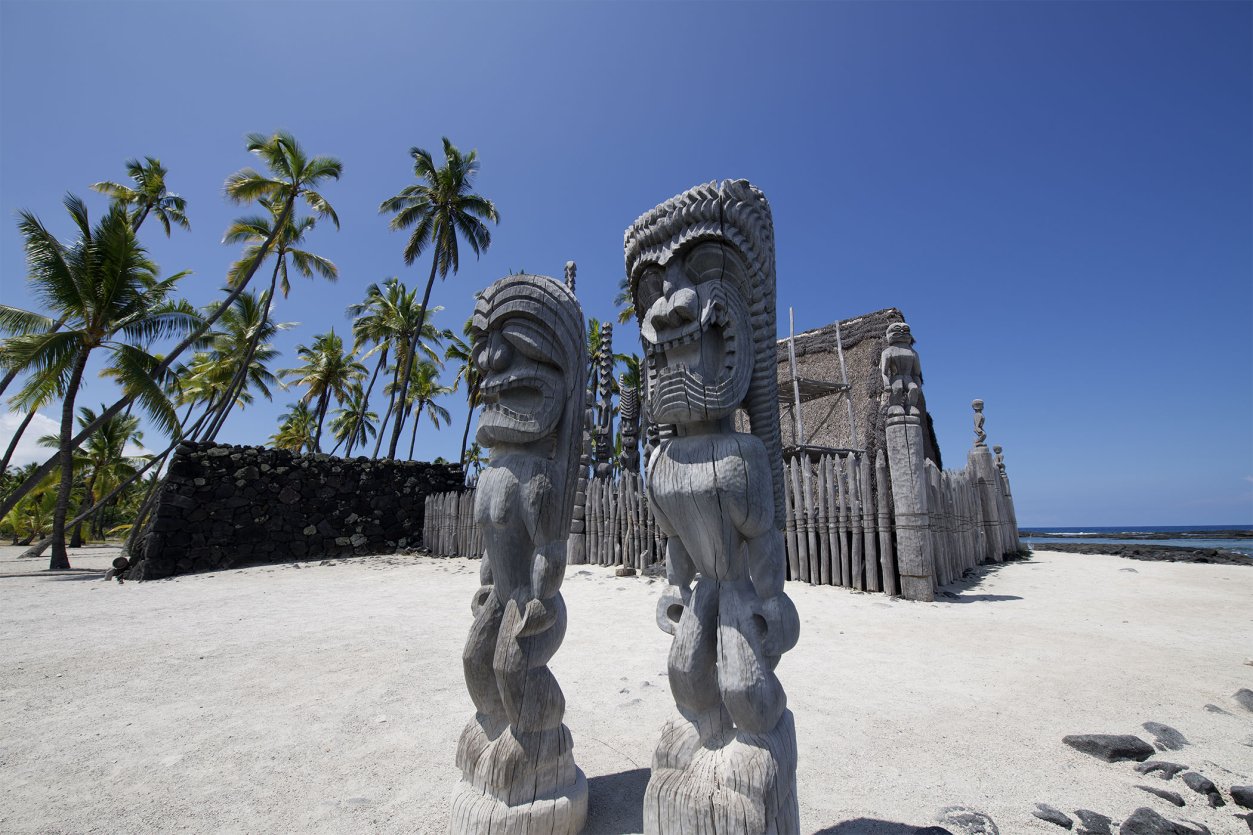
Heiau are ancient Hawaiian temples — stone platforms and walled enclosures found on every island. Many remain active places of practice for Native Hawaiians, not ruins. Treat them the way you'd treat a working church: quiet voice, no climbing, nothing moved, nothing taken. State law (HRS §711-1107) makes damaging or desecrating a registered historic site a criminal offense, and at national park sites like Puʻuhonua o Hōnaunau the rules are posted at the entrance.
Three specific behaviors to avoid:
- Don't climb on or move stones — at heiau, at petroglyph fields, anywhere a structure looks old.
- Don't leave your own "offerings." Rocks wrapped in ti leaves left by visitors have become a litter problem at sites across the islands. If you weren't taught the protocol, the respectful move is to leave nothing.
- Don't take lava rocks, sand, or coral home. Removing natural material from a national park violates federal regulations (36 CFR §2.1), and it's culturally frowned on everywhere else. Hawaiʻi Volcanoes National Park receives mailed-back rocks every week from visitors having second thoughts. Skip the cycle entirely.
The same goes for rock stacking. Those balanced cairns may look meditative on Instagram, but they topple, crush the creatures living underneath, and clutter places that are significant to someone else. Browse our guide to the heiau of Hawaiʻi to visit these sites the right way — or book a guided cultural tour led by someone who can share the history firsthand.
When a Sign Says Kapu, Stay Out
You will see the word kapu on signs across the islands — nailed to fence posts, painted on driftwood, posted at trailheads. In the Hawaiian language, kapu means forbidden, prohibited, sacred. In ancient Hawaiʻi it named the entire system of sacred law. On a modern sign, it works like "no trespassing" — but with the added weight that the land behind it may hold cultural or spiritual significance for the family that posted it.
This matters most with the famous-but-illegal spots: trails and swimming holes that circulate on social media even though they cross private land or closed public land. The pin on someone's map doesn't make access legal, and locals are tired of pulling injured hikers off closed trails. If a gate is locked, a sign is posted, or a trail appears on the current closure list, the answer is no — there's always a legal alternative nearby that's just as beautiful.
On the Road
Hawaiʻi drives differently, and the horn is the giveaway. Locals essentially never honk except in genuine emergencies. Leaning on your horn in traffic reads as open hostility. The flip side is the mahalo wave: when someone lets you merge, you raise a hand (or throw a small shaka) in thanks. It's expected, it costs nothing, and it's the fastest way to drive like you belong.
- Let faster traffic pass. On two-lane roads like the Hāna Highway, use the pull-outs. A line of cars behind you is your cue.
- Don't stop in the road for photos. Find a designated pull-off. The rainbow will still be there.
- Drive slowly through residential areas. Many island neighborhoods have no sidewalks, so people — and their dogs, and their kids — walk in the road.
- Never block driveways or beach-access paths when you park, and don't park on grass or in front of gates marked kapu.
- Yield to pedestrians at crosswalks. Hawaiʻi traffic law requires it at marked and unmarked crossings, and it's enforced more strictly than most mainland visitors expect.
Language, Greetings & the Shaka
Hawaiian is one of the state's two official languages, and a serious revival is underway, with immersion schools raising a new generation of native speakers. You don't need to be fluent. You need about five words, used sincerely:
- Aloha — hello, goodbye, and love. Say it like you mean it.
- Mahalo — thank you. Use it instead of "thanks" at every counter and you'll feel the difference.
- Keiki — children. You'll see it on menus and signs everywhere.
- Mauka / makai — toward the mountain / toward the sea. How locals give directions.
- Pau — finished, done. "All pau" means you're done with your plate.
Make an honest attempt at place names, ʻokina and all. The ʻokina (ʻ) is a glottal stop — the catch in "uh-oh" — and it changes meaning, so Hawaiʻi is ha-WAI-ʻi, three syllables. Our Hawaiian words guide and Hawaiian alphabet page have audio pronunciations for the words you'll actually use.
Then there's the shaka — thumb and pinky out, middle fingers curled. It means hello, thanks, all good. Throw one to the driver who let you merge or the kid at the shave ice window. Use it genuinely, not ironically; it's a real piece of daily communication, not a photo prop.

Receiving a Lei
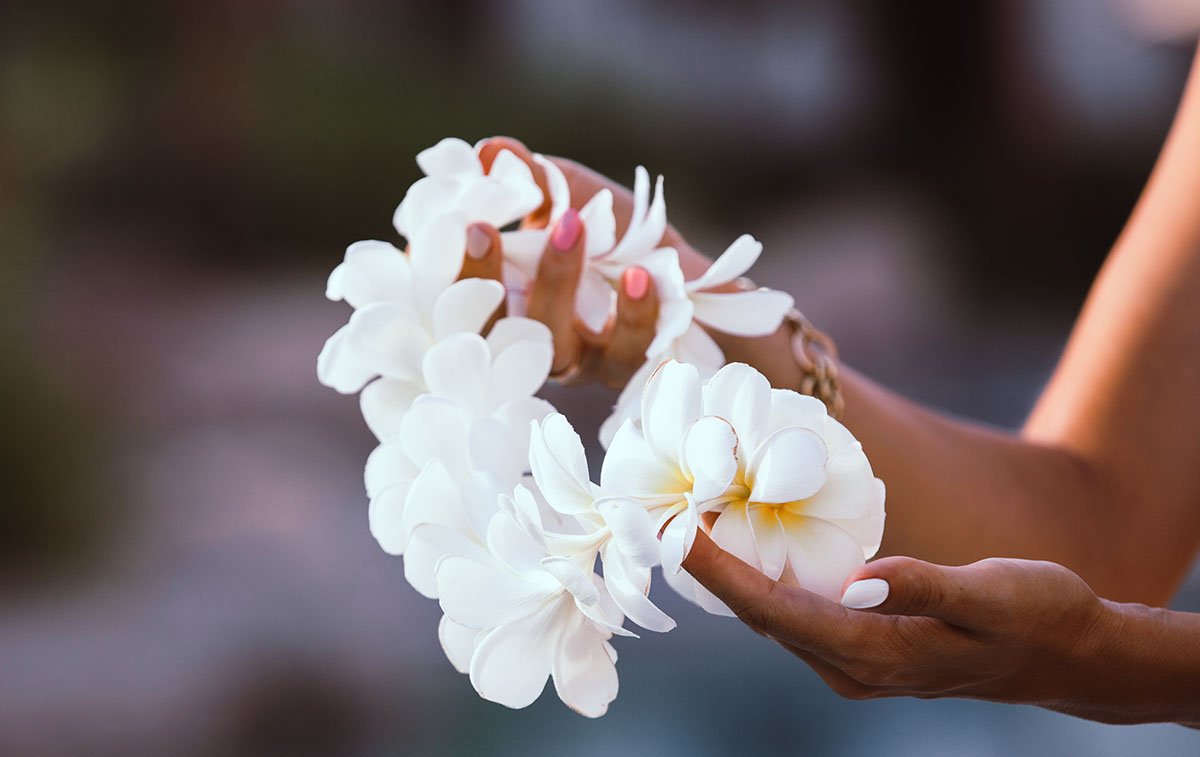
If someone places a lei around your neck at a luau, a wedding, or a hotel arrival, accept it. Declining a lei is a genuine slight, like refusing an offered handshake. Wear it draped over your shoulders so it hangs evenly front and back, and don't remove it in front of the person who gave it to you.
When the flowers fade, return the lei to nature: hang it on a tree, scatter the petals, or set it in the ocean. The trash can is the one wrong answer. Tradition also holds that a visibly pregnant person should receive an open (untied) lei rather than a closed circle. The full protocol — including what to do with a lei when you fly home — is in our lei etiquette guide.
At Restaurants, Shops & In Town
Tip well. Hawaiʻi has one of the highest costs of living in the country, and the people serving your mai tai mostly can't afford to live near where they pour it. 18-20% at restaurants, a few dollars per bag for bellhops, a few dollars a day for housekeeping (left with a note so it's clearly intentional), 15-20% for tour guides and boat crews.
Embrace island time. Service moves at a relaxed pace, and treating that as a defect rather than a feature is the classic visitor mistake. Build slack into your dinner plans and nobody — including you — has a bad night.
Spend local when you can. The family plate-lunch counter, the farmers market stall, the shop that isn't a chain — that's where your vacation dollars actually stay on the island. Dress code is genuinely casual nearly everywhere: a clean aloha shirt counts as dressed up. Our guide on how to not look like a tourist covers the wardrobe side.
On the Trail
Hiking etiquette in Hawaiʻi is mostly leave-no-trace plus one island-specific layer: access. Stick to legal, open trails — the state's Nā Ala Hele trail system lists official routes, and our trail status page tracks current closures. Stay on the marked path; shortcutting switchbacks causes erosion that takes decades to heal in island ecosystems, and off-trail wandering is how visitors end up in rescue helicopters.
- Pack out everything you pack in, including fruit peels.
- Brush the mud off your boots between hikes; it's how invasive species and plant diseases move between valleys and islands.
- Yield to uphill hikers, and greet people you pass. Trail aloha is real.
- Don't go around locked gates or "trail closed" signs, even if the path beyond looks well-worn. See the kapu section above; it applies double on trails.
Photos & Social Media
Ask before photographing people, especially anyone engaged in cultural practice, from hula dancers at a hālau rehearsal to a family at a beach ceremony. A luau performer on stage expects cameras; a practitioner at a heiau does not. When in doubt, the question costs you ten seconds and earns you genuine goodwill.
And think before you geotag. More than one fragile spot has been overrun after going viral, and some of the most-tagged "secret" locations are the illegal-access ones from the kapu section. Share the photo; consider keeping the pin general. The islands will thank you in their own way.
The One-Sentence Version
Every rule on this page is the same rule wearing different clothes: you are a guest in a place people love fiercely, so act like the kind of guest who gets invited back. For the deeper background on the culture itself, start with our Hawaiian culture & heritage guide, the full culture do's and don'ts briefing, and our pre-arrival tips.
Related Reading
- Hawaiian Culture Do's and Don'ts — the companion briefing with fines and laws spelled out
- Hawaii Beach Etiquette: 12 Rules That Earn You Local Respect
- Hawaiian Lei Etiquette: How to Receive and Wear One
- Ethical Wildlife Encounters in Hawaii
- The Hawaii Shaka — How and When to Use It
- Hawaiian Words to Know for Your Vacation
- How to Not Look Like a Tourist in Hawaii
- Hawaiian Luaus: What to Expect