


Heads up: this article includes affiliate links. We earn a small commission if you book through them, at no extra cost to you. We only link to operators we’d send a friend to. Hawaii self-guided driving tour apps have rewritten the math on a narrated road trip. Ten years ago, the only way to get a guided story on the Road to Hana, the Hilo-to-Volcanoes loop, or the road up to Hāʻena was to sit in a tour van with eleven strangers, fight for a window seat, and stop where the schedule said you stopped. Now I rent a car, pull up an app on my phone, and the narrator picks up the second I hit each GPS trigger. Same stories. My pace. My music in between. My stops when the kids need a bathroom. The trade is real. A live guide reads the group, points out a humpback breaching out the left side, lets the van linger at ʻOheʻo when the sun comes through. An app can’t do any of that. What an app can do is cost a fraction of a van seat, run on your schedule, and keep playing if you stop for a forty-minute coffee detour. For most travelers, on most Hawaii drives, that’s the better trade. This guide covers the three apps with real Hawaii route libraries for summer 2026, the drives each one does best, and the pre-flight checklist that keeps the experience from turning into a phone-battery panic at mile twenty.
The three apps worth knowing
Three apps have meaningful Hawaii coverage. Each one is pitched at a different kind of traveler.
Shaka Guide — the Hawaii-native one
Shaka Guide has the deepest Hawaii catalog of the three. The library spans all four major islands and includes the headline drives plus a long bench of secondary loops: the Kohala Coast backcountry on the Big Island, the East Oahu shoreline, Wailua Valley and the waterfalls on Kauai, the West Maui coastline. The narration is GPS-triggered, plays automatically as you reach each point, and works offline once the route is downloaded (see how it works). Individual driving tours currently run roughly $20 to $25 depending on the route, with shorter walking tours priced lower. The long-form coverage of the app, including what’s on each island, the offline download flow, and the family pass, lives at the dedicated Shaka Guide page.
Action Tour Guide — the multi-destination one
Action Tour Guide covers national parks and scenic drives across the US, and Hawaii sits inside that bigger catalog. The Road to Hana and Big Island volcanoes routes are the ones travelers ask about most. Pricing is per route and the offline behavior is similar to Shaka Guide. If you’ve already used Action Tour Guide on a Yosemite or Glacier trip, the interface will feel identical.
GuideAlong (formerly GyPSy Guide) — the national-park one
GuideAlong rebranded from GyPSy Guide a few years ago, so both names still float around. The strength here is national-park-style routes, and the Hawaii lineup covers all four major islands. If your trip is anchored to a Big Island volcano day, GuideAlong’s narration is dense and detail-heavy in a way that fits the science-of-the-place vibe. Across all three apps, the pattern is the same: download once over wifi at the hotel, drive into a spotty-signal area, audio keeps playing. The narration is structured around drive direction, so on a loop you usually want the “classic” or “forward” version unless the marketing copy explicitly says reverse works.
The drives each app is built for
The best self-guided audio routes in Hawaii are the ones with enough mileage and enough density of named places to justify a narrator. Short, simple drives don’t need an app. All-day scenic loops do.
Kualoa and the windward coast are the visual payoff of an Oahu Circle Island self-guided tour.
Oahu — the Circle Island day
Oahu is the island where self-guided shines. The Circle Island route packs a huge density of stops into a single-day loop, and the navigation gets non-obvious in a few spots. A typical loop runs Waikīkī, Hanauma Bay lookout, Makapuʻu, Kailua, Kualoa, Polynesian Cultural Center, Sunset Beach, Haleʻiwa, then back via the H-2. Google Maps clocks the driving at around four hours; add real stops and you’re at eight. Narration between waypoints is the difference between “we drove around the island” and “we understood what we were looking at.” Shaka Guide’s Oahu Grand Circle Island and Legendary North Shore Loop are the two to look at first. For a half-day, the East Shoreline Drive covers Lānaʻi Lookout, Hanauma overlook, and Makapuʻu without committing you to the full circuit. For deeper context on what’s on the route, the North Shore Oahu region guide and the Kualoa Ranch page both pair well with whichever app you pick.
The Road to Hana: 620 curves, 59 bridges, dozens of named stops.
Maui — the Road to Hana, and then some
Maui is the app-tour homeland. The Road to Hana is the flagship self-guided drive in Hawaii, with 620 curves and 59 bridges, dozens of named stops, and so many tour vans on it that going self-guided is the only way to set your own pace. Shaka Guide runs three versions: Classic (one way to Hāna), Loop (back via the unpaved south route, weather depending), and Reverse (start from Hāna and drive west, which is the trick for beating the morning bus convoy). Action Tour Guide also has a strong Road to Hana route if you’ve used their app before. Beyond Hana, the Haleakalā sunrise and sunset routes are app-friendly because the timing logic gets complicated and a narrator handles it well. The West Maui Coastline is the sleeper pick: gorgeous, much less driven than Hana, and well narrated by Shaka Guide. Pair the app with the Road to Hana stops list so you can decide ahead of time which waterfalls and beaches you want to actually leave the car for, plus the Road to Hana overview for the bigger picture.
Big Island — the long-mileage island
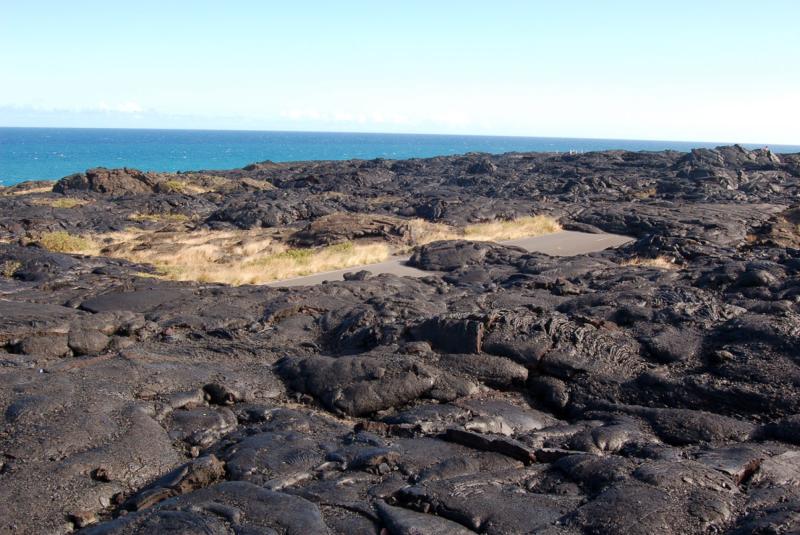
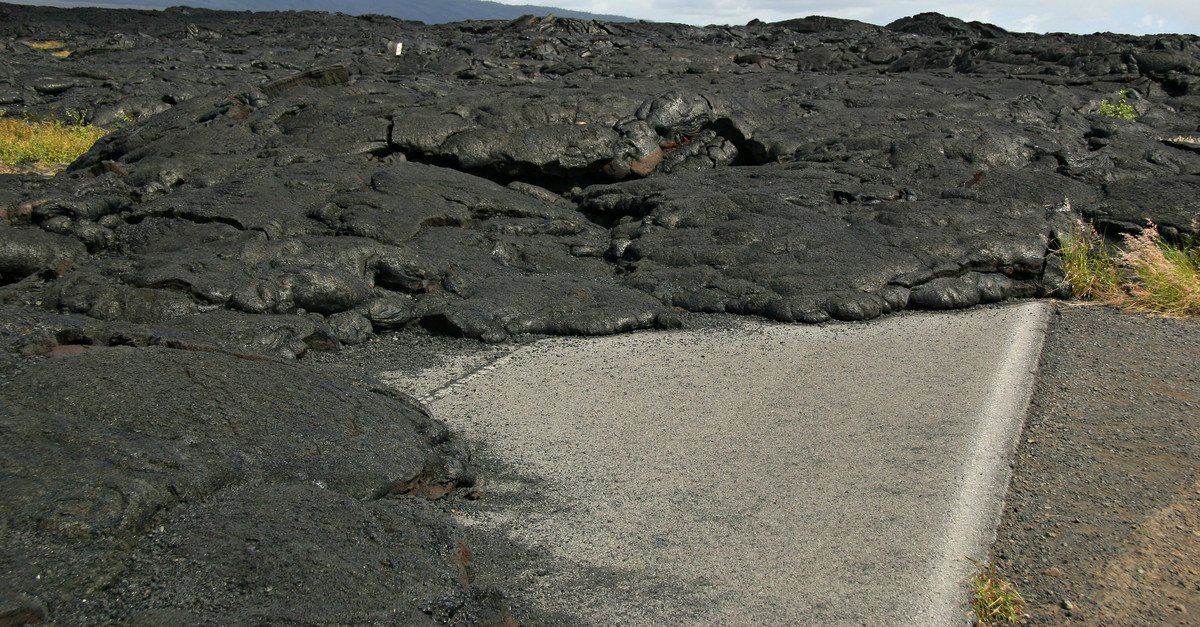
The Big Island is larger than all the other Hawaiian islands combined, which means every meaningful drive is a big drive. That’s exactly where audio narration earns its keep. Two routes to consider first. Hawaiʻi Volcanoes National Park, where both Shaka Guide and GuideAlong have strong tours (GuideAlong’s is the more detail-heavy national-park style). And the South Island Epic Coastal Journey, which runs Kona down past Punaluʻu and through to the eastern flank. Add the Kona Big Kahuna tour if you’re based in Kona and want a half-day intro to the region. The Chain of Craters Road sits inside the Volcanoes NP tour but is worth knowing about separately: a roughly 19-mile dead-end drive ending at sea cliffs, with some of the better narration writing in any of these libraries. For the long Saddle Road crossing between Kona and Hilo, an app helps but isn’t required. The Saddle Road region overview covers what you’d want to know in a few minutes of reading.
Hanalei Bay: the end-of-the-road moment on Kauai's narrated north shore drive.
Kauai — the short island with the great drives
Kauai is the smallest of the four islands you’d self-guide, and the drives are correspondingly shorter. They’re also among the prettiest in Hawaii, and the stories along them run deep. Two routes to lock in. The North Shore drive from Līhuʻe up Kūhiō Highway to Hāʻena and Kēʻē Beach, where Shaka Guide’s North Shore Kauai tour is the standard. And the Waimea Canyon and Nā Pali drive up the west side, narrated by Shaka Guide’s Waimea and Nā Pali tour and paired with the Waimea Canyon page. Both are roughly half-day drives that turn into full-day drives once you actually stop at the places the narrator tells you about. The Wailua Valley and Waterfalls tour is the calm third pick if you’re staying on the east side and want a gentler narrated morning.
Before you tap play — the practical checklist
A self-guided tour is only as good as the kit you’ve got with you. Five things to sort out before you leave the hotel:
- Rent the car first. None of this works without your own vehicle. The aggregator I use is Discount Hawaii Car Rental, which pools the major brands' Hawaii inventory and lets you compare in one place. To sanity-check the total against a worked example first, the rental car cost calculator breaks it down by island and class.
- Download the route over wifi at the hotel. All three apps work offline once a route is downloaded, but the download itself is a few hundred megabytes and you don't want to start it on cellular at the trailhead. Plug in, download, then drive.
- Buy a phone mount and a car USB charger. The narration runs on your phone, the navigation runs on your phone, and you're going to drive six to eight hours. A vent or dashboard mount with a reliable USB-C charger is the difference between "great day" and "dead phone at Hāna." Both are readily available on Amazon for under thirty dollars combined and pack flat.
- Set the route direction before you start. Most of these tours have a "classic" and a "reverse" or "loop" version. Picking the wrong direction means the narration is out of sync the whole drive. The app will usually flag the intended direction on the route page.
- Plan one real stop per hour. The narration is connective tissue, not the destination. Pick three to five spots per drive where you'll actually get out, walk around, and let the day breathe. The point of the app is to make the in-between drives interesting, not to keep you in the car for eight hours straight.
When a self-guided app isn't the right call
A live guide still wins in a few specific cases, and it’s worth saying so. A first Road to Hana with anxious drivers, especially when the rental contract limits where you can drive. A guided Hāna tour solves that, and the guided Road to Hana tours page has the operator comparison. Same logic for Mauna Kea summit: rental contracts ( most major brands explicitly prohibit driving to the summit) and altitude make the guided version meaningfully safer. A multi-stop day with elderly family members who don’t want to navigate or troubleshoot mid-drive. A group of friends who’d rather drink coffee and chat than listen to a narrator. Any tour where the value is meeting someone who lives there. That’s a live-guide thing, full stop. For everything else (couples, families with teens, solo travelers, repeat visitors who already know the broad strokes and want depth), a phone in a dashboard mount with one of these three apps loaded is the version of the Hawaii driving day most people are going to enjoy more.
Final planning notes
- Don't stack two big drives on the same day. Hana is one day. Volcanoes is one day. Waimea Canyon and the north shore is one day. The narration gets exhausting if you double up, and you stop hearing it.
- The family pass on Shaka Guide is the move for groups. Per their FAQ, one purchase works across as many devices as you log in with the same account. The per-person math gets silly fast otherwise.
- Check the operator's most-recent reviews before you buy. Audio gets re-recorded and routes get updated. The reviews from the last three months are a better signal than the cumulative average, especially for less-trafficked routes.
- Keep the Hawaii tours hub open in another tab. If a route turns out not to be for you, the guided version of the same drive is usually one click away. On a few of these (Road to Hana, Pearl Harbor, Hawaiʻi Volcanoes), there are good arguments for the guided version even when the app version is excellent.
The Hawaii you’ll remember is the one where somebody (a person, a narrator, or a phone) told you what you were actually looking at. The drive does most of the work on its own. A good audio tour just makes sure you don’t miss the point.