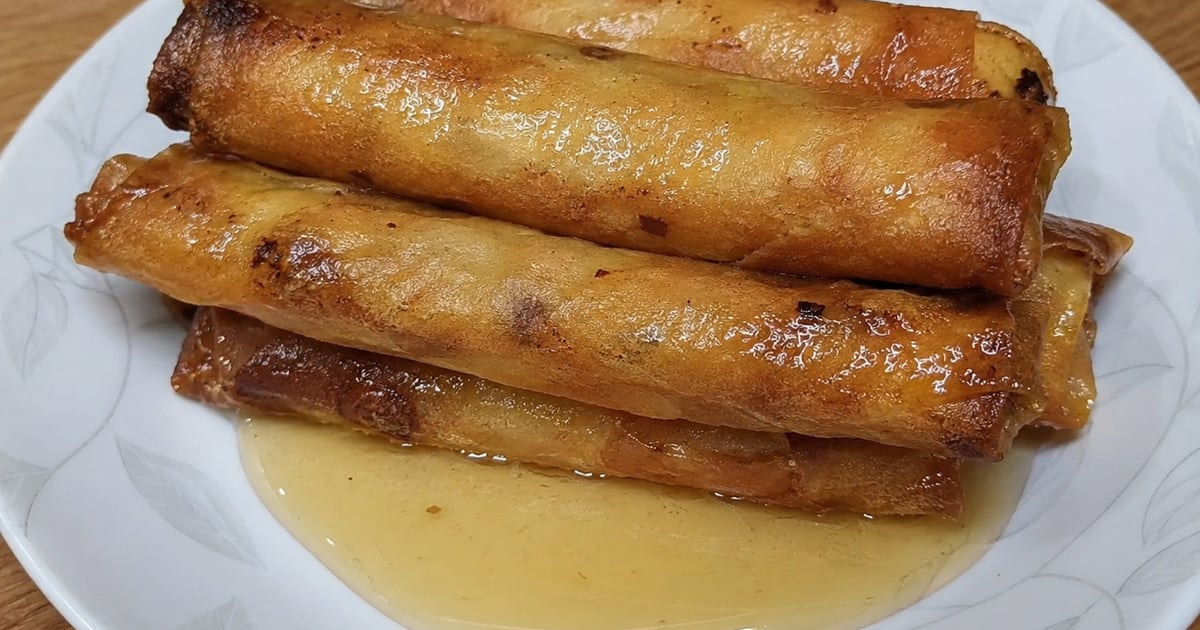

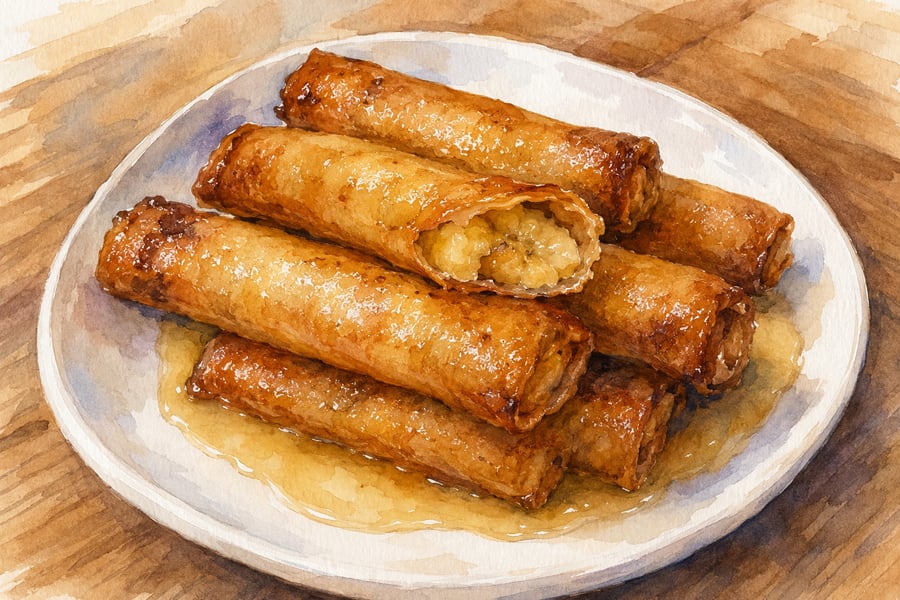
Turon is a sweet lumpia — ripe saba banana wrapped in a thin spring-roll wrapper, rolled in brown sugar, and deep-fried until the sugar caramelizes against the pan and the wrapper turns the color of a paper bag. It is what kids in Filipino-Hawaiian households eat on the walk home from school. It is what comes out of the kitchen on Sunday after the rice is cooked and there are too many bananas on the counter.
Filipino sugar-plantation laborers brought turon to Hawaii in the early 1900s, along with pancit, adobo, and lumpia. The classic version uses saba — a starchy cooking banana that holds its shape when heated and turns custardy inside the wrapper. Many Hawaii households add a sliver of fresh or canned jackfruit (langka) inside the roll, which gives turon its distinct floral perfume. The trick is the brown sugar coating, which the wrapper picks up, takes into the oil, and turns into a glassy caramelized shell.
At a glance
10 to 12 turon
20 minutes
15 minutes frying
Easy
Ingredients
For the filling
- 5 ripe saba bananas (the small, plump Filipino cooking bananas), peeled and halved lengthwise — you need 10 long pieces
- ½ cup jackfruit (langka), drained from a can and cut into thin strips, OR ½ cup ripe mango cut into matchsticks (optional but worth it)
For wrapping and frying
- 10 to 12 spring roll wrappers (also labeled "lumpia wrappers" — the thin, dry sheets, not the thicker fresh ones)
- ¾ cup light brown sugar, packed
- 1 small bowl of water for sealing the wrappers
- 4 cups neutral oil (vegetable or canola) for deep-frying
For serving (optional)
- Vanilla ice cream or coconut ice cream
- Halo halo
- A drizzle of sweetened condensed milk
Equipment
- Heavy-bottomed pot or wok for deep frying
- Slotted spoon or wire spider
- Wire cooling rack set over a sheet pan (paper towels will stick to the caramelized sugar; the rack is critical)
- Frying thermometer (or a wooden chopstick — if bubbles form steadily around it, the oil is ready)
Substitutions if no saba
- Plantains: choose ones with mostly yellow skin and brown speckles; very firm green plantains will be starchy and bland
- Regular Cavendish (supermarket) bananas: use them slightly underripe so they hold their shape in the fryer — they will be sweeter and softer than saba
Method
- Slice the bananas. Peel each saba banana and slice in half lengthwise so you have flat, long halves. If the bananas are very long, you can also halve them crosswise. The pieces should fit on a wrapper with about an inch of margin on each side.
- Roll in brown sugar. Place the brown sugar in a shallow dish. Roll each banana piece in the sugar to coat thoroughly on all sides. The sugar is what caramelizes against the wrapper in the fryer and gives turon its glassy crust.
- Wrap. Lay a spring roll wrapper on a clean surface with one corner pointing toward you. Place a sugared banana piece across the bottom third of the wrapper. Add a few strips of jackfruit alongside if using. Fold the bottom corner up over the filling. Fold the left and right corners in over the filling like an envelope. Roll up snugly toward the top corner. Wet the top corner with a fingertip dipped in water and press to seal. Place seam-side down on a plate. Repeat with the rest. Sprinkle any leftover brown sugar over the rolled turon.
- Heat the oil. Pour the oil into your pot to a depth of about 2 inches. Heat to 350°F over medium-high heat. Test with a wooden chopstick — if steady bubbles form around it within a second or two, the oil is ready.
- Fry in batches. Carefully lower 2 or 3 turon into the oil seam-side down. Fry for 2 to 3 minutes per side, turning once with the slotted spoon, until the wrapper is deep golden brown and the sugar has caramelized into a glassy coating. Lift onto the wire cooling rack. Do not put them on paper towels or the caramelized sugar will weld them to the paper. Repeat with the rest.
- Serve hot. Turon is best within five minutes of leaving the fryer, when the wrapper is shatter-crisp and the banana inside is still molten. Eat as is, or top with a scoop of vanilla ice cream — the contrast of hot caramelized sugar and cold cream is the move.
Notes from a local cook
Use saba if you possibly can. Filipino markets and many Asian grocery stores in Hawaii carry saba bananas year round. They are short, plump, with thick yellow skin and a green-yellow tip when ripe. They cook into a custardy, almost sweet-potato-like flesh that regular Cavendish bananas cannot match. If your only option is Cavendish, use them when the peel is still half green — a fully ripe Cavendish will turn to mush in the fryer.
Oil temperature is the whole game. Too cool and the wrapper soaks up oil and gets greasy; too hot and the sugar burns before the banana warms through. Aim for 350°F and adjust the heat between batches to hold it steady. If the oil starts smoking, pull it off the heat for a minute.
Drain on a rack, never on paper. The brown sugar coating will fuse to a paper towel as it cools and you will lose half the caramelized crust trying to peel it off. A wire rack lets air circulate and keeps the bottom from getting soggy.
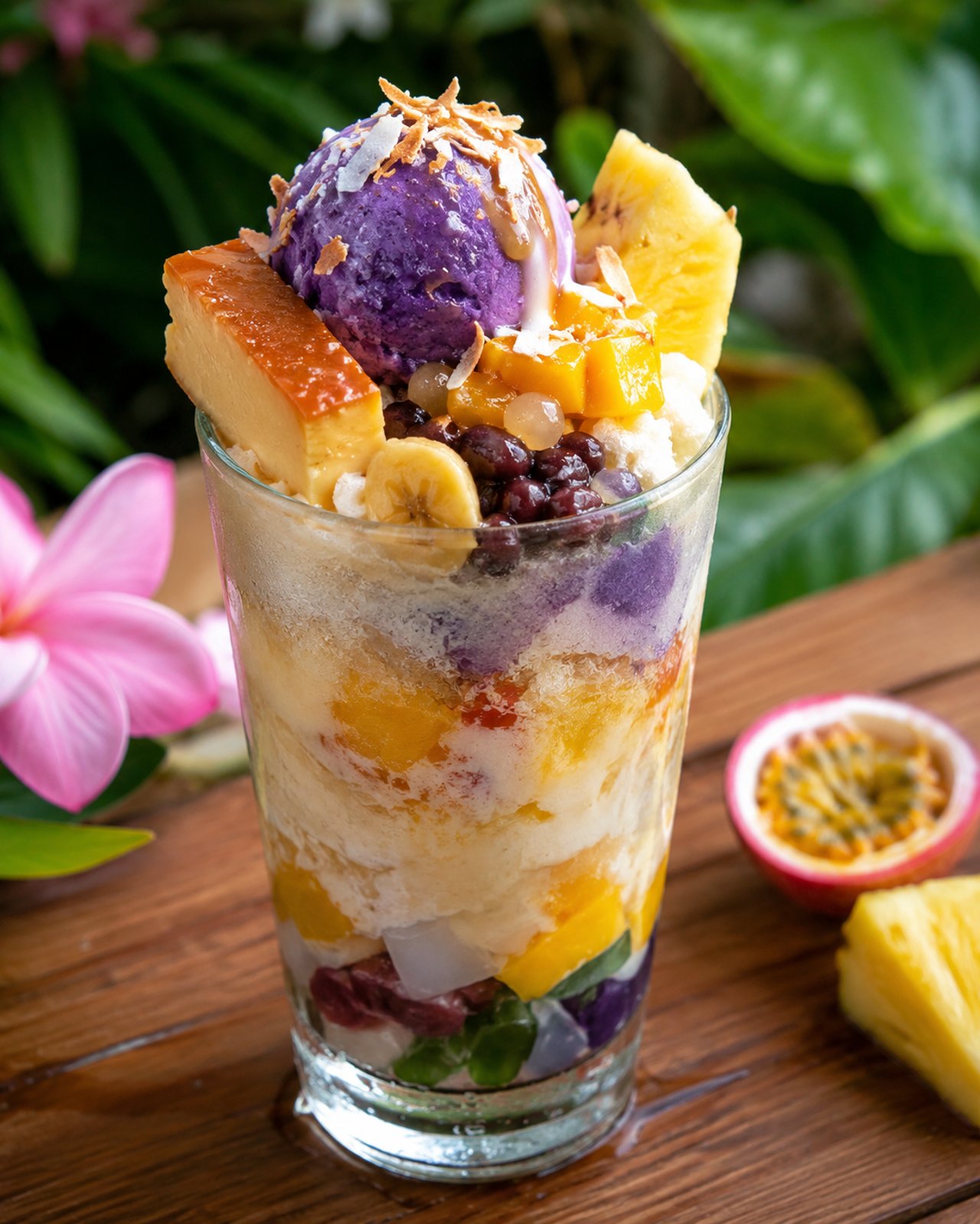
The halo halo move. Cut a finished turon into bite-sized pieces and use it as a topping on halo halo. The contrast of crispy caramelized sweetness against the shaved ice and ube ice cream is exactly the kind of thing Filipino-Hawaiian desserts do best.
While You're on the Islands
Eat it made by someone else. Filipino bakeries and lunch counters across Hawaii sell turon by the piece, usually wrapped in white deli paper and still hot. Elena's Restaurant in Waipahu (Oahu) has been a Filipino-Hawaiian institution since 1974 and turon is on the regular dessert menu. Most Goldilocks bakery locations across the state also carry it. For more Filipino-Hawaiian dishes, see our recipes for savory lumpia, chicken adobo, and pancit bihon.
Buy the ingredients fresh. Lumpia wrappers and ripe saba (plantains) or jackfruit are sold at Filipino markets statewide — ask at the register if you don't see them and they're usually just behind the counter near the turon warming case.
Bring It Home
What you can substitute, what you can't: lumpia wrappers and saba bananas are both sold at most mainland Filipino and Asian grocery stores. If you can't find saba, ripe regular bananas (slightly firmer than fully ripe) are the standard substitute — same caramelized result, just a slightly different flavor.
Filipino-Hawaiian food across the islands